What is the Log Weight Calculator?
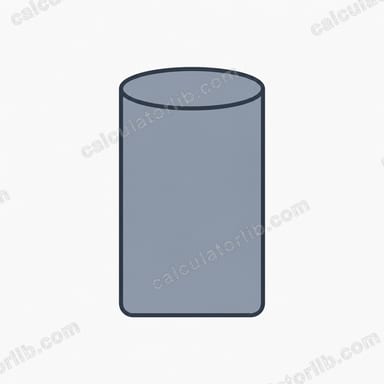
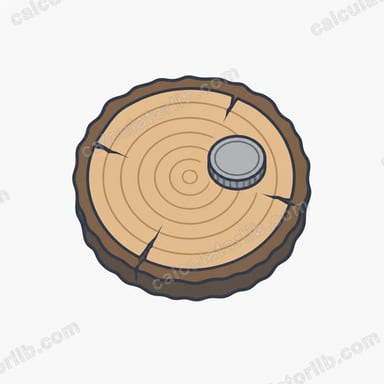
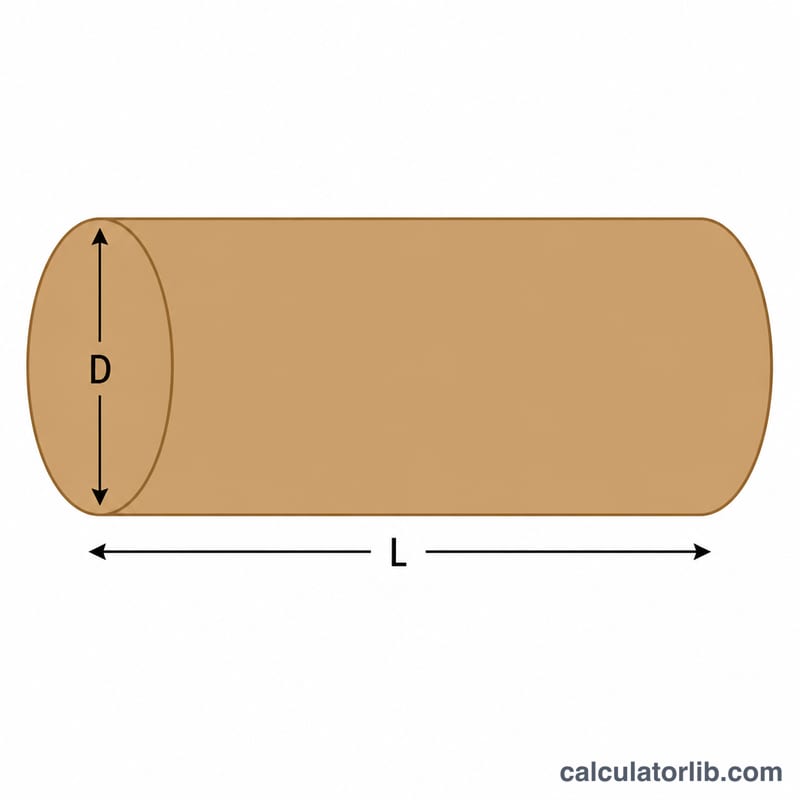
The Log Weight Calculator estimates how much a log or piece of round timber weighs based on its diameter, length and the density of the wood. By modelling the log as a cylinder, it computes the timber's volume and multiplies by the wood density to give a practical weight estimate — handy for transport planning, firewood sales, forestry work and DIY projects.
How to use it
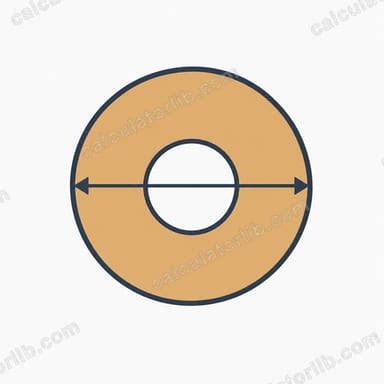
Enter the log's diameter in centimetres (measure across the middle), its length in metres, and the wood density in kilograms per cubic metre. Click calculate to see the estimated weight in kilograms along with the log's volume. Typical densities: pine ≈ 500, fir ≈ 450, oak ≈ 700, beech ≈ 720, and freshly cut "green" logs ≈ 900–1000 because of their moisture content.
The formula explained
A log is approximated as a cylinder. Its volume is \(V = \pi \times r^{2} \times L\), where \(r\) is the radius (half the diameter) and \(L\) is the length, both in metres. Weight is then \(W = V \times \rho\), where \(\rho\) is the density. The full formula is:
$$W = \pi \left(\frac{\text{Diameter (cm)}}{200}\right)^{2} \cdot \text{Length (m)} \cdot \text{Density (kg/m}^3\text{)}$$The calculator converts the diameter from centimetres to metres automatically.
Board feet estimate the lumber you can saw from the log, not its weight. Doyle: (D − 4)² × L ÷ 16. International ¼-inch: 0.905 × (0.22D² − 0.71D) per 4-ft section, with ½ inch of taper per section. D is the small-end diameter inside bark in inches, L the length in feet.
Worked example
For a log 30 cm in diameter, 3 m long, with oak density 700 kg/m³: the radius is 0.15 m, so volume:
$$V = \pi \times 0.15^{2} \times 3 = 0.2121 \text{ m}^3$$Weight:
$$W = 0.2121 \times 700 \approx 148.4 \text{ kg}$$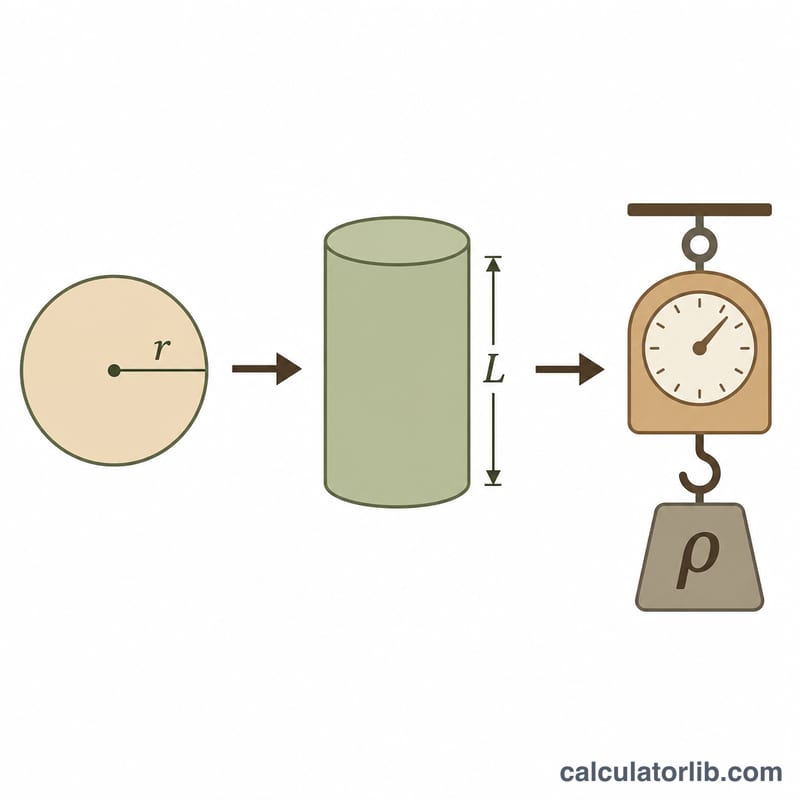
Wood Density Reference Table by Species
Log weight is driven almost entirely by density, so picking the right value for the density field matters far more than measuring the diameter to the last millimetre. Two densities are useful: air-dry (seasoned) density, measured at roughly 12% moisture content, and green density, the weight of freshly felled wood still full of sap. A freshly cut log can weigh 1.5 to 2 times its seasoned weight, and softwood sapwood is often the wettest part of the stem.
| Species | Air-dry density, ~12% MC (kg/m³) | Typical green density (kg/m³) |
|---|---|---|
| Western red cedar | 350–390 | 400–500 |
| Eastern white pine | 350–400 | 550–650 |
| Silver fir | 400–450 | 700–800 |
| Poplar / aspen | 400–470 | 650–800 |
| Spruce (Norway / white) | 400–470 | 700–800 |
| Hemlock | 450–500 | 750–850 |
| Scots pine (redwood) | 500–550 | 700–850 |
| Douglas fir | 500–540 | 600–700 |
| Elm | 550–620 | 800–900 |
| Larch (European / western) | 550–600 | 750–850 |
| Cherry | 550–600 | 750–850 |
| Walnut | 600–660 | 800–900 |
| Teak | 630–680 | 800–950 |
| Birch | 620–680 | 850–950 |
| Ash | 650–720 | 750–900 |
| Maple (hard / sugar) | 690–750 | 850–950 |
| Beech | 690–740 | 850–950 |
| Oak (white / English / red) | 700–770 | 950–1050 |
| Eucalyptus (grandis to globulus) | 650–900 | 900–1100 |
| Ipe (lapacho) | 1000–1100 | 1100–1200 |
How to read these numbers. Every figure is a range, not a constant. Density varies with growth rate, site, the proportion of heartwood to sapwood, and where in the stem the sample comes from; individual logs routinely fall 10–15% outside a species' published average. Names are also loose — "pine", "cedar", "fir" and "eucalyptus" each cover dozens of species with very different densities, so identify the species if you can.
Wood that has been sitting on a landing for a few months sits somewhere between the two columns. For a log felled in winter and stacked until summer, a value midway between the green and air-dry figures is usually closer than either extreme.
Sources. Values are consistent with the ranges published in the Wood Handbook: Wood as an Engineering Material (USDA Forest Products Laboratory, United States) and The Wood Database, both of which give specific gravity and green/air-dry weights species by species. National and regional timber authorities publish their own tables — if you are working to a local grading or trade standard, use that standard's figures in preference to these.
Log Weight by Diameter and Length: Comparison Table
The table below runs the cylinder formula \( V = \pi (d/200)^2 \cdot L \) across the log sizes people most often handle by hand or with a small trailer. Weight is shown for a mid-range hardwood/softwood density of 600 kg/m³ (seasoned) and for wet, freshly felled wood at 950 kg/m³.
| Diameter (cm) | Length (m) | Volume (m³) | Weight at 600 kg/m³ (kg) | Weight at 950 kg/m³ (kg) |
|---|---|---|---|---|
| 20 | 1 | 0.031 | 18.8 | 29.8 |
| 20 | 2 | 0.063 | 37.7 | 59.7 |
| 20 | 3 | 0.094 | 56.5 | 89.5 |
| 30 | 1 | 0.071 | 42.4 | 67.2 |
| 30 | 2 | 0.141 | 84.8 | 134.3 |
| 30 | 3 | 0.212 | 127.2 | 201.5 |
| 40 | 1 | 0.126 | 75.4 | 119.4 |
| 40 | 2 | 0.251 | 150.8 | 238.8 |
| 40 | 3 | 0.377 | 226.2 | 358.1 |
| 50 | 1 | 0.196 | 117.8 | 186.5 |
| 50 | 2 | 0.393 | 235.6 | 373.1 |
| 50 | 3 | 0.589 | 353.4 | 559.6 |
| 60 | 1 | 0.283 | 169.6 | 268.6 |
| 60 | 2 | 0.565 | 339.3 | 537.2 |
| 60 | 3 | 0.848 | 508.9 | 805.8 |
What the numbers mean for lifting
Manual-handling guidance differs by country, but the common reference points are similar: the NIOSH lifting equation used in the United States is built on a 23 kg load constant, and ISO 11228-1 (used as the basis for much European guidance) uses a 25 kg reference mass for occasional two-handed lifting in ideal conditions. Logs are awkward, dirty and often lifted while bent over, so the practical one-person limit is well below those figures.
- Comfortable one-person lift (≲25 kg): only the 20 cm × 1 m log, and only when seasoned (18.8 kg). Green, the same log is close to 30 kg and already borderline.
- Two-person lift (≲50 kg): the 20 cm × 2 m and 30 cm × 1 m logs sit in this band dry. Green, the 20 cm × 2 m log at about 60 kg is a genuine two-person carry with a good grip at each end.
- Needs mechanical help (>80 kg): everything from 30 cm × 2 m upward. A green 40 cm × 2 m log at roughly 239 kg, or a green 50 cm × 3 m butt at about 560 kg, is tractor, loader, winch or timber-crane work — not a job for levers and willpower.
What the numbers mean for a trailer load
Small unbraked utility trailers commonly carry 350–750 kg of payload; braked car trailers typically run from about 1,000 kg upward. Exact limits, licence classes and the maximum permitted combination weight are set nationally, so treat these as illustrative only and read your own trailer plate.
- A 500 kg payload is filled by roughly three green 40 cm × 2 m logs (about 716 kg for three — so only two fit), or by about 13 seasoned 20 cm × 2 m logs (490 kg).
- One single green 60 cm × 3 m butt log weighs about 806 kg — more than most unbraked trailers are rated to carry, on its own.
- A cubic metre of stacked round firewood is not a cubic metre of wood: stacking voids mean a stacked cubic metre contains roughly 0.6–0.7 m³ of solid wood, so weigh by solid volume as the table does, then scale.
FAQ
Why does my result differ from the actual weight? Logs are not perfect cylinders — they taper, have bark and may be hollow — and moisture content varies a lot, so treat the figure as an estimate.
How do I find wood density? Use a species reference table; green (freshly felled) wood is much heavier than seasoned wood.
Can I use it for firewood? Yes — it's a good way to estimate the load weight for transport and pricing.