What This Calculator Does
The Maximum Lights per Circuit Calculator estimates how many light fixtures you can safely connect to a single electrical circuit. It multiplies the circuit voltage by the breaker amperage to get total capacity, applies the common 80% continuous-load derating rule, and divides by the wattage of each fixture. The result is rounded down to a whole number of fixtures.
Note: This tool reflects the widely used US/NEC-style 80% continuous-load guideline (common breaker sizes 15A, 20A, 30A and voltages 120V, 240V, 277V). Always confirm with your local electrical code and a licensed electrician — circuit design also depends on wire gauge, other connected devices, and inrush current.
How to Use It
Pick your circuit voltage (120 V is standard for US residential lighting), choose the breaker rating in amps, and enter the wattage of one fixture. Use the actual draw of the bulb or driver — for LED fixtures this is far lower than the equivalent incandescent rating, so you can run many more lights.
The Formula Explained
Capacity in watts = Volts × Amps. The 80% factor reserves headroom for continuous loads (lighting that runs more than 3 hours). Dividing usable watts by watts per fixture and flooring gives a safe whole-number count:
$$\text{Max Fixtures} = \left\lfloor \frac{\text{Voltage (V)} \times \text{Breaker (A)} \times 0.8}{\text{Watts per Fixture}} \right\rfloor$$
Worked Example
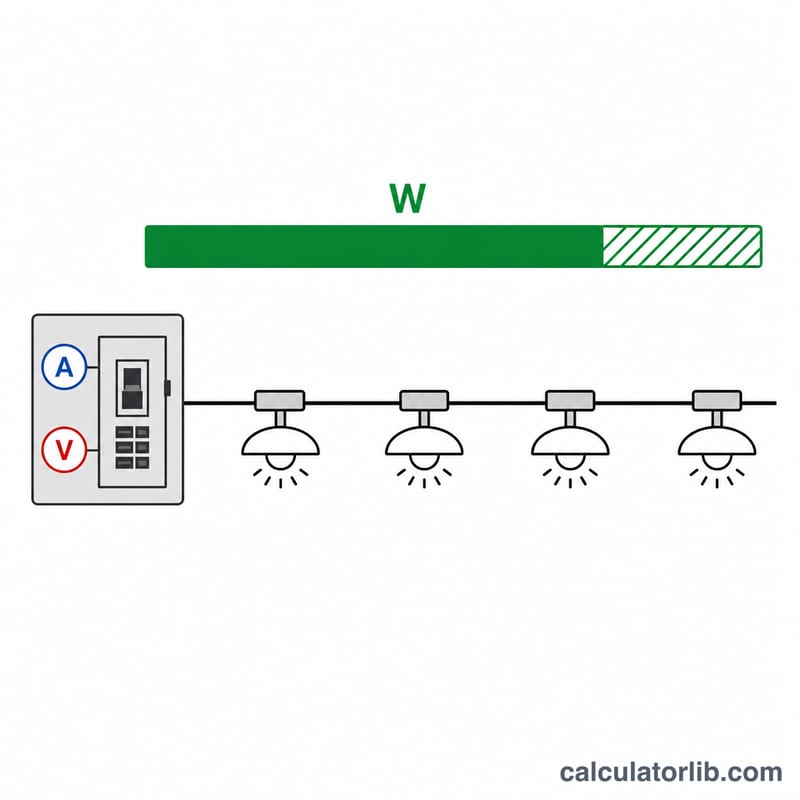
A 120 V circuit on a 15 A breaker with 60 W incandescent fixtures: usable watts = \(120 \times 15 \times 0.8 = 1{,}440\ \text{W}\). Dividing by 60 W gives 24 — so up to 24 fixtures. Switch to 10 W LEDs and the same circuit supports 144 fixtures.
Usable Lighting Capacity by Circuit Size
A circuit's total capacity is voltage × breaker rating. Lighting usually runs for three hours or more at a time, so it counts as a continuous load. US practice under the National Electrical Code (NEC) limits a continuous load to 80% of the breaker rating:
$$\text{Usable Watts} = \text{Voltage} \times \text{Breaker Amps} \times 0.8$$For example, a 120 V, 15 A circuit has \(120 \times 15 = 1{,}800\) W of total capacity. Its usable continuous capacity is \(1{,}800 \times 0.8 = 1{,}440\) W.
| Voltage | Breaker | Total Capacity (V × A) | Usable Continuous Watts (80%) |
|---|---|---|---|
| 120 V | 15 A | 1,800 W | 1,440 W |
| 120 V | 20 A | 2,400 W | 1,920 W |
| 120 V | 30 A | 3,600 W | 2,880 W |
| 240 V | 15 A | 3,600 W | 2,880 W |
| 240 V | 20 A | 4,800 W | 3,840 W |
| 240 V | 30 A | 7,200 W | 5,760 W |
| 277 V | 15 A | 4,155 W | 3,324 W |
| 277 V | 20 A | 5,540 W | 4,432 W |
| 277 V | 30 A | 8,310 W | 6,648 W |
Note: These are guideline values based on US/NEC practice. They are not universal limits. In North America, 277 V is mainly used for commercial lighting on 480Y/277 V systems. Other countries use different voltages, breaker sizes and wiring rules. In every case, the real limit also depends on local electrical code, the wire gauge and how the circuit is installed, and any other loads on the same circuit. A licensed electrician or your local code authority has the final word.
Max Fixtures by Fixture Type and Breaker
The tables below divide the usable continuous watts on two common US 120 V circuits by typical fixture wattages. Each result is rounded down to a whole fixture:
$$\text{Max Fixtures} = \left\lfloor \frac{\text{Usable Watts}}{\text{Watts per Fixture}} \right\rfloor$$For example, with 100 W bulbs on a 120 V, 20 A circuit: \(\lfloor 1{,}920 \div 100 \rfloor = \lfloor 19.2 \rfloor = 19\) fixtures.
| Fixture Type | Typical Draw | 120 V / 15 A (1,440 W) | 120 V / 20 A (1,920 W) |
|---|---|---|---|
| Incandescent bulb | 100 W | 14 | 19 |
| Incandescent bulb | 60 W | 24 | 32 |
| Halogen bulb | 43 W | 33 | 44 |
| CFL bulb | 13 W | 110 | 147 |
| LED bulb | 9 W | 160 | 213 |
| LED recessed downlight | 12 W | 120 | 160 |
| LED troffer (panel) | 40 W | 36 | 48 |
The wattages above are typical examples, not exact ratings. Use the actual rated input wattage printed on your fixture, lamp or LED driver. With LEDs, the driver can draw a bit more than the nominal lamp wattage. In practice, LED circuits are usually limited by other factors before wattage becomes a problem: inrush current at switch-on, dimmer ratings, the ballast or driver load, and how many fixtures you can reasonably connect. Leave some headroom instead of loading a circuit to the calculated maximum.
Related tools
- Watts to amps: the current a load draws at a given voltage.
- Breaker size: the breaker rating a load needs.
- Bulb energy cost: running cost of one bulb or a set of identical bulbs per day, month and year.
- Lighting kWh usage: total kWh and cost of all the lights in a room or home over any number of days.
FAQ
Why only 80%? Electrical code limits continuous loads to 80% of a breaker's rating to prevent nuisance trips and overheating.
Does this include switches or outlets? No — it assumes a dedicated lighting circuit. Subtract any other loads first.
What wattage should I use? Use the fixture's rated power draw (watts), not the lumen output or the incandescent equivalent.