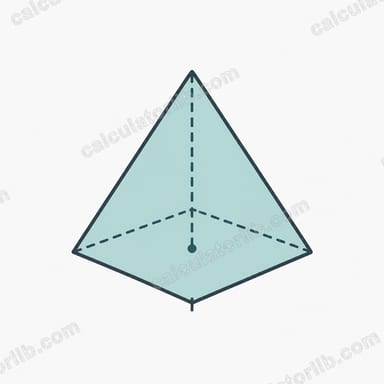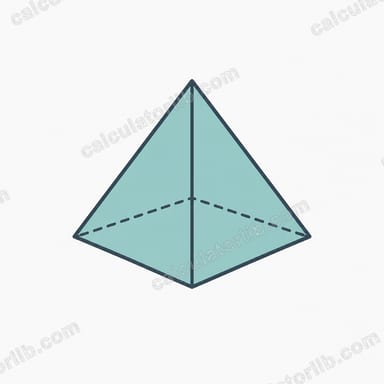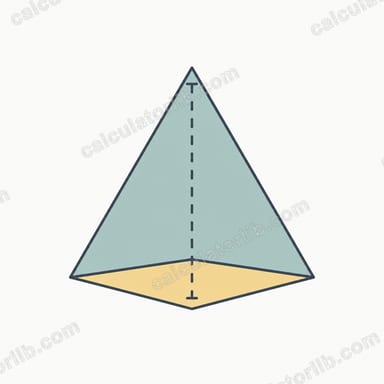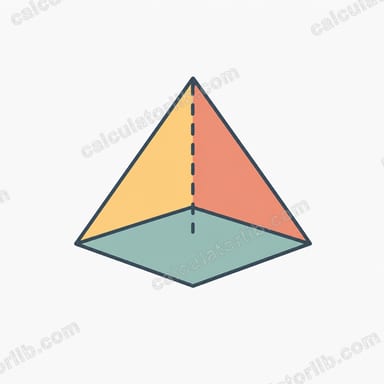
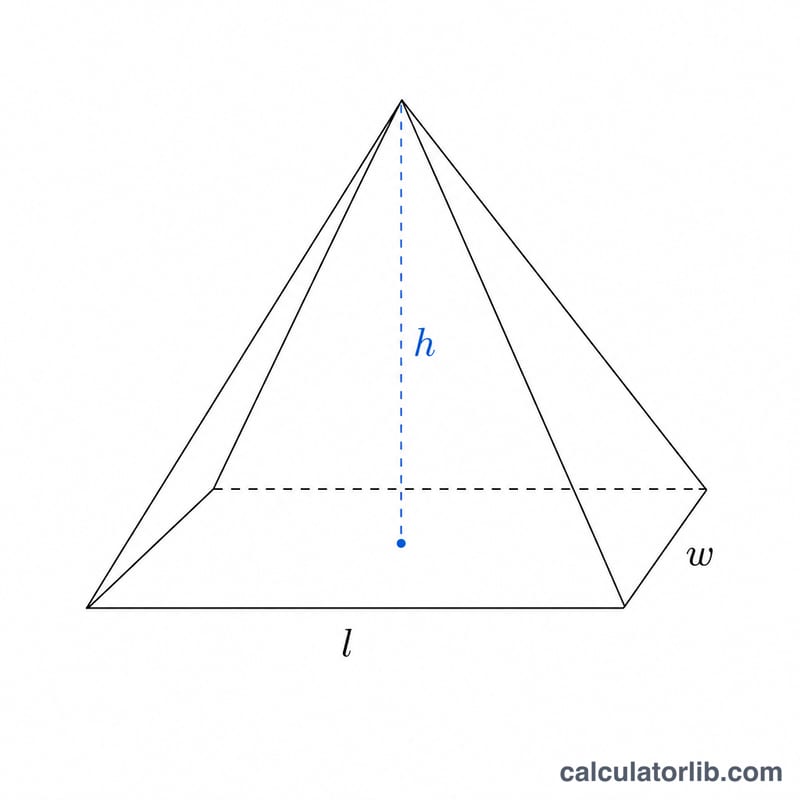
Pyramid volume formula: V = (1/3) × B × h, where B is the area of the base and h is the perpendicular height. For a rectangular base B = l × w, so V = (1/3) × l × w × h. Example: a 3 × 3 base with a height of 4 gives 12 cubic units.
What This Calculator Does
The Rectangular Pyramid Volume Calculator works out three key measurements for a right rectangular pyramid — one with a rectangular base and an apex sitting directly above the centre of that base. From just three inputs it returns the volume, the base area, and the total surface area. All dimensions are entered in metres, so results come back in cubic metres (volume) and square metres (areas).
The Inputs You Enter
- Base Length (m): the longer side of the rectangular base.
- Base Width (m): the shorter side of the rectangular base.
- Height (m): the vertical (perpendicular) distance from the base to the apex — not the slant height.
All three values must be positive numbers. If any is zero or negative, the calculator returns an error because a pyramid cannot have a non-positive dimension.
The Formulas Used
The volume follows the standard pyramid formula:
$$V = \frac{1}{3} \times \text{Length (m)} \times \text{Width (m)} \times \text{Height (m)}$$
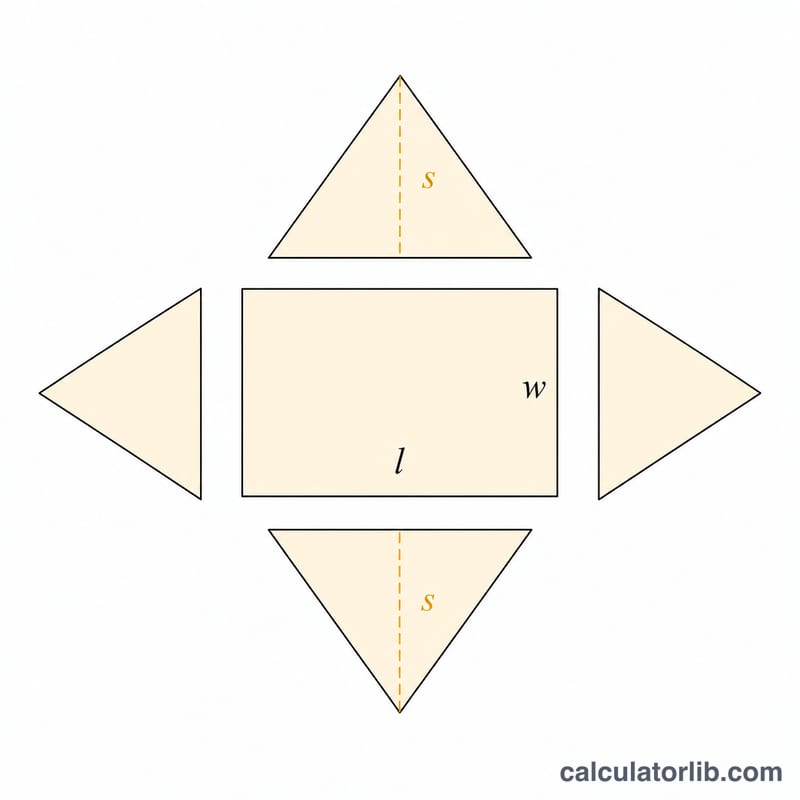
The base area is simply \(\text{Length} \times \text{Width}\). For surface area, the tool first finds two slant heights using the Pythagorean theorem:
- Slant height 1 \(= \sqrt{\text{Height}^{2} + \left(\tfrac{\text{Width}}{2}\right)^{2}}\)
- Slant height 2 \(= \sqrt{\text{Height}^{2} + \left(\tfrac{\text{Length}}{2}\right)^{2}}\)
It then adds the base area to the four triangular faces (two pairs):
$$\text{Surface Area} = (L \times W) + (L \times \text{slant1}) + (W \times \text{slant2})$$
Worked Example
Suppose Length = 6 m, Width = 4 m, Height = 9 m.
- $$V = (6 \times 4 \times 9) \div 3 = 216 \div 3 = \mathbf{72 \text{ m}^3}$$
- Base area \(= 6 \times 4 = \mathbf{24 \text{ m}^2}\)
- Slant1 \(= \sqrt{81 + 4} = \sqrt{85} \approx 9.22 \text{ m}\); Slant2 \(= \sqrt{81 + 9} = \sqrt{90} \approx 9.49 \text{ m}\)
- Surface area \(= 24 + (6 \times 9.22) + (4 \times 9.49) \approx 24 + 55.3 + 37.9 = \mathbf{117.2 \text{ m}^2}\)
Unit Conversions for Volume and Area
The calculator works in metres, so results come out in cubic metres (m³) and square metres (m²). If your measurements are in other units, convert each length to metres before entering it. Convert all three lengths (length, width and height) the same way, because mixing units gives a meaningless volume.
| Length unit | Equals in metres |
|---|---|
| 1 foot (ft) | 0.3048 m |
| 1 inch (in) | 0.0254 m |
| 1 centimetre (cm) | 0.01 m |
| 1 yard (yd) | 0.9144 m |
| Result unit | Equivalent |
|---|---|
| 1 m³ | 35.3147 ft³ |
| 1 m³ | 1,000 L |
| 1 m³ | 1,000,000 cm³ |
| 1 m² | 10.7639 ft² |
| 1 m² | 10,000 cm² |
Example: a pyramid measuring 20 ft by 10 ft by 15 ft becomes 6.096 m by 3.048 m by 4.572 m before entry. Multiply the resulting m³ by 35.3147 to return to cubic feet, or multiply the m² by 10.7639 for square feet.
How Dimensions Change Volume and Surface Area
The table compares five right rectangular pyramids. Volume is \(V=\tfrac{1}{3}lwh\), base area is \(lw\), and total surface area is \(lw + l\sqrt{h^2+(w/2)^2} + w\sqrt{h^2+(l/2)^2}\). All lengths are in metres. For the first row, \(V=\tfrac{1}{3}\times 6\times 4\times 9=\)72 m³.
| Scenario (L × W × H, m) | Volume (m³) | Base area (m²) | Total surface area (m²) |
|---|---|---|---|
| A: 6 × 4 × 9 (reference) | 72.00 | 24.00 | 117.26 |
| B: 6 × 4 × 18 (height doubled) | 144.00 | 24.00 | 205.66 |
| C: 12 × 8 × 9 (base doubled in both directions) | 288.00 | 96.00 | 300.72 |
| D: 5 × 5 × 6 (square base) | 50.00 | 25.00 | 90.00 |
| E: 10 × 8 × 2 (flat, wide) | 53.33 | 80.00 | 167.80 |
- Height: doubling the height (A to B) exactly doubles the volume (72 to 144), because volume is linear in height. Surface area rises only from 117.26 to 205.66, about 1.75 times, because the slant heights grow with a square root and the base area does not change.
- Base: doubling both base sides (A to C) multiplies volume and base area by 4, but surface area by only about 2.56.
- Shape: scenario E has a similar volume to scenario D but much more surface area, which matters for cladding, roofing or paint estimates.
Check for the square pyramid D: slant height \(\sqrt{6^2+2.5^2}=6.5\) m, so lateral area \(=4\times\tfrac{1}{2}\times 5\times 6.5=65\) m², and total \(=65+25=90\) m².
Key Terms Explained
- Apex
- The single top point where all the triangular faces meet.
- Base
- The rectangular face at the bottom, with a length and a width.
- Perpendicular height (h)
- The straight-line distance from the apex down to the base plane, measured at a right angle to the base. It is the height used in the volume formula, not the slanted edge length.
- Slant height
- The height of a triangular lateral face, measured from the midpoint of a base edge up to the apex. A rectangular base gives two different values: \(s_l=\sqrt{h^2+(w/2)^2}\) for the two faces on the length edges, and \(s_w=\sqrt{h^2+(l/2)^2}\) for the two faces on the width edges. They are equal only when the base is square.
- Lateral faces
- The four triangular side faces. They come in two congruent pairs for a rectangular base.
- Right pyramid
- A pyramid whose apex lies directly above the centre of the base. This calculator assumes a right pyramid.
- Oblique pyramid
- A pyramid whose apex is offset from the centre of the base. Its volume is still \(\tfrac{1}{3}\times\) base area \(\times\) perpendicular height, but the surface-area formulas here do not apply.
- Base area
- Length × width, in m².
- Lateral vs. total surface area
- Lateral surface area is the four triangular faces only: \(l\,s_l + w\,s_w\). Total surface area adds the base area to that.
Frequently Asked Questions
Do I use the height or the slant height? Enter the vertical height (apex straight down to the base centre). The calculator computes the slant heights internally for surface area.
Can I use other units? The fields are labelled in metres, but the maths works for any consistent unit — just treat volume as the cubed unit and area as the squared unit.
Why divide by 3? Any pyramid holds exactly one-third the volume of a prism with the same base and height, which is why the formula divides the product by 3.