What is the Ratio Simplifier Calculator?
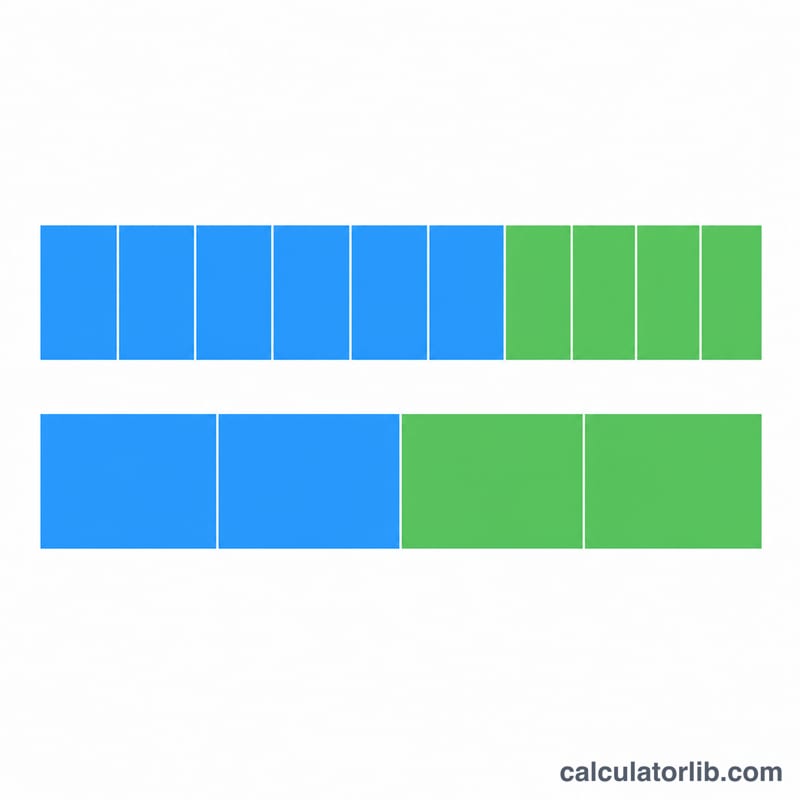
This tool reduces any ratio A : B to its simplest whole-number form. Each term can be a whole number, integer, decimal, simple fraction, or mixed number — and the two terms can even be different types. The calculator converts every value to an exact fraction, scales both sides to integers, and divides by the greatest common factor (GCF).
How to use it
Enter a value for A and a value for B using any of these formats: a whole number like 5, a negative integer like -12, a decimal like 2.5, a simple fraction like 3/4, or a mixed number like 3 1/8 (whole, space, then numerator/denominator). Press calculate to see the reduced ratio plus the worked steps.
The formula
Each term becomes a fraction num/den. Both terms are placed over the least common denominator \(L = \operatorname{lcm}(d_A, d_B)\), where \(\operatorname{lcm}(x, y) = x \cdot y / \gcd(x, y)\). Multiplying both sides of a ratio by the same nonzero number \(L\) leaves the ratio unchanged but clears the fractions, giving integers \(a : b\). Finally divide both by \(g = \gcd(|a|, |b|)\) computed with the Euclidean algorithm.
$$\begin{gathered} \text{A} : \text{B} \;=\; \frac{a}{g} : \frac{b}{g} \\[1.5em] \text{where}\quad \left\{ \begin{aligned} L &= \operatorname{lcm}(d_A,\, d_B) \\ a &= \text{A} \cdot \tfrac{L}{d_A} \\ b &= \text{B} \cdot \tfrac{L}{d_B} \\ g &= \gcd(a,\, b) \end{aligned} \right. \end{gathered}$$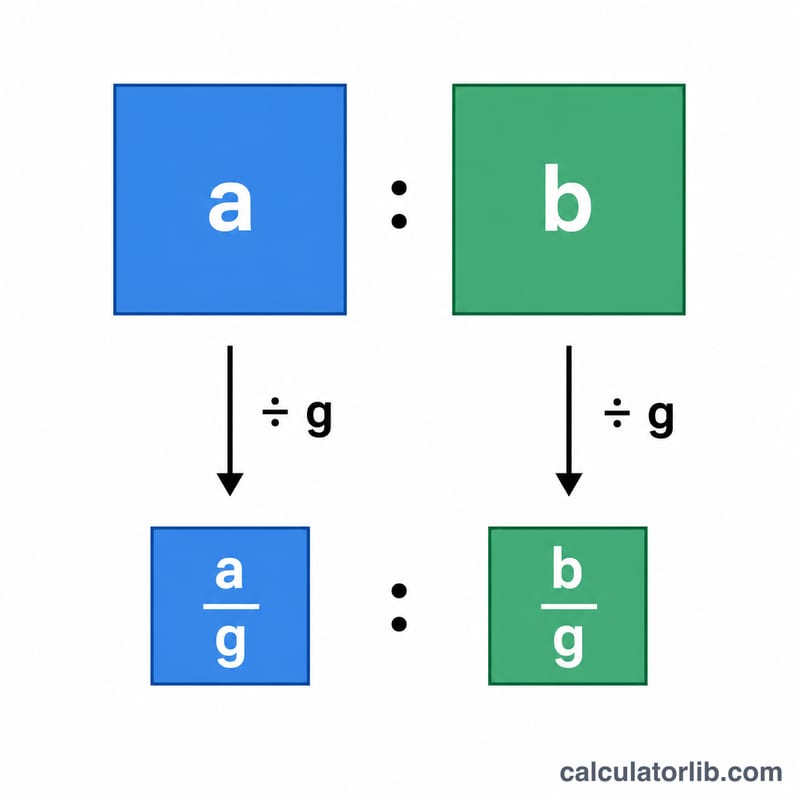
Worked example
For A = 5 and B = 3 1/8: A parses to \(5/1\); B parses to \((3 \times 8 + 1)/8 = 25/8\). The LCM of 1 and 8 is 8, so \(a = 5 \times 8 = 40\) and \(b = 25\). \(\gcd(40, 25) = 5\), giving $$\frac{40}{5} : \frac{25}{5} = \textbf{8 : 5}.$$
More Ratio Simplification Examples
Example 1: Decimals (2.5 : 0.75)
- Write each term over a power of 10: \(2.5 = \frac{25}{10}\) and \(0.75 = \frac{75}{100}\). The largest number of decimal places is 2, so scale both terms by 100.
- Multiply: \(2.5 \times 100 = 250\) and \(0.75 \times 100 = 75\), giving \(250 : 75\).
- Find the gcd with the Euclidean algorithm: \(250 = 3 \times 75 + 25\), then \(75 = 3 \times 25 + 0\), so \(\gcd(250, 75) = 25\).
- Divide both terms: \(250 \div 25 = 10\) and \(75 \div 25 = 3\).
Result: 2.5 : 0.75 = 10 : 3
Example 2: Two fractions (3/4 : 5/6)
- The denominators are \(d_A = 4\) and \(d_B = 6\), so \(L = \operatorname{lcm}(4, 6) = 12\).
- Scale each term: \(a = \frac{3}{4} \times 12 = 9\) and \(b = \frac{5}{6} \times 12 = 10\), giving \(9 : 10\).
- \(\gcd(9, 10) = 1\), because \(10 = 1 \times 9 + 1\) and \(9 = 9 \times 1 + 0\).
Since the gcd is 1, the ratio is already in lowest terms: 3/4 : 5/6 = 9 : 10
Example 3: A negative integer ratio (-48 : 36)
- Both terms are already integers, so \(L = 1\) and no scaling is needed.
- Find the gcd using absolute values: \(48 = 1 \times 36 + 12\), then \(36 = 3 \times 12 + 0\), so \(\gcd(48, 36) = 12\).
- Divide both terms: \(-48 \div 12 = -4\) and \(36 \div 12 = 3\).
Result: -48 : 36 = -4 : 3. The sign stays on the term that was negative. The gcd is always taken as a positive number.
Ratio Terms Explained
- Ratio: a comparison of two quantities by division, written \(A : B\) or \(\frac{A}{B}\).
- Antecedent and consequent: in \(A : B\), the first term A is the antecedent and the second term B is the consequent.
- Lowest terms (simplest form): a ratio whose terms are whole numbers with no common factor greater than 1.
- Equivalent ratios: ratios that have the same value, such as \(2 : 3\), \(4 : 6\) and \(10 : 15\). You get them by multiplying or dividing both terms by the same non-zero number.
- Greatest common factor / divisor (GCF/GCD): the largest whole number that divides two or more integers exactly. \(\gcd(12, 18) = 6\).
- Least common multiple (LCM): the smallest positive whole number that is a multiple of each of the given numbers. \(\operatorname{lcm}(4, 6) = 12\).
- Improper fraction vs. mixed number: an improper fraction has a numerator at least as large as its denominator (\(\frac{7}{3}\)). A mixed number combines a whole number and a proper fraction (\(2\frac{1}{3}\)). They name the same value.
- Coprime numbers: two integers whose only common positive divisor is 1, meaning their gcd is 1 (for example 9 and 10). The terms of a ratio in lowest terms are coprime.
FAQ
Can I mix decimals and fractions? Yes. A = 2.5 and B = 0.75 reduce to 10 : 3.
Are negative ratios supported? Yes — the sign is preserved on each term, so -4 : 6 reduces to -2 : 3.
What about zero? 0 : 6 reduces to 0 : 1; 0 : 0 cannot be reduced and stays 0 : 0.