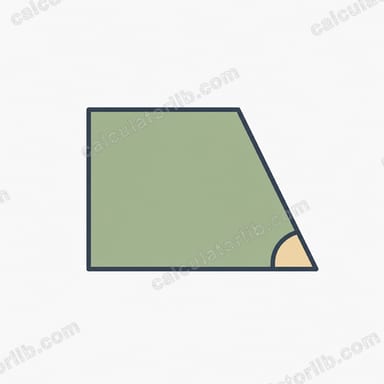
What is the Trapezoid Angle Calculator?
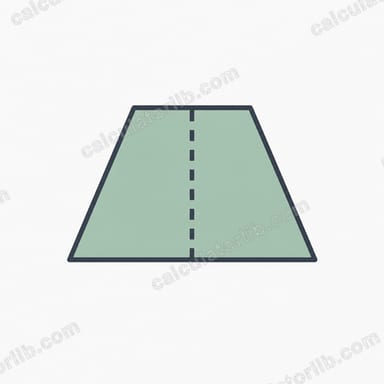
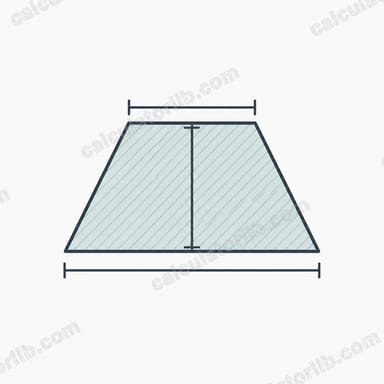
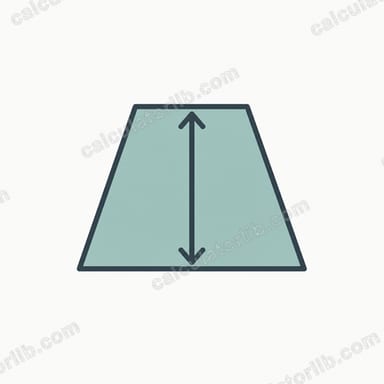
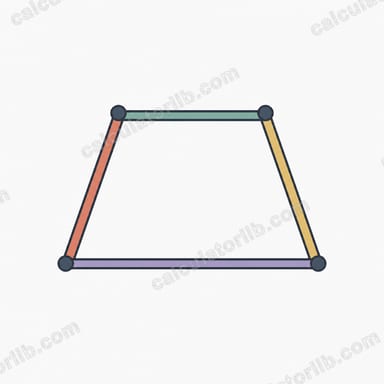
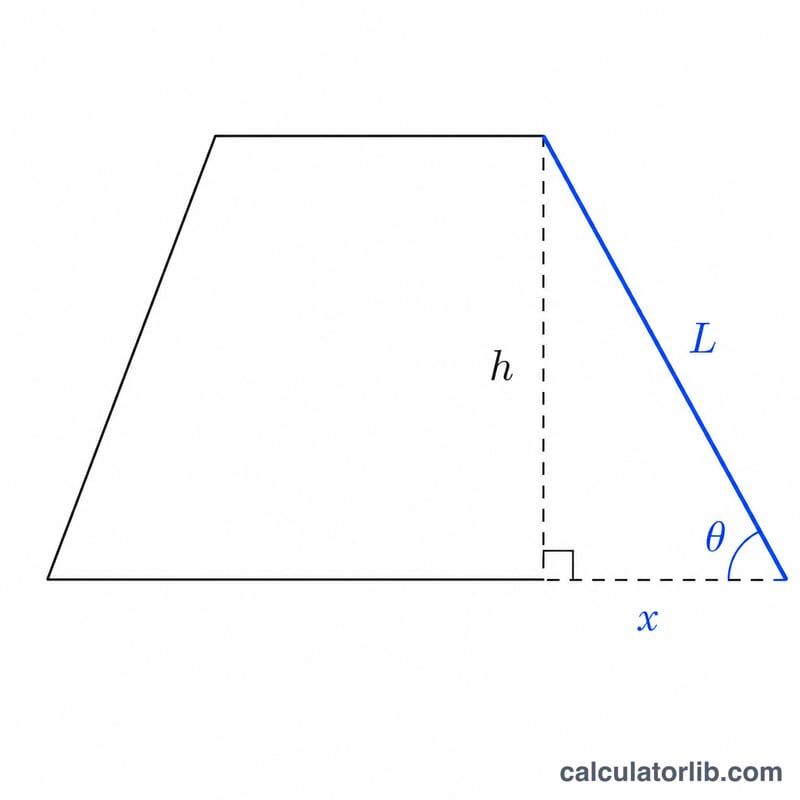
A trapezoid (or trapezium) has two parallel sides of different lengths joined by two slanted legs. This calculator finds the interior angles formed by a leg with the two parallel bases, along with the actual length of the slanted leg. You only need two measurements: the vertical height between the parallel sides and the horizontal offset (how far the leg runs sideways across that height).
How to use it
Enter the height (the perpendicular distance between the two parallel sides) and the horizontal offset of the leg. The tool returns the bottom angle (where the leg meets the longer base), the supplementary top angle, and the leg length. Use consistent units — both inputs in the same units (cm, inches, etc.).
The formula explained
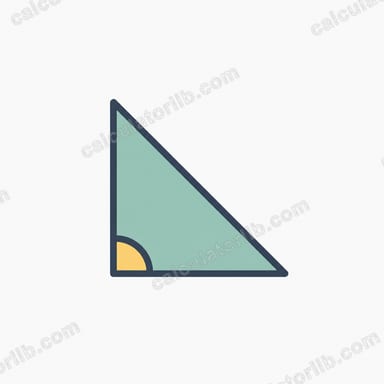
The slanted leg, the height, and the horizontal offset form a right triangle. The base angle is the inverse tangent of opposite over adjacent: \(\theta = \arctan(\text{height} / \text{offset})\). Because the bottom and top angles sit on the same straight leg between two parallel lines, they are co-interior (supplementary) angles, so they add to \(180^{\circ}\). The leg length is the hypotenuse: \(\sqrt{\text{height}^{2} + \text{offset}^{2}}\).
$$\begin{gathered} \theta_{\text{bottom}} = \tan^{-1}\!\left(\frac{\text{Height}}{\left|\text{Offset}\right|}\right) \\[1.2em] \theta_{\text{top}} = 180^{\circ} - \theta_{\text{bottom}} \qquad L = \sqrt{\text{Height}^{2} + \text{Offset}^{2}} \end{gathered}$$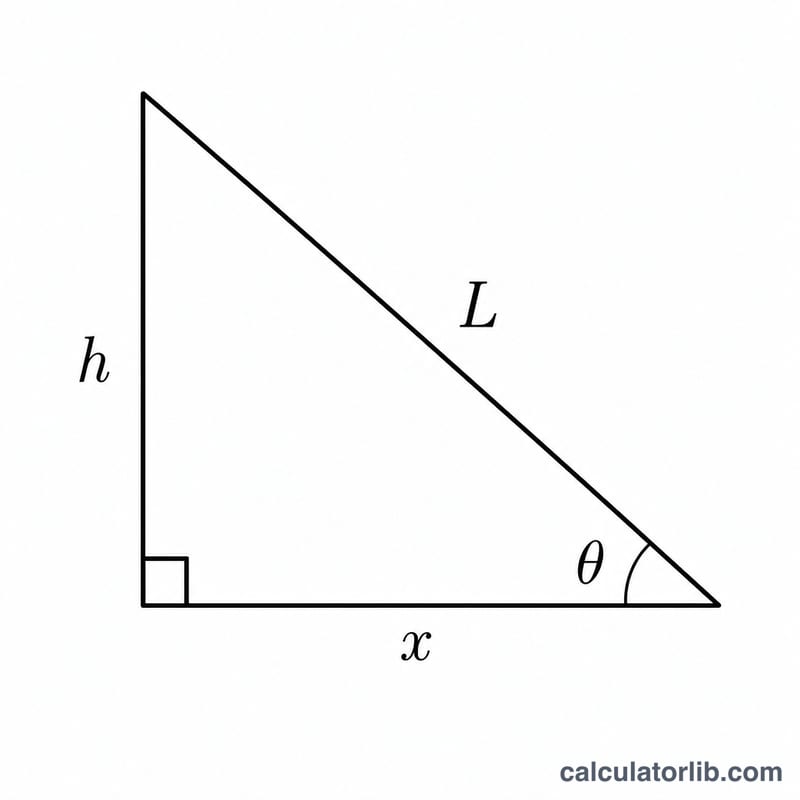
Worked example
Suppose height = 4 and offset = 3. The base angle is \(\arctan(4/3) = 53.13^{\circ}\). The top angle is \(180 - 53.13 = 126.87^{\circ}\). The leg length is \(\sqrt{16 + 9} = \sqrt{25} = 5\). This is the classic 3-4-5 right triangle.
Common Height-to-Offset Ratios and Their Leg Angles
The leg of a trapezoid is fixed by just two numbers: the vertical height \(h\) and the horizontal offset \(x\) (how far the leg's top end sits inward or outward from its bottom end). Because the angle depends only on the ratio \(h:|x|\), the table below is unit-independent — a 3:4 leg measures 36.87° whether the numbers are millimetres, inches or metres:
$$\theta_{\text{bottom}} = \tan^{-1}\!\left(\frac{h}{|x|}\right), \qquad \theta_{\text{top}} = 180^{\circ} - \theta_{\text{bottom}}, \qquad L = \sqrt{h^{2} + x^{2}}$$| Height : offset (h:|x|) | Base angle \(\theta_{\text{bottom}}\) | Top angle \(\theta_{\text{top}}\) | Leg length per 1 unit of offset |
|---|---|---|---|
| 1 : 4 | 14.04° | 165.96° | 1.031 × offset |
| 1 : 3 | 18.43° | 161.57° | 1.054 × offset |
| 1 : 2 | 26.57° | 153.43° | 1.118 × offset |
| 3 : 4 | 36.87° | 143.13° | 1.250 × offset |
| 1 : 1 | 45.00° | 135.00° | 1.414 × offset |
| 4 : 3 | 53.13° | 126.87° | 1.667 × offset |
| 2 : 1 | 63.43° | 116.57° | 2.236 × offset |
| 3 : 1 | 71.57° | 108.43° | 3.162 × offset |
| 4 : 1 | 75.96° | 104.04° | 4.123 × offset |
| any h : 0 (offset 0) | 90.00° | 90.00° | not defined — the leg equals the height |
How to read the table
- The angles are exact trigonometric results, rounded to 2 decimal places. For example \(\tan^{-1}(3/4)\) is 36.8699…°, and \(\tan^{-1}(1)\) is exactly 45°. Only 45°/135° and 90°/90° land on "round" values; the rest are irrational.
- Scaling does not change the angle. A leg with \(h=30\), \(x=40\) has the same 36.87° base angle as \(h=3\), \(x=4\) — but its length scales by the same factor (1.25 × 40 = 50 instead of 1.25 × 4 = 5).
- Base and top angles are supplementary (\(\theta_{\text{bottom}} + \theta_{\text{top}} = 180^{\circ}\)) because the two parallel sides are cut by the leg as a transversal, making the interior angles on the same side co-interior.
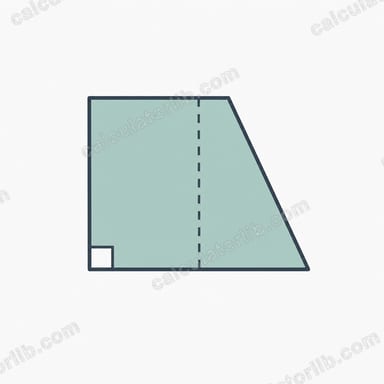
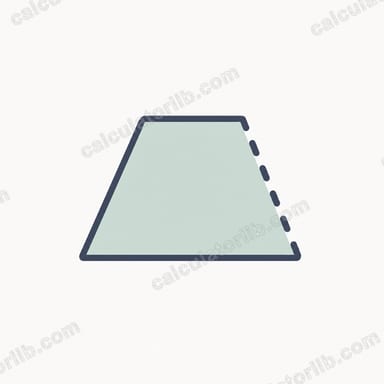
- Offset 0 gives a right trapezoid: the leg is vertical, so it forms 90° with both the base and the top, and "leg length per unit of offset" is meaningless because the offset is zero.
- Sign of the offset does not matter for the angle — the formula uses \(|x|\), so an inward-leaning leg (\(x = -45\)) and an outward one (\(x = 45\)) share the same base angle.
In an isosceles trapezoid both legs have the same height and the same absolute offset, so both base angles are equal and both top angles are equal: one row of this table describes the whole shape. In a general (scalene) trapezoid each leg has its own offset, so run the calculation once per leg.
FAQ
What if the offset is zero? A zero offset means the leg is vertical, giving a base angle of exactly \(90^{\circ}\) (a right trapezoid).
Why do the angles sum to 180°? The two parallel bases are cut by the same leg, forming co-interior angles, which are always supplementary.
Can I use negative offset? Yes — the calculator uses the absolute value of the offset, so direction does not change the angle magnitude.