What this calculator does
This tool evaluates the six trigonometric functions of an angle theta measured in radians: sine, cosine, tangent, cosecant (csc), secant (sec) and cotangent (cot). You can pick a single function, the sin/cos/tan trio, or the reciprocal csc/sec/cot trio from the Function dropdown. It is pure mathematics and applies identically everywhere.
How to use it
Choose which functions you want from the Function selector. Then type the angle in the Angle theta field. The input is already in radians, so no degree conversion is performed. You may enter a plain decimal such as 0.5236, or a symbolic expression where the token pi stands for the constant pi: for example pi/6, 2pi, pi/4, or 3pi/2. The calculator parses the expression, substitutes pi, and reports the requested function values.

The formulas explained
Sine and cosine are the fundamental functions. Tangent is their ratio, \(\tan\theta=\frac{\sin\theta}{\cos\theta}\). The reciprocal functions are
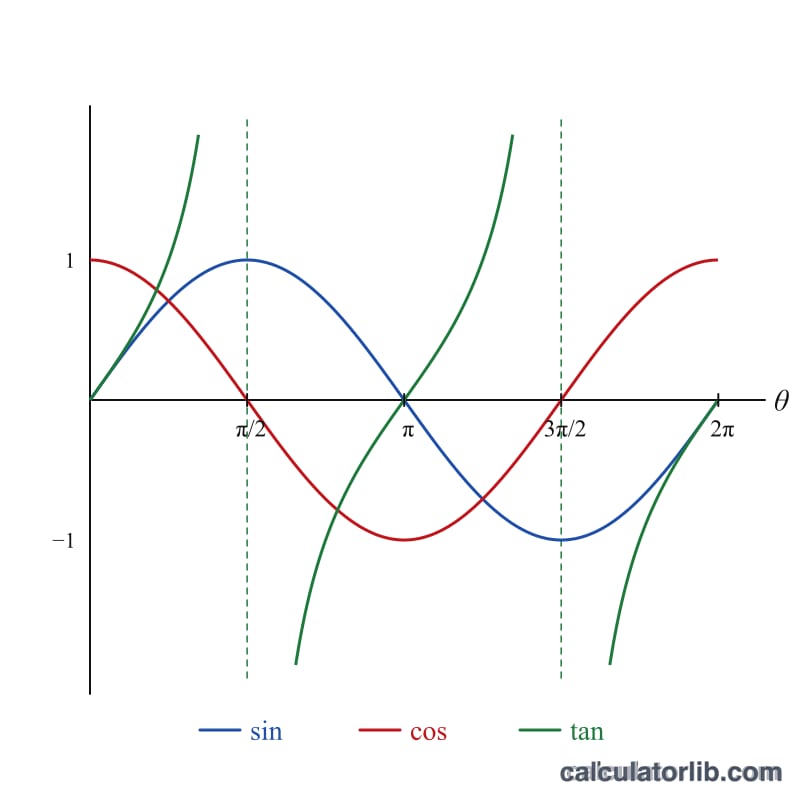
$$\csc\theta=\frac{1}{\sin\theta},\quad \sec\theta=\frac{1}{\cos\theta},\quad \cot\theta=\frac{\cos\theta}{\sin\theta}$$Tangent and secant are undefined wherever \(\cos\theta=0\) (at \(\theta=\pi/2+k\pi\)), and cosecant and cotangent are undefined wherever \(\sin\theta=0\) (at \(\theta=k\pi\)). In those cases the calculator reports "undefined" instead of dividing by zero. Tiny floating-point residues near exact zeros are cleaned up so results stay tidy.
Worked example
With Function set to sin, cos, tan and Angle set to pi/6, \(\theta=0.5235987756\) rad. Then \(\sin\theta=0.5\), \(\cos\theta=0.8660254038\) (which is the square root of 3 over 2), and
(which is 1 over the square root of 3). Switching to the csc, sec, cot trio for the same angle gives \(\csc=2\), \(\sec=1.1547005384\), and \(\cot=1.7320508076\) (the square root of 3).
Common Angles and Exact Trigonometric Values
The table lists the standard angles in radians (0 to 2π) with exact values and decimal approximations (4 decimal places). Reciprocal functions are undefined wherever their denominator is zero: \(\csc\theta = 1/\sin\theta\), \(\sec\theta = 1/\cos\theta\), \(\cot\theta = \cos\theta/\sin\theta\).
| Angle θ (exact) | θ (decimal rad) | sin θ | cos θ | tan θ | csc θ | sec θ | cot θ |
|---|---|---|---|---|---|---|---|
| 0 | 0 | 0 | 1 | 0 | undefined | 1 | undefined |
| π/6 | 0.5236 | 1/2 = 0.5 | √3/2 ≈ 0.8660 | √3/3 ≈ 0.5774 | 2 | 2√3/3 ≈ 1.1547 | √3 ≈ 1.7321 |
| π/4 | 0.7854 | √2/2 ≈ 0.7071 | √2/2 ≈ 0.7071 | 1 | √2 ≈ 1.4142 | √2 ≈ 1.4142 | 1 |
| π/3 | 1.0472 | √3/2 ≈ 0.8660 | 1/2 = 0.5 | √3 ≈ 1.7321 | 2√3/3 ≈ 1.1547 | 2 | √3/3 ≈ 0.5774 |
| π/2 | 1.5708 | 1 | 0 | undefined | 1 | undefined | 0 |
| 2π/3 | 2.0944 | √3/2 ≈ 0.8660 | −1/2 = −0.5 | −√3 ≈ −1.7321 | 2√3/3 ≈ 1.1547 | −2 | −√3/3 ≈ −0.5774 |
| 3π/4 | 2.3562 | √2/2 ≈ 0.7071 | −√2/2 ≈ −0.7071 | −1 | √2 ≈ 1.4142 | −√2 ≈ −1.4142 | −1 |
| 5π/6 | 2.6180 | 1/2 = 0.5 | −√3/2 ≈ −0.8660 | −√3/3 ≈ −0.5774 | 2 | −2√3/3 ≈ −1.1547 | −√3 ≈ −1.7321 |
| π | 3.1416 | 0 | −1 | 0 | undefined | −1 | undefined |
| 3π/2 | 4.7124 | −1 | 0 | undefined | −1 | undefined | 0 |
| 2π | 6.2832 | 0 | 1 | 0 | undefined | 1 | undefined |
“Undefined” means division by zero: tan and sec are undefined where cos θ = 0, and csc and cot are undefined where sin θ = 0.
Degrees to Radians Conversion Table
To convert degrees to radians, multiply by π/180:
$$\text{radians} = \text{degrees} \times \frac{\pi}{180}$$
For example, \(150^\circ \times \pi/180 = 5\pi/6 \approx 2.6180\) rad.
| Degrees | Radians (multiple of π) | Radians (decimal) |
|---|---|---|
| 0° | 0 | 0 |
| 30° | π/6 | 0.5236 |
| 45° | π/4 | 0.7854 |
| 60° | π/3 | 1.0472 |
| 90° | π/2 | 1.5708 |
| 120° | 2π/3 | 2.0944 |
| 135° | 3π/4 | 2.3562 |
| 150° | 5π/6 | 2.6180 |
| 180° | π | 3.1416 |
| 210° | 7π/6 | 3.6652 |
| 225° | 5π/4 | 3.9270 |
| 240° | 4π/3 | 4.1888 |
| 270° | 3π/2 | 4.7124 |
| 300° | 5π/3 | 5.2360 |
| 315° | 7π/4 | 5.4978 |
| 330° | 11π/6 | 5.7596 |
| 360° | 2π | 6.2832 |
To convert back, multiply radians by 180/π.
Interpreting the Results: Signs, Quadrants and Periodicity
Signs by quadrant (the ASTC rule)
“All Students Take Calculus” lists which functions are positive in quadrants I to IV, starting from the positive x-axis and going counterclockwise.
| Quadrant | Angle range (rad) | Positive functions | Negative functions |
|---|---|---|---|
| I | 0 to π/2 | All six | None |
| II | π/2 to π | sin, csc | cos, sec, tan, cot |
| III | π to 3π/2 | tan, cot | sin, csc, cos, sec |
| IV | 3π/2 to 2π | cos, sec | sin, csc, tan, cot |
Ranges
- sin θ and cos θ always lie in \([-1, 1]\).
- csc θ and sec θ satisfy \(|\csc\theta| \ge 1\) and \(|\sec\theta| \ge 1\); they never take values strictly between −1 and 1.
- tan θ and cot θ can take any real value, from very negative to very positive.
Periodicity
- sin, cos, csc and sec repeat every \(2\pi\): \(\sin(\theta + 2\pi) = \sin\theta\).
- tan and cot repeat every \(\pi\): \(\tan(\theta + \pi) = \tan\theta\).
So an angle such as \(7\pi/6\) gives the same sin and cos as \(7\pi/6 - 2\pi = -5\pi/6\).
Large values and asymptotes
A very large result means the angle is close to a vertical asymptote. tan and sec blow up near \(\pi/2 + k\pi\) (where cos θ = 0), and csc and cot blow up near \(k\pi\) (where sin θ = 0). For example, \(\tan(1.57) \approx 1255.77\) because 1.57 is only about 0.0008 rad below \(\pi/2\). Computers store π only approximately, so entering pi/2 into tan may return a huge number (around \(10^{16}\)) instead of “undefined”. Treat such a value as undefined in exact math.
FAQ
Are the inputs in degrees or radians? Radians. If you have degrees, multiply by \(\pi/180\) first (for example 30 degrees = \(\pi/6\)).
Why does it say "undefined"? Because the requested function divides by a quantity that is zero at that angle — for instance tan and sec at \(\pi/2\), or csc and cot at 0 or \(\pi\).
Can I type expressions? Yes. Use pi for the constant pi together with multiplication and division, such as pi/3 or 2pi/3.