
什麼是四面體數?
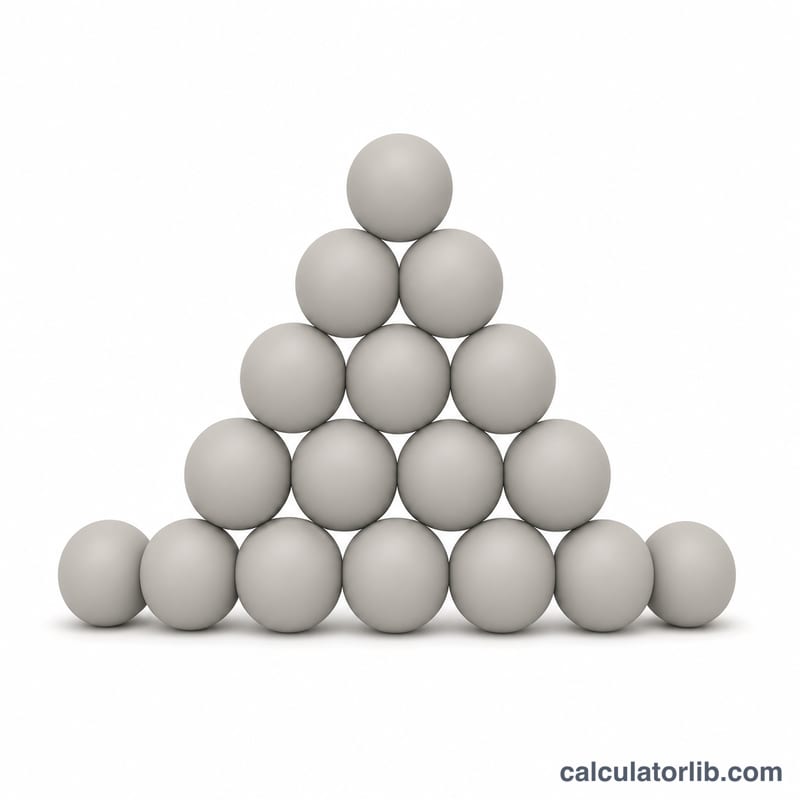
四面體數是指將大小相同的球體堆疊成正三角錐(四面體)共 \(n\) 層時,球體的總數。最頂層只有一顆球,往下每一層都是更大的三角形排列。第 \(n\) 個四面體數記作 \(T_n\),就是這 \(n\) 層所有球體累加起來的總和。這是純數學概念,無論在世界任何地方都完全適用。
如何使用本計算機
輸入堆疊的層數 \(n\)(大於或等於 0 的整數),計算機會回傳三項結果:四面體數 \(T_n\)(球體總數)、以球體直徑為單位表示的堆疊實際高度 \(h_n\),以及底層的球體數量。若輸入 \(n = 0\),代表空堆疊(0 顆球、高度為 0)。
公式說明
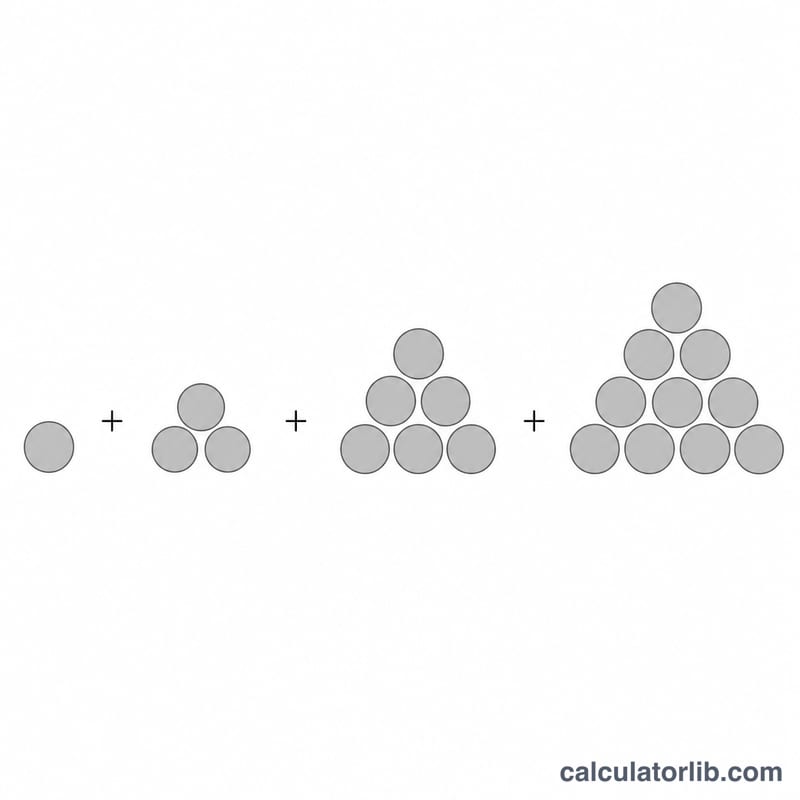
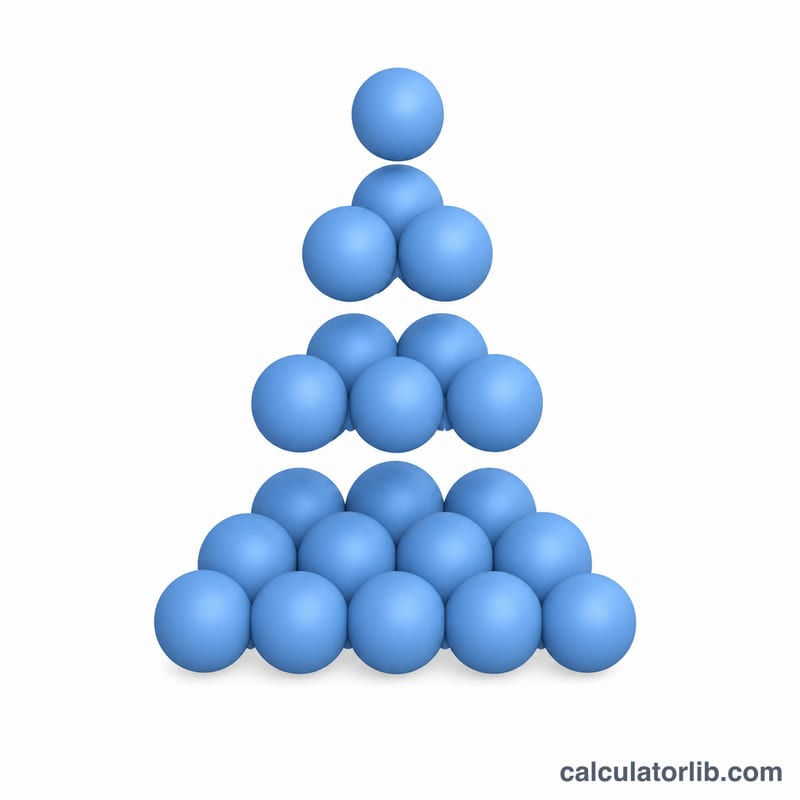
每一層 \(k\) 本身就是一個三角形,放著第 \(k\) 個三角形數的球體 \(P_k = k(k+1)/2\),因此由上往下各層的球數依序為 1、3、6、10……。將前 \(n\) 個三角形數相加,即可得到封閉公式 $$T_n = \dfrac{n(n+1)(n+2)}{6}$$
至於高度,直徑為 \(d\) 的密堆積球體,相鄰兩層球心的垂直間距為 \(\sqrt{2/3} \approx 0.8165\) 個直徑。再加上頂部與底部各半個半徑,便得到完整的實際高度 $$h_n = d\left((n-1)\cdot\sqrt{\tfrac{2}{3}} + 1\right)$$ 對於單一顆球(\(n = 1\)),此公式正確地回傳一個直徑的高度。
實例演算(n = 4)
四層分別放有 1、3、6、10 顆球,所以 $$T_n = 1 + 3 + 6 + 10 = 20$$ 以封閉公式驗算同樣得到:$$\frac{4\cdot 5\cdot 6}{6} = 20 \text{ 顆球}$$ 高度則為 $$h_n = (4-1)\cdot 0.8165 + 1 = 2.4495 + 1 = 3.4495 \text{ 個球體直徑}$$
常見問題
最底層有幾顆球?底層放的是第 \(n\) 個三角形數,也就是 \(P_n = n(n+1)/2\) 顆球。
如果我想換算成實際長度怎麼辦?高度是以「直徑」為單位表示的。只要把 \(h_n\) 乘上你實際的球體直徑 \(d\)(公分、公釐等皆可),就能得到實際長度。
為什麼高度要用 sqrt(2/3)?在密堆積中,每顆上層球都會嵌進下方三顆球形成的凹窩裡;這樣的幾何關係使得相鄰層球心之間的垂直間距為 \(\sqrt{2/3} = \sqrt{6}/3 \approx 0.8165\) 個直徑。