What this calculator does
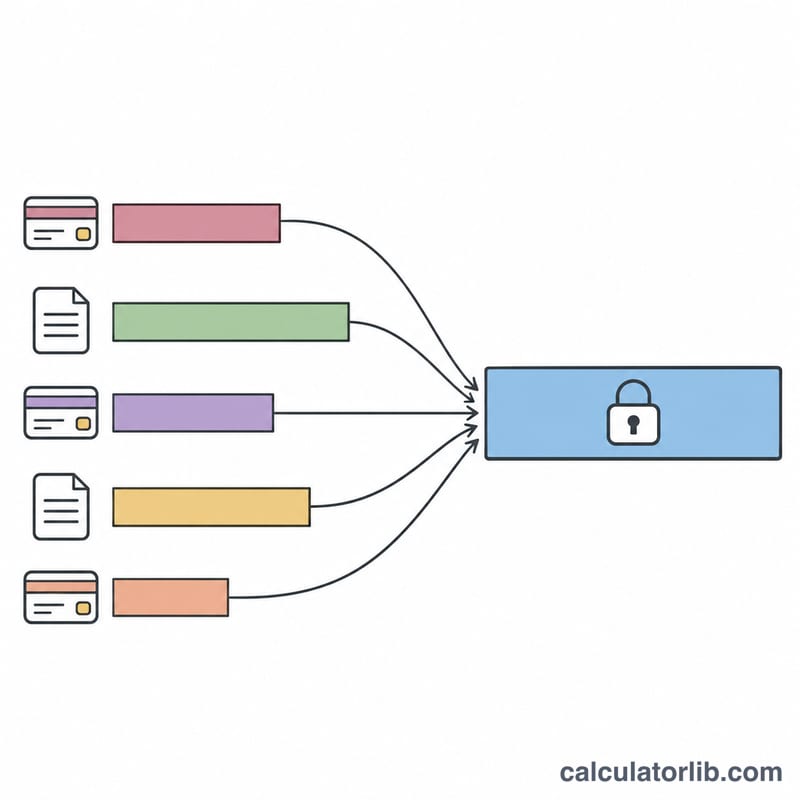
This calculator compares two ways of repaying up to five debts. The first path keeps every debt as it is, each with its own fixed monthly payment. The second path replaces them with one fixed-rate installment loan that carries an optional origination fee. It reports months to payoff, total interest, fees, total cash paid and the difference between the two paths. It suits anyone with credit cards or personal loans who is weighing a consolidation offer.
How to use it
For each of up to five rows, enter the balance, the APR and the fixed monthly payment. Enter 0 as the balance to leave a row unused. Then enter the consolidation loan APR, the loan term in whole months (1 to 360), the origination fee as a percentage of the amount consolidated, and whether the fee is added to the loan or paid upfront. Each active debt payment must exceed one month of interest, or the debt would never be repaid.
Formula
Each existing debt is stepped month by month. The loan uses the standard level-payment annuity formula.
$$r = \frac{\text{APR}}{1200}, \qquad b_{k+1} = \max\left(0,\ b_k(1+r) - P\right)$$$$M = \frac{L\,r}{1-(1+r)^{-n}}$$$$\text{Savings} = (S + I_{\text{current}}) - (M\,n + F_{\text{upfront}})$$Here \(r\) = monthly rate, \(b_k\) = balance at the start of month \(k\), \(P\) = fixed monthly payment of a debt, \(L\) = loan amount, \(n\) = term in months, \(M\) = loan payment (\(M = L/n\) when \(r = 0\)), \(S\) = sum of active balances, \(I_{\text{current}}\) = total interest on the existing debts, and \(F_{\text{upfront}}\) = the fee when paid in cash, otherwise 0.
Conventions and assumptions
- The monthly rate is APR divided by 100 and by 12 for every debt and for the loan. Interest is charged once a month on the balance at the start of the month. Daily-balance card interest is not modelled.
- Each existing debt is simulated alone with its own payment. The final payment is reduced to the remaining balance plus interest. Money freed when a debt ends is not redirected to other debts, and no new charges are added.
- The loan is fully amortizing at a fixed rate. Its amount is the sum of active balances, plus the fee when the fee is financed.
- The fee equals the sum of balances times the fee percent divided by 100. When financed it is added to the principal and accrues interest. When paid upfront it is cash at month 0 and is added to total cost.
- Total cost is every payment made: for current debts, balances plus interest; for the loan, \(M\,n\) plus any upfront fee. No discounting is applied.
- Arithmetic is not rounded month by month. Currency is displayed to two decimals, so lender figures may differ by small amounts.
- Not modelled: teaser rates, balance transfer fees, late fees, penalty APR, minimum-payment formulas, new spending, taxes and credit-score effects.
Worked example
Three debts: $5,000 at 22.99% APR paying $150, $3,000 at 19.99% paying $90, and $2,000 at 25.99% paying $70. The loan is 11.99% APR for 60 months with a 5% fee added to the loan.
$$S = 5000 + 3000 + 2000 = 10000$$$$F = 10000 \times 0.05 = 500, \qquad L = 10000 + 500 = 10500$$Current path: the monthly payments total $310, the last debt is repaid in month 54, total interest is $5,610.30 and total paid is $15,610.30.
$$M = \frac{10500\,r}{1-(1+r)^{-60}} = 233.51, \quad r = \frac{11.99}{1200}$$The monthly payment changes by \(233.51 - 310 = -76.49\), so it falls by $76.49. Loan interest is \(233.51 \times 60 - 10500 = 3510.82\) and the loan total paid is $14,010.82.
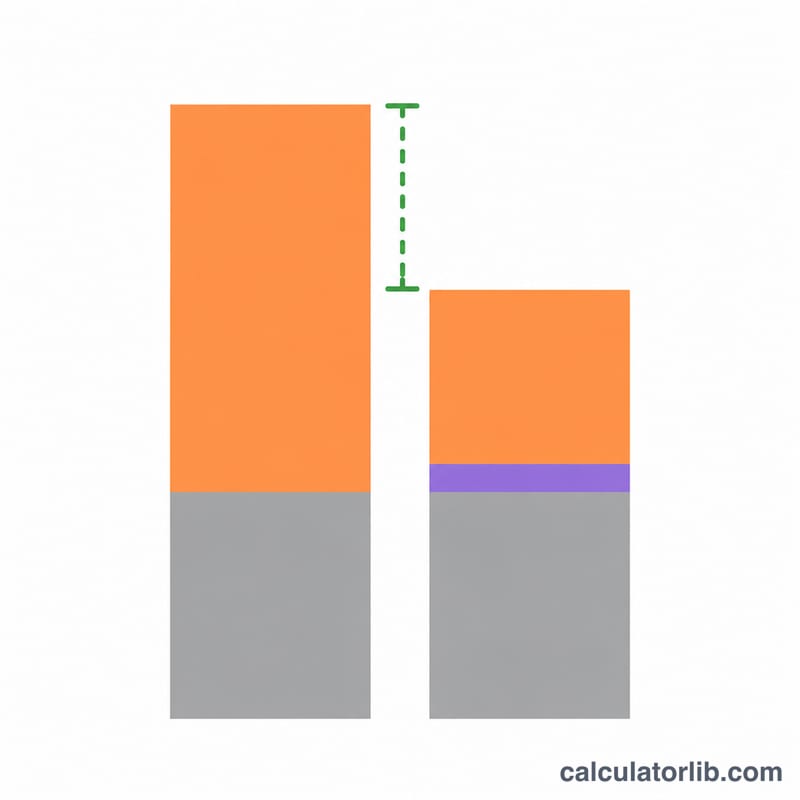
$$\text{Savings} = 15610.30 - 14010.82 = 1599.48$$Interest saved is $2,099.48. The loan runs 60 months against 54, so the month difference is \(54 - 60 = -6\): consolidation finishes 6 months later but costs $1,599.48 less in total.
Reading the result
A positive savings figure means consolidation costs less cash overall. A negative figure is an extra cost, often caused by a long term or a high fee. Compare the monthly payment change too: a lower payment can come with a longer payoff. The existing-debt path assumes fixed payments with no redirection, so a payoff strategy that rolls freed payments forward could narrow the gap. Results are estimates and not financial advice. Check the lender APR, fee and terms before applying.
FAQ
Why can savings be negative?
A long loan term or large origination fee can add more interest and fees than the existing debts would cost. The calculator shows this as an extra cost.
What happens to a debt row with a zero balance?
It is ignored, including its APR and payment.
Should the fee be financed or paid upfront?
Financing the fee increases the principal, so it accrues interest. Paying upfront avoids that interest but needs cash at month 0. Compare both settings.
Why does a payment fail validation?
If a monthly payment does not exceed one month of interest, the balance never falls. Raise the payment.
Does the calculator include teaser rates or balance transfers?
No. Only fixed-rate loans and the listed fee are modelled.
Sources
- What do I need to know about consolidating my credit card debt?, Consumer Financial Protection Bureau, 2026