What Is the Brix to Specific Gravity Calculator?
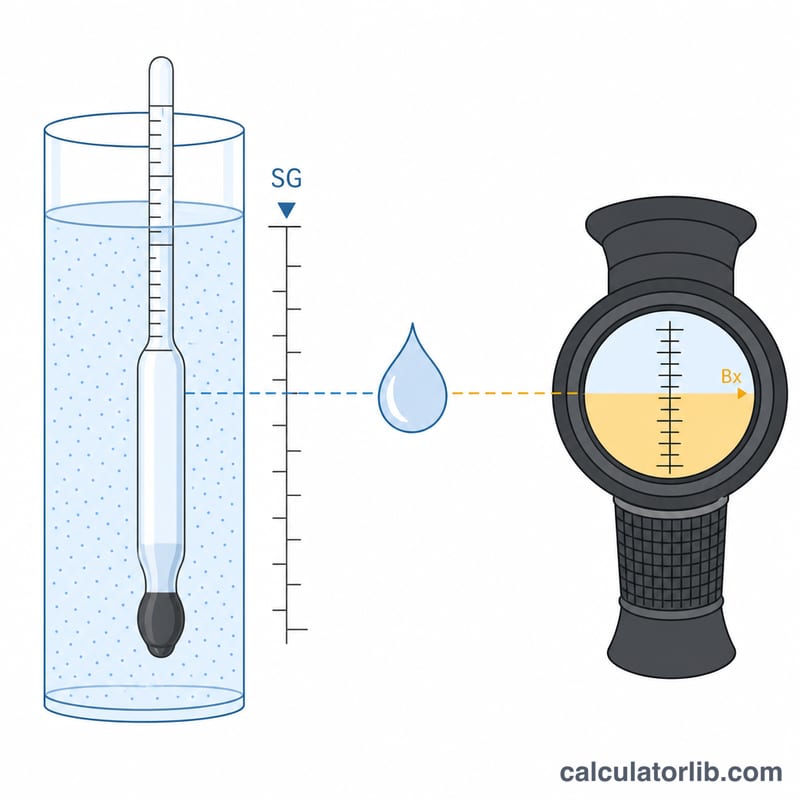
This calculator converts degrees Brix (°Bx)—a measure of dissolved sugar content used with a refractometer—into specific gravity (SG), the density measure used by hydrometers in brewing, winemaking, and other fermentation hobbies. Because refractometers report Brix and many recipes are written in SG, a quick, accurate conversion is essential for tracking sugar levels and predicting alcohol content.
How to Use It
Enter your Brix reading (typically between 0 and 40 for most worts and musts) and the calculator returns the equivalent specific gravity. A reading of 0 °Bx returns 1.000, exactly the density of pure water.
The Formula Explained
The conversion uses a widely adopted cubic-derived approximation:
$$\text{SG} = 1 + \frac{\text{°Bx}}{258.6 - \left(\frac{\text{°Bx}}{258.2}\times 227.1\right)}$$
The denominator shrinks slightly as Brix increases, which captures the nonlinear way sugar concentration affects density. This formula is accurate for the dilute-to-moderate sugar range common in brewing and winemaking.
Worked Example
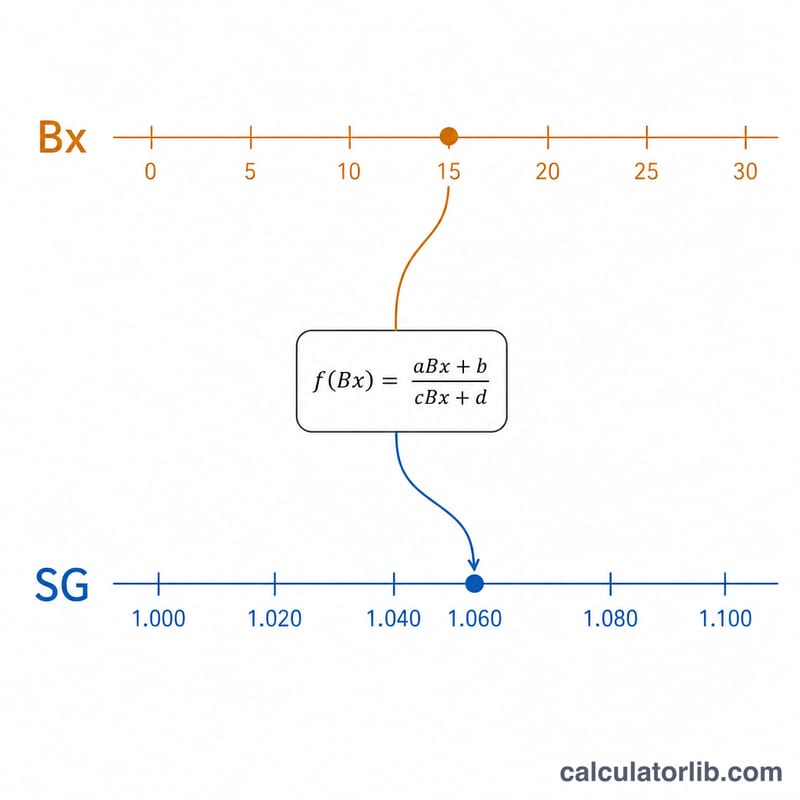
Suppose your refractometer reads 12 °Bx. First compute the denominator: \(258.6 - (12/258.2)\times 227.1 = 258.6 - 10.554 = 248.046\). Then $$\text{SG} = 1 + \frac{12}{248.046} = 1 + 0.04838 \approx 1.0484$$ That matches the typical original gravity of a moderate-strength wort.
Typical Gravity Ranges for Beer and Wine
The table below lists commonly quoted starting (original) gravity ranges for popular homebrewed products, with approximate Brix equivalents. These are general homebrewing guidelines, not strict standards. Styles, recipes and regional definitions vary, and the Brix figures are rounded.
| Product | Typical original gravity (SG) | Approx. °Bx |
|---|---|---|
| Light lagers | 1.035–1.050 | ~9–12 |
| Pale ales / IPAs | 1.050–1.070 | ~12–17 |
| Strong ales | 1.070–1.100 | ~17–24 |
| Wine musts (grape) | 1.088–1.110 | ~21–26 |
| Cider (apple juice) | ~1.045–1.065 | ~11–16 |
| Mead (honey must) | ~1.080–1.130 | ~19–30 |
Mead and cider vary widely with the amount of honey or the apple variety used, so treat these as rough starting points. Your own target depends on the yeast, the style and the sweetness and strength you want.
Interpreting Your SG Result
Specific gravity compares the density of your liquid to that of water (1.000). Dissolved sugars make the liquid denser, so a higher SG means more fermentable material and, after fermentation, a higher potential alcohol content. For example, 1.048 is the SG for a 12 °Bx wort, from \(\text{SG} = 1 + \frac{12}{258.6 - (12/258.2)\times 227.1}\).
A common estimate of alcohol by volume is:
$$\text{ABV} \approx (\text{OG} - \text{FG}) \times 131.25$$
Example: with OG = 1.050 and a final gravity FG = 1.010, ABV ≈ (1.050 − 1.010) × 131.25 = 0.040 × 131.25 = 5.25%.
Important limitation: a refractometer gives a reliable Brix reading only before fermentation. Once yeast has produced alcohol, the alcohol changes how light bends, so the reading no longer reflects sugar alone. Converting a post-fermentation Brix reading directly to SG will give a wrong answer unless you apply a dedicated correction formula. Use a hydrometer for final gravity, or a correction, and treat all of these formulas as close approximations rather than exact values.
FAQ
Is this exact? It is a high-quality approximation valid across normal fermentation ranges. Very high sugar musts may drift slightly from precise lab values.
Should I correct for alcohol? Refractometers read inaccurately once fermentation begins; use this conversion mainly for the initial (pre-fermentation) reading, or apply a separate alcohol-correction formula for finished gravity.
What does SG = 1.000 mean? It is the density of pure water—zero dissolved sugar—so 0 °Bx correctly converts to 1.000.