What is the Degrees to Slope Percent Calculator?
This tool converts a slope measured as an angle in degrees into a slope grade percentage. Grade percent describes how many units a surface rises (or falls) for every 100 units travelled horizontally. It is the standard way roads, ramps, roofs, drainage lines, and trails are described, and it differs from the angle in degrees because grade follows the tangent function rather than a linear scale.
Which slope tool do you need?
- Slope calculator: slope, angle, distance and line equation between two points.
- Point-slope calculator: the slope m from two points, ready for the point-slope form y − y₁ = m(x − x₁).
- Slope-intercept calculator: the slope m and y-intercept b of the line y = mx + b through two points.
- Slope percentage calculator: the percent grade from rise and run (rise ÷ run × 100).
- Slope to degrees: the angle of a slope in degrees and radians.
- Degrees to slope percent (this page): the percent grade of an angle given in degrees.
How to use it
Enter the slope angle in degrees and read off the grade percent and the equivalent "1 in N" ratio. A 45° angle equals exactly 100% grade because the rise equals the run. Note that grade percent grows toward infinity as the angle approaches 90°, so very steep angles produce very large percentages.
The formula explained
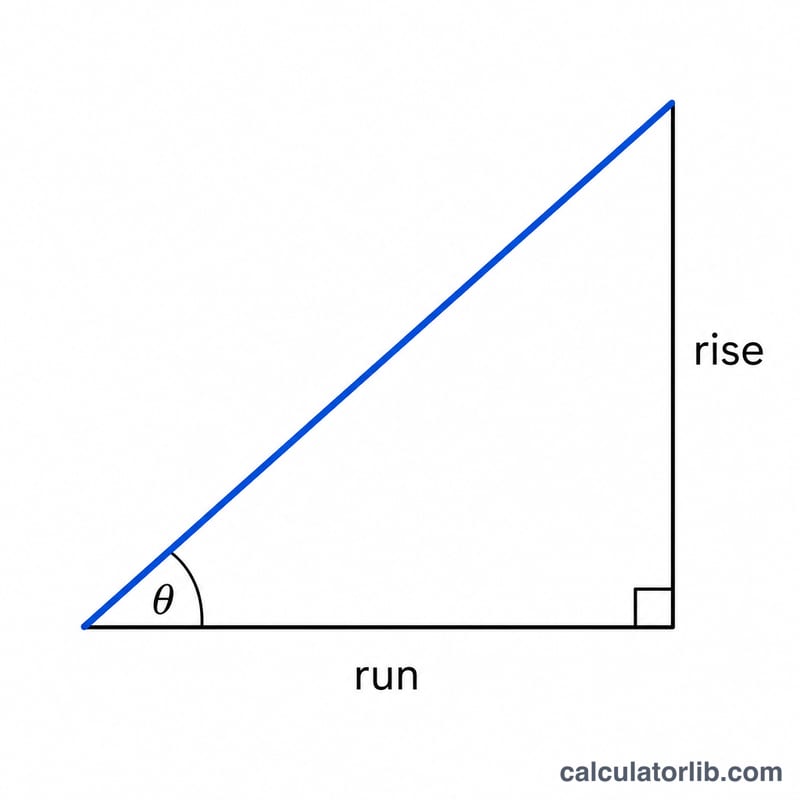
The conversion uses the tangent of the angle: $$\text{Slope \%} = \tan\!\left(\text{Angle (}^\circ\text{)} \times \frac{\pi}{180}\right) \times 100$$. The angle is first converted from degrees to radians by multiplying by \(\pi/180\), the tangent gives the rise-over-run ratio, and multiplying by 100 turns that ratio into a percentage. The "1 in N" ratio is simply the reciprocal of the tangent.
Worked example
For a 30° angle: \(\tan(30^\circ) \approx 0.57735\). Multiplying by 100 gives a grade of about 57.74%. The reciprocal, \(1 \div 0.57735 \approx 1.732\), means the slope is roughly 1 in 1.73.
Typical Slopes in Roads, Ramps and Roofs
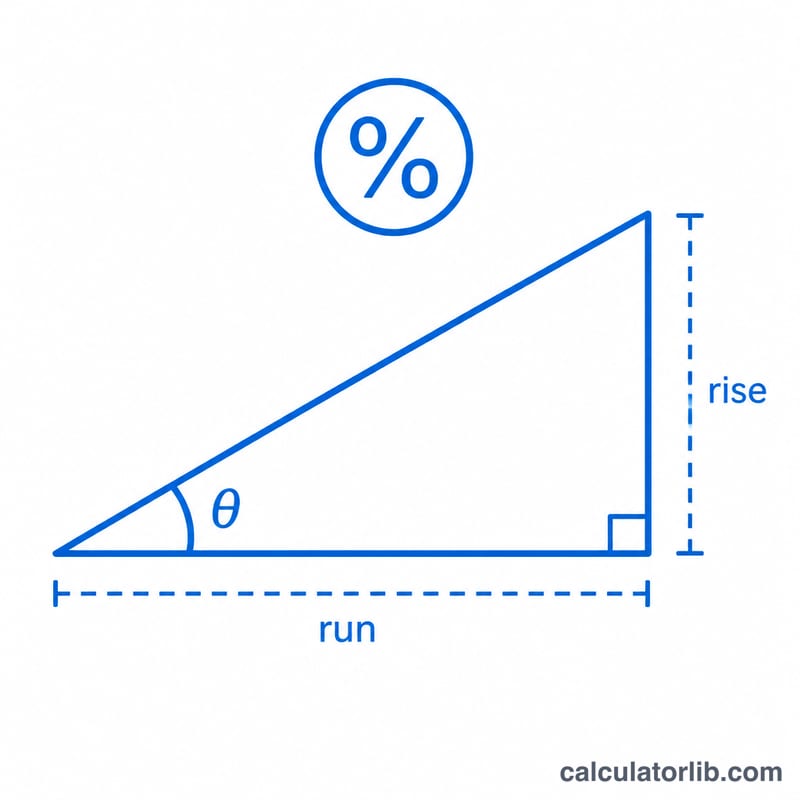
The conversion used throughout is \(\text{Slope \%} = \tan(\theta) \times 100\), and the 1-in-N ratio is \(N = 100 / \text{Slope \%}\). The values below are rounded. Most of them come from United States standards and conventions, so check the rules that apply where you are.
| Application | Degrees | Slope percent | 1-in-N | Source / note |
|---|---|---|---|---|
| Maximum accessible ramp running slope (1:12) | 4.76° | 8.33% | 1 in 12 | US ADA Standards for Accessible Design (2010), section 405 |
| Maximum cross slope of accessible routes and ramps (1:48) | 1.19° | 2.08% | 1 in 48 | US ADA Standards for Accessible Design (2010), sections 402 and 403 for routes, 405 for ramps |
| Interstate highway grade, lower end of typical maximum | 2.86° | 5% | 1 in 20 | US practice (AASHTO design guidance); the limit varies with design speed and terrain |
| Interstate highway grade, upper end of typical maximum | 3.43° | 6% | 1 in 16.7 | US practice (AASHTO design guidance); the limit varies with design speed and terrain |
| Roof pitch 4:12 (4 in rise per 12 in run) | 18.43° | 33.3% | 1 in 3 | Common US/Canada roofing convention, not a single legal standard |
| Roof pitch 6:12 (6 in rise per 12 in run) | 26.57° | 50% | 1 in 2 | Common US/Canada roofing convention, not a single legal standard |
Check on the 6:12 roof: \(\tan(26.57^\circ) \approx 0.5\), so the slope is about 50%.
Slope percent and degrees are not proportional. Small angles convert roughly 1.75% per degree, but at steeper angles the percentage grows much faster. A 45° slope is 100%, and slopes steeper than 45° exceed 100%.
FAQ
Is 100% grade the same as vertical? No. 100% grade is a 45° angle, where rise equals run. A vertical drop is 90°, which is an infinite grade.
Why isn't 10° equal to 10%? Because grade follows the tangent curve, not a straight line. \(\tan(10^\circ) \approx 0.176\), so 10° is about 17.6% grade.
Can I enter negative angles? Yes — a negative angle represents a downward slope and returns a negative grade percent.