What Is the Frost Point?
The frost point is the temperature to which air must be cooled, at constant pressure and water-vapor content, for water vapor to deposit directly as frost (ice) rather than condense as liquid dew. It is the sub-freezing analogue of the dew point and uses saturation values calculated over ice instead of over liquid water. The frost point is essential in meteorology, aviation icing forecasts, cold-storage engineering, and frost-protection planning for agriculture.
How to Use This Calculator
Enter the current air temperature in degrees Celsius and the relative humidity as a percentage (0.01–100). The calculator returns the frost point temperature in °C using the Magnus-Tetens approximation with coefficients tuned for saturation over ice. Frost point is most physically meaningful when the air temperature is below 0 °C.
The Formula Explained
We first compute an intermediate term γ that blends the humidity ratio with the temperature:
$$\gamma = \ln\!\left(\frac{\text{RH}}{100}\right) + \frac{22.46 \times T}{272.62 + T}$$
Then the frost point is:
$$T_f = \frac{272.62 \times \gamma}{22.46 - \gamma}$$
The constants 22.46 and 272.62 °C are the Magnus coefficients for the ice phase (Sonntag/Alduchov-style fits). At 100% relative humidity, \(\ln(1) = 0\) and \(T_f\) collapses back toward \(T\), as expected.
Worked Example
Suppose T = −5 °C and RH = 80%. First, $$\gamma = \ln(0.80) + \frac{22.46 \times -5}{272.62 - 5} = -0.22314 + \frac{-112.3}{267.62} = -0.22314 - 0.41962 = -0.64276.$$ Then $$T_f = \frac{272.62 \times -0.64276}{22.46 + 0.64276} = \frac{-175.25}{23.10276} \approx -7.59 \text{ °C}.$$ So frost would form on surfaces cooled to about −7.6 °C.
Frost Point vs Dew Point Across Sample Conditions
The table applies the Magnus formula over ice, \(T_f = \frac{c\,\gamma}{b-\gamma}\) with \(\gamma = \ln(RH/100) + \frac{bT}{c+T}\), \(b = 22.46\) and \(c = 272.62\). For comparison, the last column uses the liquid-water Magnus coefficients (17.62 and 243.12 °C) in the same form. All temperatures are in °C and are rounded to two decimals.
| Air temp (°C) | RH (%) | Frost point (°C) | Dew point over liquid water (°C) |
|---|---|---|---|
| -10 | 50 | -17.58 | -18.47 |
| -10 | 80 | -12.49 | -12.80 |
| -10 | 95 | -10.58 | -10.65 |
| -5 | 50 | -12.87 | -13.83 |
| -2 | 80 | -4.64 | -4.99 |
| -20 | 80 | -22.30 | -22.56 |
Worked check for the first row: \(\gamma = \ln(0.50) + \frac{22.46\times(-10)}{272.62-10} = -0.6931 - 0.8552 = -1.5484\), so \(T_f = \frac{272.62\times(-1.5484)}{22.46+1.5484} \approx -17.58\) °C.
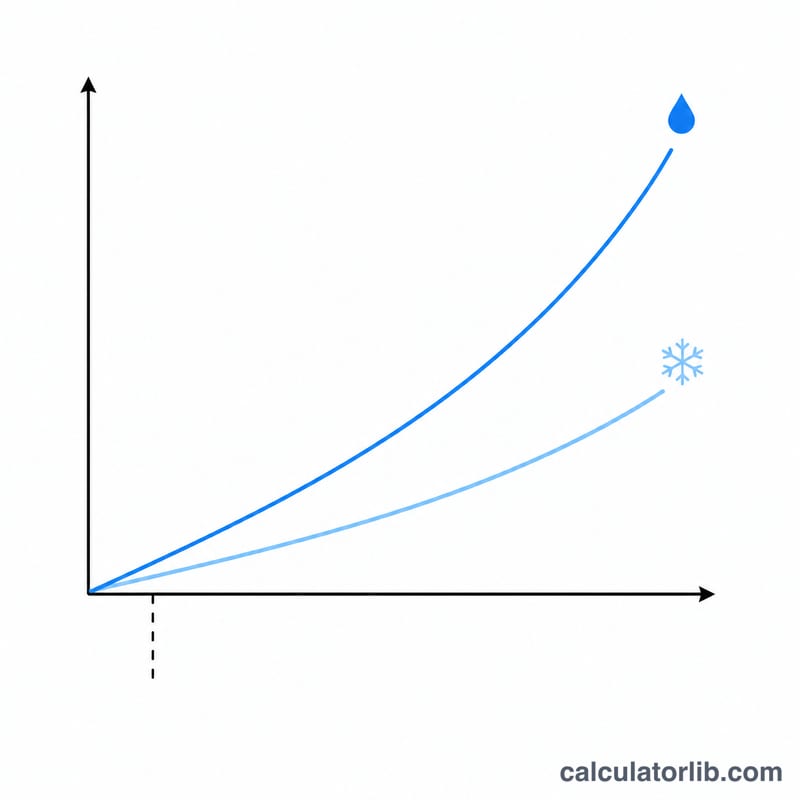
In every row the frost point is slightly higher (warmer) than the liquid-water dew point. The gap widens as the air gets drier.
Interpreting the Frost Point Result
- Depression: The difference between air temperature and frost point shows how far the air is from saturation with respect to ice. A small difference means the air is close to ice saturation.
- RH of 100%: When the frost point equals the air temperature, relative humidity (with respect to ice) is 100%. Any surface at or below that temperature can collect frost.
- Larger spread: A frost point well below the air temperature means drier air. A surface must be cooled much further before frost can deposit on it.
- Surface vs air temperature: Surfaces can fall below the air temperature through radiative cooling, for example under a clear night sky. Frost can therefore form on a surface even when the measured air temperature is above the frost point.
- Frost point vs dew point: For sub-freezing air, the frost point is at or above the dew point calculated over liquid water. This is because saturation vapor pressure over ice is lower than over supercooled liquid water at the same temperature. The two values coincide at 0 °C.
The result describes the state of the air only. It does not predict whether frost will actually form on a given object, because that also depends on the surface temperature, airflow and moisture supply.
Constants Used in the Magnus Ice Formula
| Symbol | Value | Meaning |
|---|---|---|
| \(b\) | 22.46 (dimensionless) | Magnus coefficient for saturation over ice |
| \(c\) | 272.62 °C | Magnus temperature coefficient for saturation over ice |
| \(\ln\) | natural logarithm | Converts the humidity ratio \(RH/100\) into the term \(\ln(RH/100)\) |
- Valid temperature range: roughly -45 °C to 0 °C. Outside this range the approximation becomes less reliable.
- Valid humidity range: \(0 < RH \le 100\)%. RH must be greater than zero because \(\ln(0)\) is undefined.
- Difference from the liquid-water version: The common Magnus coefficients for saturation over liquid water are \(b = 17.62\) and \(c = 243.12\) °C. The ice coefficients are larger because ice has a lower saturation vapor pressure and a different temperature dependence (the latent heat of sublimation is greater than that of vaporization).
The formula is an empirical approximation, so results are best treated as accurate to a small fraction of a degree within the stated range.
FAQ
Frost point vs dew point — what's the difference? Below 0 °C, vapor can deposit as ice. The frost point uses ice-saturation coefficients and is slightly higher than the liquid-water dew point at the same conditions.
Can I use this above freezing? The math runs, but the result is only physically meaningful for sub-freezing air where ice saturation applies. Above 0 °C use a dew point calculator.
Why must humidity be above 0%? The formula takes the natural log of RH/100, which is undefined at 0; we clamp tiny values to avoid errors.