What the Inverse Log (Antilog) Calculator Does
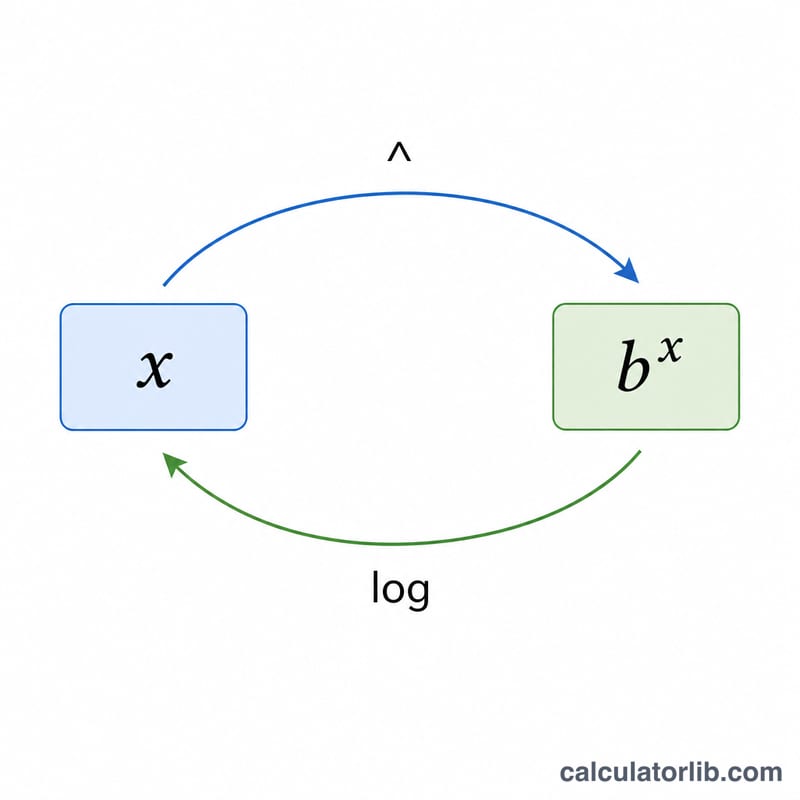
The inverse logarithm — also called the antilogarithm — reverses a logarithm. If you know the log of a number, the antilog gives you the original number back. This calculator takes a single value and raises your chosen base to that power. In other words, it computes basex, where x is the number you enter and base is the one you pick from the list.
The Inputs You Provide
- Enter a number — the exponent x. This can be any positive, negative, or decimal value (for example 2, -1.5, or 0.301).
- Select base — choose one of three options:
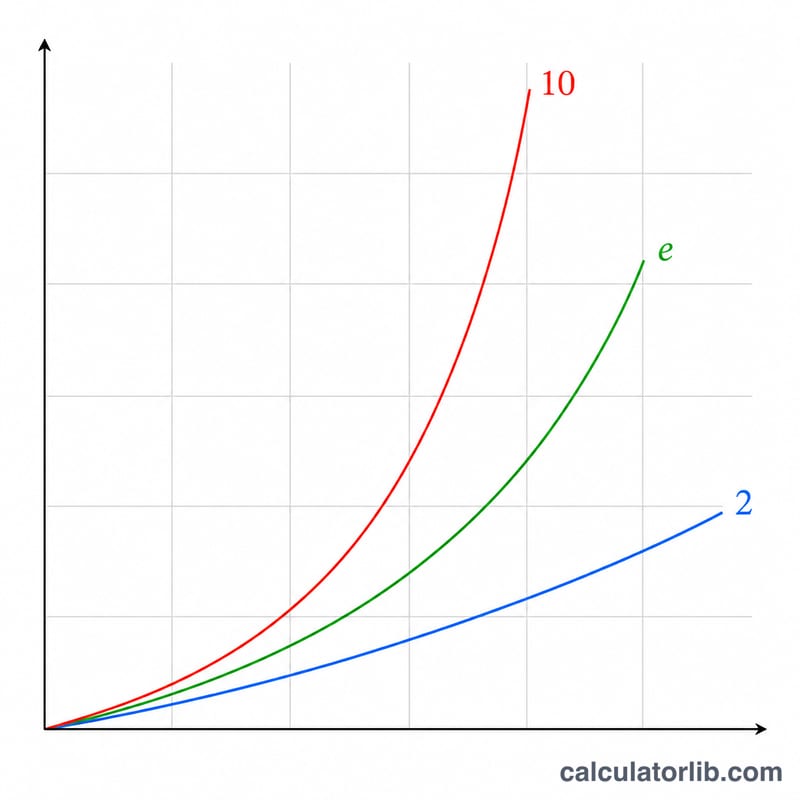
- 10 (Common log) — calculates 10x, the inverse of log₁₀.
- e (Natural log) — calculates ex (≈ 2.71828x), the inverse of ln.
- 2 (Binary log) — calculates 2x, the inverse of log₂.
The Formula
The calculator applies one simple rule depending on the base you select:
- Base 10: antilog = 10x
- Base e: antilog = ex (the exponential function)
- Base 2: antilog = 2x
Each is the exact mathematical inverse of its matching logarithm, so if log₁₀(100) = 2, then the antilog of 2 in base 10 returns 100.
Worked Example
Suppose you enter 3 and select base 10. The calculator computes 103 = 1000. If instead you enter 0.301 with base 10, you get 100.301 ≈ 2.0 — which makes sense, because log₁₀(2) ≈ 0.301. Switching the base to e with the number 1 returns e1 ≈ 2.71828, and base 2 with the number 10 returns 210 = 1024.
Common Antilog Values by Base
The antilogarithm (antilog) of a number \(x\) in base \(b\) is simply \(b^{x}\). The table below lists the three bases this calculator supports — base 10 (common antilog), base \(e\) (natural antilog, \(e \approx 2.718281828\)) and base 2 (binary antilog) — for a range of exponents. Values are exact where they are clean, otherwise rounded to five significant figures.
| x | 10x (common) | ex (natural) | 2x (binary) |
|---|---|---|---|
| −3 | 0.001 | 0.049787 | 0.125 |
| −2 | 0.01 | 0.135335 | 0.25 |
| −1 | 0.1 | 0.367879 | 0.5 |
| −0.5 | 0.316228 | 0.606531 | 0.707107 |
| 0 | 1 | 1 | 1 |
| 0.301 | 1.9999 | 1.3512 | 1.2320 |
| 0.5 | 3.1623 | 1.6487 | 1.41421 |
| 1 | 10 | 2.71828 | 2 |
| 1.5 | 31.623 | 4.4817 | 2.82843 |
| 2 | 100 | 7.38906 | 4 |
| 3 | 1000 | 20.086 | 8 |
| 10 | 10,000,000,000 | 22,026.5 | 1024 |
Two patterns are worth memorising. First, every base gives 1 at \(x = 0\), because \(b^{0} = 1\) for any positive base \(b\) — that is why all three columns agree on the \(x = 0\) row. Second, a negative exponent produces the reciprocal of the positive-exponent value: \(b^{-x} = 1/b^{x}\). So \(10^{-2} = 1/100 = 0.01\), \(2^{-3} = 1/8 = 0.125\) and \(e^{-1} = 1/2.71828 \approx 0.367879\). The row \(x = 0.301\) is the well-known one where \(10^{0.301} \approx 2\), since \(\log_{10} 2 = 0.30103\).
How to Calculate an Antilog by Hand
Before electronic calculators, antilogs were read from printed log tables using the characteristic-and-mantissa split. The same procedure works today with any scientific calculator and is a good way to sanity-check a result.
- Identify the base and the exponent. Write the problem as \(b^{x}\). "Antilog" with no base stated conventionally means base 10 in engineering and chemistry work; in computing contexts it usually means base 2, and in calculus and statistics it means base \(e\). Confirm which convention applies before you start.
- Split \(x\) into its characteristic and mantissa. The characteristic is the integer part, the mantissa the non-negative fractional part. For example, \(2.301 = 2 + 0.301\), so the characteristic is 2 and the mantissa is 0.301.
- Evaluate the integer part directly. This is a plain power: \(10^{2} = 100\), \(2^{7} = 128\), \(e^{3} \approx 20.086\). Powers of ten just move the decimal point, and powers of two up to \(2^{10} = 1024\) are worth knowing by heart.
- Evaluate the fractional part. Use a log table or the \(x^{y}\) key: \(10^{0.301} \approx 1.9999\). A mantissa result for base 10 always lies between 1 and 10; for base 2 it lies between 1 and 2.
- Multiply the two parts. Because \(b^{m+n} = b^{m} \cdot b^{n}\), $$10^{2.301} = 10^{2} \times 10^{0.301} = 100 \times 1.9999 \approx 200$$ The integer part fixes the order of magnitude and the fractional part fixes the leading digits.
- Apply the reciprocal rule for negative exponents. Compute the positive power first, then invert: \(b^{-x} = 1/b^{x}\). For instance \(10^{-2} = 1/10^{2} = 1/100 = \) 0.01. Do not split a negative number as "−2 + (−0.301)" and look up a negative mantissa; classical tables instead write \(-2.301\) as \(\bar{3}.699\), meaning characteristic \(-3\) with mantissa \(+0.699\).
If your calculator only has an \(e^{x}\) key. Any base can be converted to base \(e\) with the identity $$b^{x} = e^{x \ln b}$$ Substituting the two constants you need most often, \(\ln 2 = 0.693147\) and \(\ln 10 = 2.302585\), gives \(2^{x} = e^{0.693147x}\) and \(10^{x} = e^{2.302585x}\). Checking the earlier example: \(10^{2.301} = e^{2.301 \times 2.302585} = e^{5.29825} \approx 199.99\), which matches the hand calculation. The same identity in reverse, \(\log_b N = \ln N / \ln b\), converts logarithms between bases.
Frequently Asked Questions
What is an antilog? An antilog undoes a logarithm. Since a logarithm asks "to what power do I raise the base to get this number?", the antilog simply performs that exponentiation: basex.
Can I enter a negative or decimal number? Yes. Negative exponents return fractions (for example base 10 with -2 gives 0.01), and decimals are handled precisely (100.5 ≈ 3.162).
Why are there only three bases? Base 10 (common), base e (natural), and base 2 (binary) cover the logarithms used most often in science, mathematics, and computing. These three match the standard log, ln, and log₂ functions you will encounter most frequently.