What Is a Negative Exponent?
A negative exponent tells you to take the reciprocal of the base raised to the positive version of that exponent. In symbols, \(a^{-n} = 1 / a^{n}\). So instead of multiplying the base by itself, you divide 1 by the base multiplied by itself n times. This rule keeps the laws of exponents consistent and is fundamental in algebra, scientific notation, and calculus.
$$a^{-n} = \frac{1}{a^{n}}$$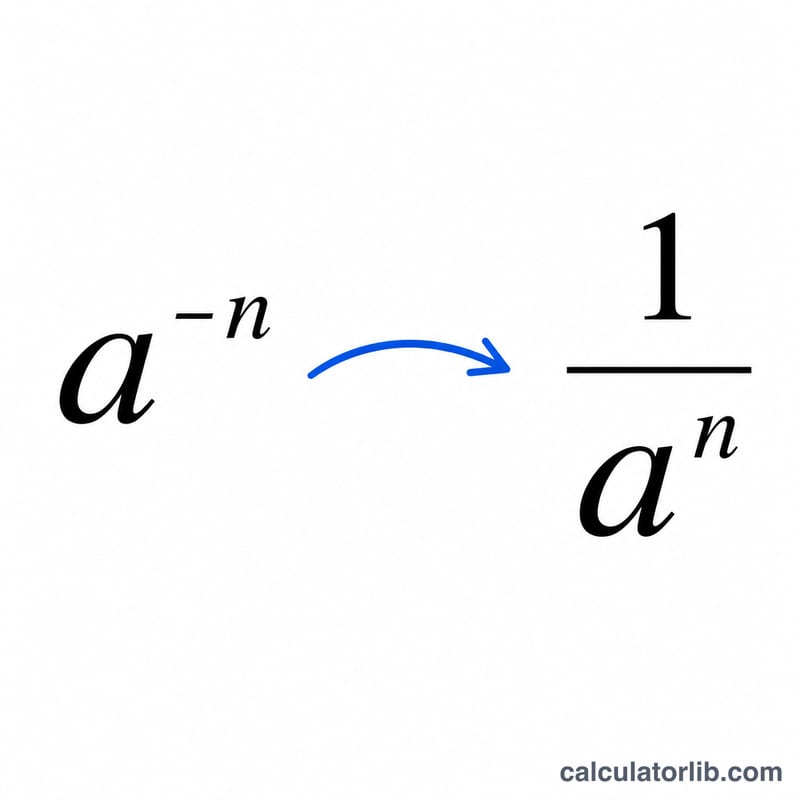
How to Use This Calculator
Enter the base (a) and the exponent (n). The exponent you type is treated as the negative power automatically — for example, entering base 2 and exponent 3 computes \(2^{-3}\). The tool returns the final value plus the positive power \(a^{n}\) so you can see the reciprocal clearly. Decimals and fractional exponents are supported.
The Formula Explained
The expression \(a^{-n}\) is defined as 1 divided by \(a^{n}\). This works because of the quotient rule of exponents: \(a^{m} / a^{m+n} = a^{-n}\), which simplifies to \(1 / a^{n}\). Note that the base cannot be zero, since dividing by zero is undefined.
Worked Example
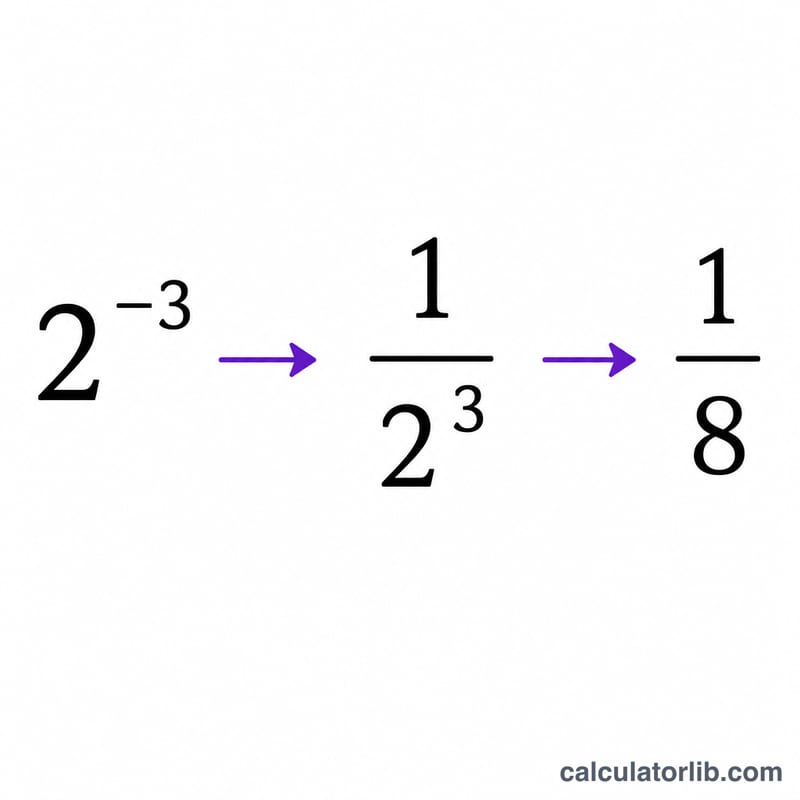
Compute \(2^{-3}\). First find the positive power: \(2^{3} = 8\). Then take the reciprocal: \(1 / 8 = 0.125\). So \(2^{-3} =\) 0.125. Likewise, \(5^{-2} = 1 / 25 = 0.04\), and \(10^{-1} = 1 / 10 = 0.1\).
Common Negative Powers Reference Table
A negative exponent means the reciprocal of the matching positive power: \(a^{-n} = \frac{1}{a^n}\) (for \(a \neq 0\)). The table lists common bases, with decimals rounded where they do not terminate.
| Base a | n | a⁻ⁿ as 1/aⁿ | Decimal |
|---|---|---|---|
| 2 | 1 | 1/2 | 0.5 |
| 2 | 2 | 1/4 | 0.25 |
| 2 | 3 | 1/8 | 0.125 |
| 2 | 4 | 1/16 | 0.0625 |
| 2 | 5 | 1/32 | 0.03125 |
| 3 | 1 | 1/3 | ≈ 0.3333 |
| 3 | 2 | 1/9 | ≈ 0.1111 |
| 3 | 3 | 1/27 | ≈ 0.0370 |
| 3 | 4 | 1/81 | ≈ 0.01235 |
| 3 | 5 | 1/243 | ≈ 0.004115 |
| 5 | 1 | 1/5 | 0.2 |
| 5 | 2 | 1/25 | 0.04 |
| 5 | 3 | 1/125 | 0.008 |
| 5 | 4 | 1/625 | 0.0016 |
| 5 | 5 | 1/3125 | 0.00032 |
| 10 | 1 | 1/10 | 0.1 |
| 10 | 2 | 1/100 | 0.01 |
| 10 | 3 | 1/1000 | 0.001 |
| 10 | 4 | 1/10,000 | 0.0001 |
| 10 | 5 | 1/100,000 | 0.00001 |
| 10 | 6 | 1/1,000,000 | 0.000001 |
How to Calculate a Negative Exponent by Hand
- Identify the base and exponent. In \(4^{-3}\), the base is \(a = 4\) and the exponent is \(-3\), so \(n = 3\).
- Rewrite as a reciprocal. \(4^{-3} = \frac{1}{4^3}\).
- Compute the positive power by repeated multiplication: \(4^3 = 4 \times 4 \times 4 = 64\).
- Take the reciprocal and convert to a decimal: \(\frac{1}{64} = \) 0.015625.
Fractional bases
To raise a fraction to a negative power, flip the fraction and use the positive power: \((a/b)^{-n} = (b/a)^n\). Example: \(\left(\frac{2}{3}\right)^{-2} = \left(\frac{3}{2}\right)^{2} = \frac{9}{4} = 2.25\).
Negative bases
The sign follows the positive power. If n is odd, the result is negative; if n is even, the result is positive. For example, \((-2)^{-3} = \frac{1}{(-2)^3} = \frac{1}{-8} = -0.125\), while \((-2)^{-2} = \frac{1}{4} = 0.25\). Use parentheses so the negative sign is part of the base.
Moving factors between numerator and denominator
A factor with a negative exponent can be moved across the fraction bar by changing the sign of its exponent: \(3a^{-2} = \frac{3}{a^2}\) and \(\frac{x^{-2}}{y^{-3}} = \frac{y^3}{x^2}\). Only the factor carrying the exponent moves; the coefficient 3 stays where it is.
Note: the base cannot be 0, since \(0^{-n}\) would mean dividing by zero. Also, \(a^0 = 1\) for any nonzero a.
Comparing Results Across Different Bases and Exponents
| Expression | Positive power aⁿ | Result a⁻ⁿ |
|---|---|---|
| 2⁻² | 4 | 0.25 |
| 2⁻³ | 8 | 0.125 |
| 0.5⁻² | 0.25 | 4 |
| 0.5⁻³ | 0.125 | 8 |
| (−2)⁻² | 4 | 0.25 |
| (−2)⁻³ | −8 | -0.125 |
| (−3)⁻² | 9 | ≈ 0.1111 |
| (−3)⁻³ | −27 | ≈ −0.037 |
| 10⁻² | 100 | 0.01 |
| 10⁻³ | 1000 | 0.001 |
Key patterns:
- Bases greater than 1 give results between 0 and 1 (in absolute value), shrinking as n grows.
- Bases between 0 and 1 give results greater than 1, because \(0.5^{-2} = \left(\frac{1}{0.5}\right)^2 = 2^2 = 4\).
- Negative bases give a negative result for odd n and a positive result for even n.
FAQ
What is a number to a negative power? It is the reciprocal of that number to the positive power — flip it to a fraction.
Can the base be negative? Yes. For example, \((-2)^{-2} = 1 / (-2)^{2} = 1 / 4 = 0.25\). Fractional exponents of negative bases may be undefined in real numbers.
What happens if the base is 0? 0 raised to a negative exponent is undefined because it requires dividing by zero.