What is the Ratio Unit Conversion Calculator?
This is a universal mathematical tool that converts a dimensionless ratio expressed in one unit into all the other common ratio units at once: none (unitless), percent (%), permille (parts per thousand), permyriad (basis points / parts per ten-thousand), ppm, ppb, ppt and ppq (parts per million, billion, trillion and quadrillion). Because every one of these is simply a power-of-ten scale of the same pure fraction, the conversions are exact and apply everywhere - there are no country-specific rules.
How to use it
Type the number you have into Ratio value, then pick its unit from the Input unit dropdown. The calculator instantly shows the equivalent value in every other unit. For example, enter 1 and select Percent (%) to see that 1% equals 10 permille, 100 basis points, 10,000 ppm, and so on.
The formula explained
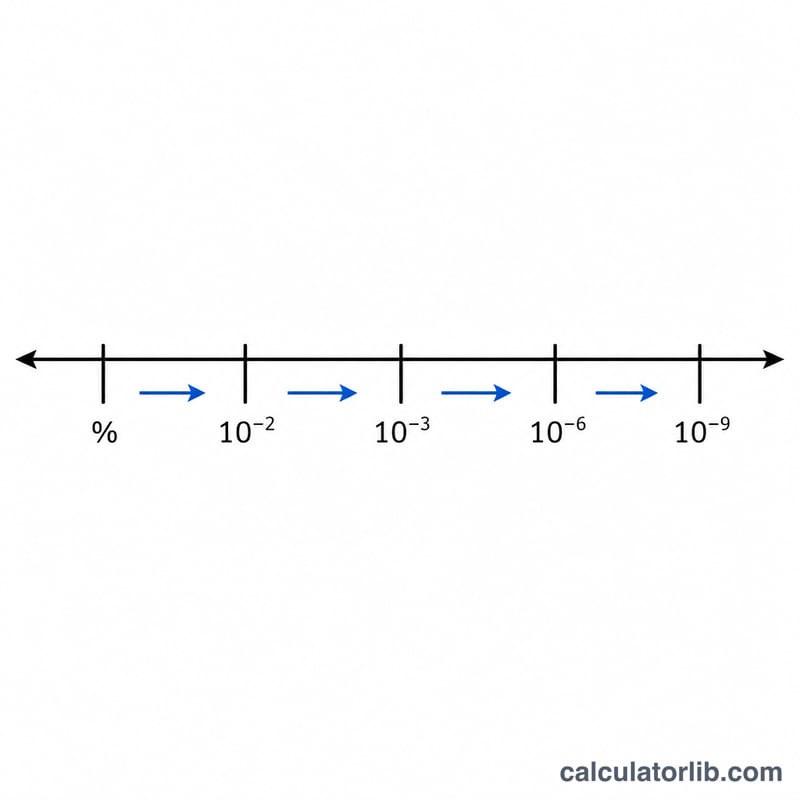
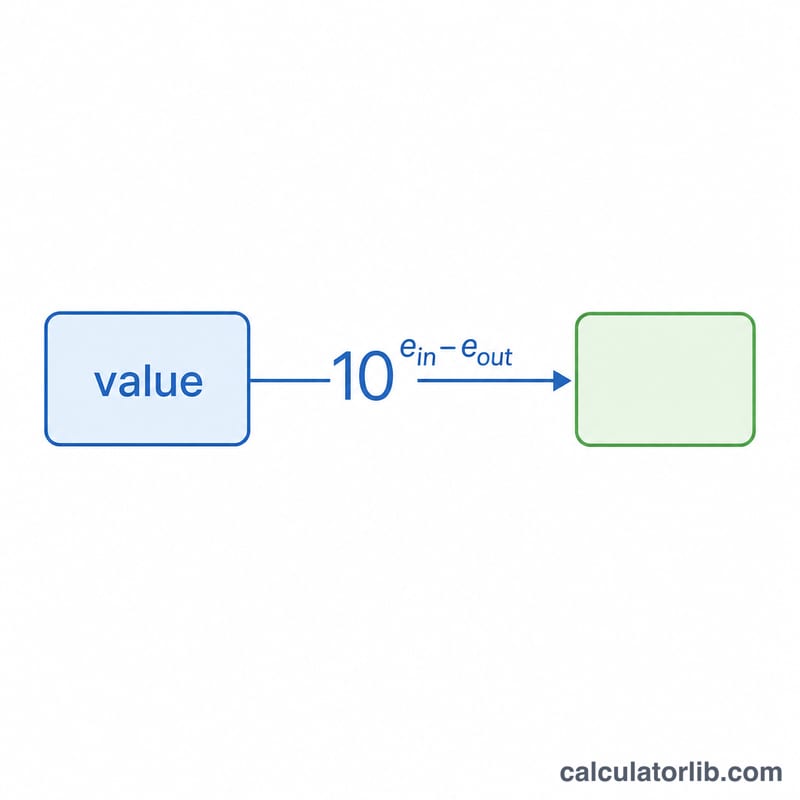
Each unit corresponds to an exponent of ten. None = \(10^{0}\), percent = \(10^{-2}\), permille = \(10^{-3}\), permyriad = \(10^{-4}\), ppm = \(10^{-6}\), ppb = \(10^{-9}\), ppt = \(10^{-12}\) and ppq = \(10^{-15}\). First the input is reduced to a canonical fraction $$f = \text{value} \times 10^{e_{\text{in}}}$$ Then any output unit U is found with $$\text{out}_U = \text{value} \times 10^{\,e_{\text{in}} - e_U}$$ Working with the difference of exponents avoids floating-point drift.
Worked example
Enter value = 500 with Input unit = ppm (e = -6). The fraction is $$f = 500 \times 10^{-6} = 0.0005$$ As percent that is \(0.0005 / 0.01 = 0.05\%\), as permille 0.5, and as a plain fraction 0.0005. Switch the same 0.05% back to ppm and you again get 500.
More Worked Examples
Every example uses the same rule. Each unit is a power of ten, written \(10^{e}\). To convert, multiply the value by ten raised to the input exponent minus the output exponent:
$$\text{Output} = \text{Value} \times 10^{\,e_{\text{in}} - e_{\text{out}}}$$The exponents are: plain fraction 0, percent −2, permille −3, permyriad (basis point) −4, ppm −6, ppb −9, ppt −12 and ppq −15.
Example 1: 25 basis points to percent and to a plain fraction
- Input unit: basis point (permyriad), so \(e_{\text{in}} = -4\).
- To percent: \(e_{\text{out}} = -2\). The exponent difference is \(-4 - (-2) = -2\).
- \(25 \times 10^{-2} = 0.25\), so 25 bp = 0.25%.
- To a plain fraction: \(e_{\text{out}} = 0\). The exponent difference is \(-4 - 0 = -4\).
- \(25 \times 10^{-4} = 0.0025\), so 25 bp = 0.0025 as a fraction.
For example, if an interest rate rises by 25 bp, it goes up by 0.25 percentage points.
Example 2: 35‰ seawater salinity to percent and ppm
- Input unit: permille, so \(e_{\text{in}} = -3\).
- To percent: \(e_{\text{out}} = -2\). The exponent difference is \(-3 - (-2) = -1\).
- \(35 \times 10^{-1} = 3.5\), so 35‰ = 3.5%.
- To ppm: \(e_{\text{out}} = -6\). The exponent difference is \(-3 - (-6) = 3\).
- \(35 \times 10^{3} = 35{,}000\), so 35‰ = 35,000 ppm.
This means a typical seawater salinity of about 35‰ is about 3.5% dissolved salts, or 35,000 ppm by mass.
Example 3: 0.5 ppb to ppt and ppm
- Input unit: ppb, so \(e_{\text{in}} = -9\).
- To ppt (parts per trillion): \(e_{\text{out}} = -12\). The exponent difference is \(-9 - (-12) = 3\).
- \(0.5 \times 10^{3} = 500\), so 0.5 ppb = 500 ppt.
- To ppm: \(e_{\text{out}} = -6\). The exponent difference is \(-9 - (-6) = -3\).
- \(0.5 \times 10^{-3} = 0.0005\), so 0.5 ppb = 0.0005 ppm.
A quick check: when you convert to a smaller unit, the number gets bigger (ppb to ppt). When you convert to a larger unit, the number gets smaller (ppb to ppm).
Definitions and Notes on Ambiguous Units
| Unit | Symbol | Meaning | Power of ten |
|---|---|---|---|
| Percent | % | Parts per hundred | \(10^{-2}\) |
| Permille | ‰ | Parts per thousand | \(10^{-3}\) |
| Permyriad / basis point | ‱, bp | Parts per ten thousand (one hundredth of a percent) | \(10^{-4}\) |
| Parts per million | ppm | Parts per million | \(10^{-6}\) |
| Parts per billion | ppb | Parts per billion (short scale, \(10^{9}\)) | \(10^{-9}\) |
| Parts per trillion | ppt | Parts per trillion (short scale, \(10^{12}\)) | \(10^{-12}\) |
| Parts per quadrillion | ppq | Parts per quadrillion (short scale, \(10^{15}\)) | \(10^{-15}\) |
Ambiguous abbreviations and number scales
“ppt” has two meanings. In this calculator, ppt means parts per trillion (\(10^{-12}\)). In some fields, though, “ppt” means parts per thousand, which is the same as permille (\(10^{-3}\)). Older ocean salinity data is a common example, where “35 ppt” means 35‰. These two meanings differ by a factor of \(10^{9}\). Check the context before you convert.
Short scale vs long scale. This calculator uses the short scale, which is standard in English. On this scale a billion is \(10^{9}\) and a trillion is \(10^{12}\). Many European languages use the long scale, where “billion” (and words like Billion or billón) means \(10^{12}\) and “trillion” means \(10^{18}\). Translated documents can mislabel ppb and ppt because of this, so the power of ten is the safest way to state a value.
Mass, volume or mole basis
ppm, ppb and similar units are dimensionless ratios, but the ratio can compare masses, volumes or amounts of substance (moles). Always state the basis:
- ppmw (or ppm by mass): for example, mg of solute per kg of sample.
- ppmv (or ppm by volume): common for gases in air. For an ideal gas, a volume fraction equals the mole fraction.
- Mole fraction: µmol/mol.
The same sample can give different numbers on a mass basis and a volume basis. This calculator only shifts the power of ten. It does not convert between bases.
mg/L and ppm
For dilute water solutions, 1 mg/L ≈ 1 ppm by mass, because one litre of such a solution has a mass of about 1 kg (1 mg/kg = 1 ppm). This shortcut breaks down for concentrated solutions, liquids other than water, and gases.
Recommended practice
The SI Brochure (BIPM) and IUPAC discourage ppm, ppb and similar terms because they are language-dependent and do not state the basis. They recommend explicit ratios with units instead, such as µg/g, ng/g, mg/kg or µmol/mol, or values written with powers of ten (for example \(2 \times 10^{-6}\)). Percent remains widely accepted.
FAQ
Is a basis point the same as permyriad? Yes. One basis point is one part per ten-thousand (\(10^{-4}\)), so 100 basis points = 1%.
What does "none / unitless" mean? It is the raw fraction itself, where 1.0 represents 100% (a whole).
Can I enter negative values? Yes. Ratios are usually non-negative, but the math scales linearly, so negatives convert correctly too.