What Is the Third Angle Calculator?
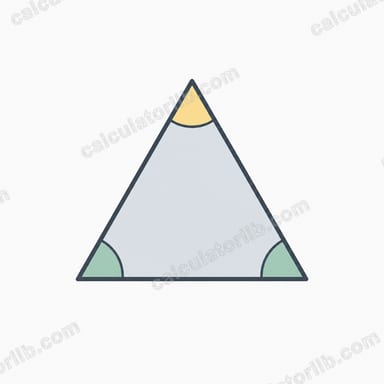
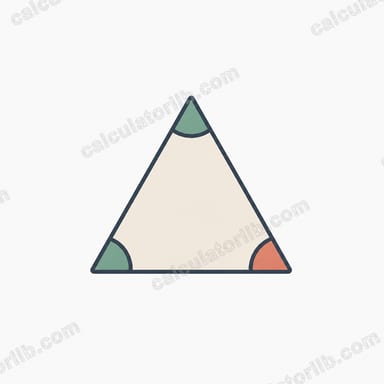
This calculator finds the missing third angle of a triangle when you already know the other two angles. It relies on one of the most fundamental rules of geometry: the interior angles of any triangle always add up to 180 degrees. This is true for every triangle — equilateral, isosceles, scalene, right, acute, or obtuse — making the tool universally applicable.
How to Use It
Enter the measures of any two known angles, A and B, in degrees. Click calculate and the tool returns angle C, the third angle. If the result is zero or negative, the two angles you entered are too large to form a valid triangle (their sum already reaches or exceeds 180°).
The Formula Explained
The governing equation is $$C = 180^{\circ} - A - B$$ Because \(A + B + C = 180^{\circ}\), rearranging for \(C\) gives 180° minus the sum of the two known angles. There is no need for trigonometry here — it is pure angle arithmetic.

Worked Example
Suppose a triangle has angles A = 60° and B = 70°. Then $$C = 180^{\circ} - 60^{\circ} - 70^{\circ} = 50^{\circ}.$$ Checking: \(60 + 70 + 50 = 180^{\circ}\), confirming a valid triangle.

Interpreting Your Result: What the Third Angle Tells You
The calculator uses the fact that the interior angles of any flat (Euclidean) triangle add up to 180°. The missing angle is \(C = 180^\circ - A - B\).
Is the result valid?
- C must be greater than 0°. If \(A + B = 180^\circ\) then C = 0°, which is degenerate and not a triangle.
- A + B must be less than 180°. If the sum is 180° or more, C is zero or negative and no triangle exists.
- A and B must each be greater than 0°.
Classifying the triangle by its angles
- Acute: all three angles are below 90°.
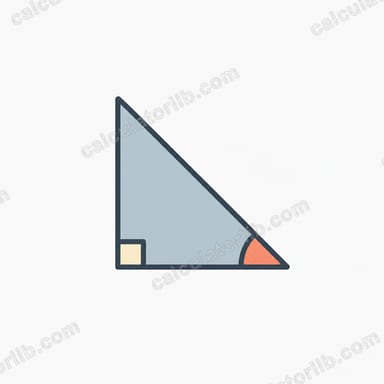
- Right: exactly one angle equals 90°. The other two are then complementary and add up to 90°.
- Obtuse: one angle is above 90°. A triangle can have at most one such angle.
Special cases
- If two angles are equal, the triangle is isosceles, and the sides opposite the equal angles are also equal.
- If all three angles are 60°, the triangle is equilateral.
- If all three angles differ, the triangle is scalene.
What angles cannot tell you
Three angles fix the shape of a triangle but not its size. Any two triangles with the same angles are similar: their sides are in the same proportion, but one can be larger than the other. To find side lengths you need at least one known side, which you can then combine with the angles using the Law of Sines.
Example Angle Combinations and Resulting Triangle Types
Each row applies \(C = 180^\circ - A - B\). The last two rows show inputs that do not form a valid triangle.
| Angle A | Angle B | Angle C = 180 − A − B | Triangle type |
|---|---|---|---|
| 60° | 60° | 60° | Equilateral (acute) |
| 90° | 45° | 45° | Right isosceles |
| 30° | 60° | 90° | Right scalene |
| 100° | 30° | 50° | Obtuse scalene |
| 50° | 50° | 80° | Acute isosceles |
| 90° | 90° | 0° | Invalid (A + B = 180°) |
| 120° | 70° | −10° | Invalid (A + B exceeds 180°) |
Worked check for the obtuse row: \(C = 180^\circ - 100^\circ - 30^\circ = 50^\circ\). Since 100° is above 90°, the triangle is obtuse, and because all three angles differ it is also scalene.
FAQ
Does this work for right triangles? Yes. If one angle is 90°, simply enter it as A or B and the calculator returns the remaining angle.
What if my answer is negative? A negative or zero result means the two angles entered cannot belong to the same triangle, since their sum must be less than 180°.
Can I use radians? This tool uses degrees. To convert, multiply radians by \(180/\pi\) before entering values.