What Is Shear Stress?
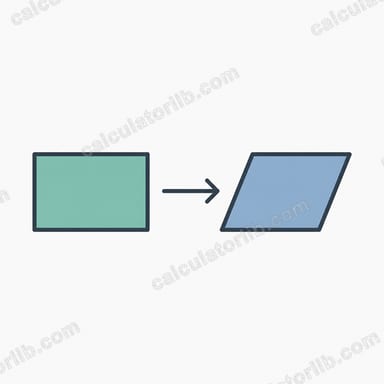
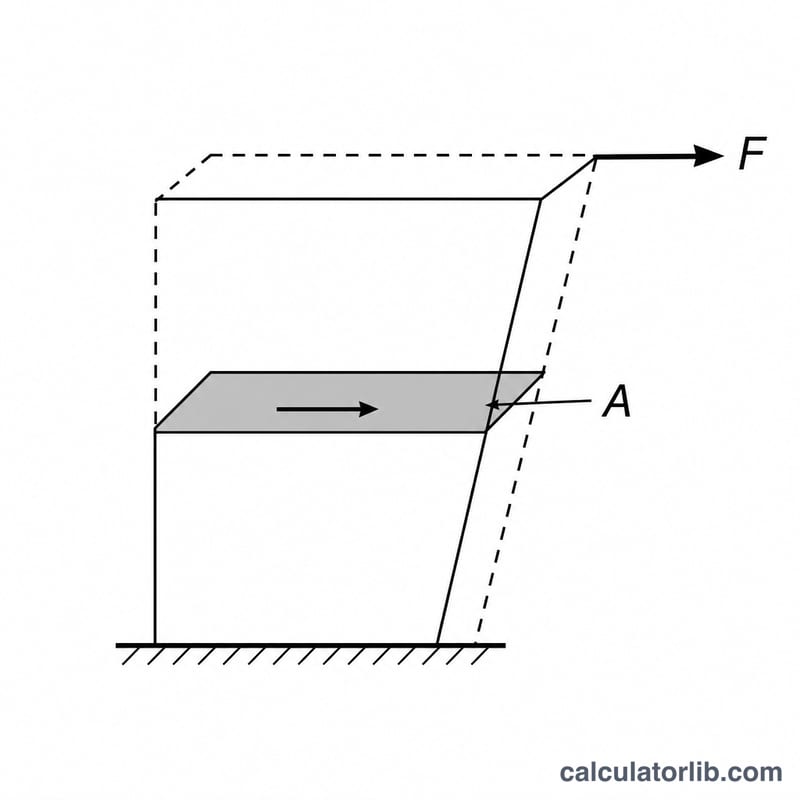
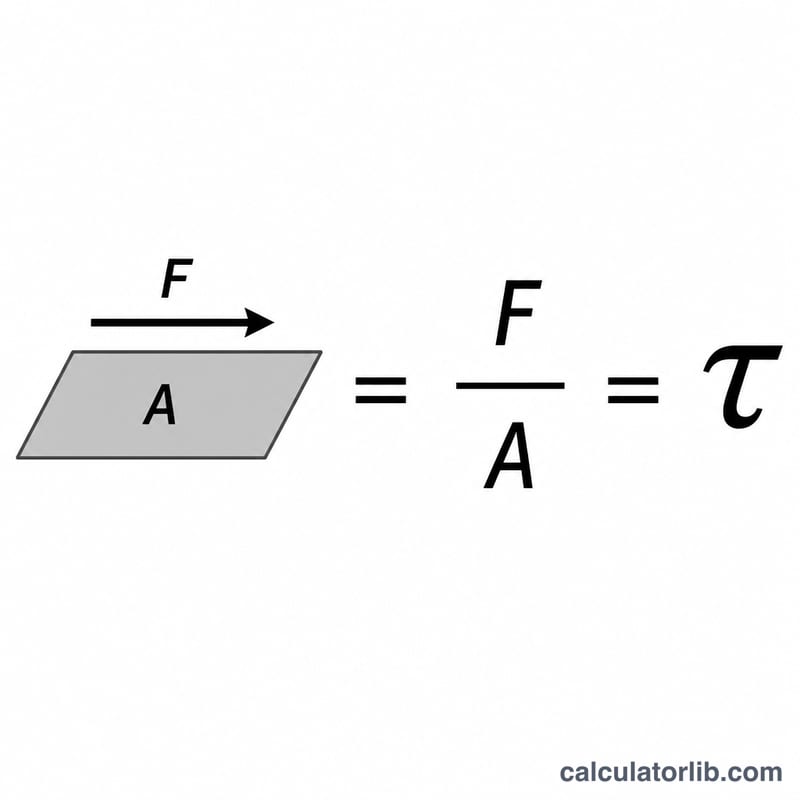
Shear stress (\(\tau\)) is the internal force per unit area that acts parallel (tangential) to the cross-section of a material, as opposed to normal stress which acts perpendicular. It arises whenever a force tends to make one part of a body slide past an adjacent part — such as a bolt under load, a riveted joint, or a beam transmitting transverse force. This calculator uses the basic average shear stress relation \(\tau = F / A\) and reports the result in pascals (Pa), kilopascals (kPa), and megapascals (MPa).
How to Use the Calculator
Enter the shear force F in newtons (N) and the cross-sectional area A in square meters (m²) over which the force acts. The tool divides force by area to give the average shear stress. If your area is in mm², convert first: \(1 \text{ mm}^2 = 1\times10^{-6} \text{ m}^2\).
The Formula Explained
The governing equation is $$\tau = \frac{F}{A}$$ where \(\tau\) is shear stress (Pa = N/m²), \(F\) is the applied shear force (N), and \(A\) is the area over which it acts (m²). Because 1 Pa is a small unit, engineering results are often expressed in MPa (\(1 \text{ MPa} = 1{,}000{,}000 \text{ Pa}\)). The calculation assumes the stress is uniformly distributed across the area — a common simplifying assumption for average shear stress.
Worked Example
Suppose a pin carries a shear force of 5,000 N across a cross-sectional area of 0.01 m². Then $$\tau = \frac{5{,}000}{0.01} = 500{,}000 \text{ Pa} = 500 \text{ kPa} = 0.5 \text{ MPa}$$ If that exceeds the material's shear strength, the pin would fail in shear.
Typical Shear Strength of Common Engineering Materials
The table lists approximate ultimate shear strengths (the stress at which a material fails in shear) for common engineering materials. Values are rounded, typical figures. Actual values vary with grade, heat treatment or temper, temperature, loading rate and the source you consult, so always use the data sheet or code value for your specific material.
| Material | Approx. ultimate shear strength (MPa) | Notes |
|---|---|---|
| Structural steel (ASTM A36) | 200–250 | Yield in shear is much lower (roughly 0.58 × tensile yield) |
| Mild (low-carbon) steel | 250–300 | Depends on grade and whether hot- or cold-worked |
| Aluminum 6061-T6 | ≈ 207 | Commonly quoted handbook value |
| Aluminum 2024-T4 | ≈ 283 | Higher-strength aircraft alloy |
| Brass | 200–300 | Wide range by alloy and temper |
| Copper | 150–220 | Annealed is at the low end; cold-worked is higher |
| Gray cast iron | 200–300 | Brittle; much weaker in tension than in compression |
| Titanium alloys (e.g., Ti-6Al-4V) | 550–650 | Varies with alloy and condition |
| Concrete | ≈ 2–8 | Strongly tied to compressive strength; codes use dedicated shear checks instead of one value |
| Wood (parallel to grain) | 5–10 | Depends on species and moisture content |
Important: these are failure (ultimate) values, not safe working stresses. Design codes and standards apply safety factors, load factors or resistance factors, so allowable stresses are considerably lower than the numbers above.
Stress Unit and Area Conversions
The calculator expects force in newtons (N) and area in square metres (m²). Convert your inputs first if they are in other units.
| Quantity | Conversion |
|---|---|
| Area | 1 mm² = 1 × 10⁻⁶ m² |
| Area | 1 cm² = 1 × 10⁻⁴ m² |
| Area | 1 in² = 6.4516 × 10⁻⁴ m² |
| Stress | 1 kPa = 1,000 Pa |
| Stress | 1 MPa = 1 × 10⁶ Pa = 1 N/mm² |
| Stress | 1 psi = 6,894.76 Pa |
| Stress | 1 ksi = 6.89476 MPa |
| Force | 1 kN = 1,000 N |
| Force | 1 lbf = 4.44822 N |
Tip: if force is in N and area is in mm², the result \(\tau = F/A\) comes out directly in MPa (N/mm²).
Interpreting Your Shear Stress Result
The calculator gives the average shear stress \(\tau = F/A\). On its own the number says little; it becomes meaningful when compared with the material's shear strength or an allowable stress.
- Allowable stress: $$\tau_{\text{allow}} = \frac{ \tau_{\text{ultimate}} }{ \text{FS} }$$ where FS is the chosen factor of safety. The applied stress should not exceed \(\tau_{\text{allow}}\).
- Factor of safety: $$\text{FS} = \frac{ \tau_{\text{failure}} }{ \tau_{\text{applied}} }$$ A value of 1 means the part is at its failure stress; higher values mean more margin.
- Average vs. maximum: \(F/A\) assumes the stress is uniform. In real members it is not. For a beam with a rectangular cross-section, the maximum shear stress at the neutral axis is \(\tau_{\max} = 1.5\,V/A\), where \(V\) is the internal shear force. For a solid circular section it is \(\tfrac{4}{3}\,V/A\).
- Single vs. double shear: in single shear (for example a bolt joining two plates) one cross-section resists the load, so \(A\) is one bolt cross-section. In double shear (a bolt through three plates) two sections resist the load, so the area is \(2A\) and the stress is halved for the same force.
Example: a force of 20,000 N acts on an area of 400 mm² = 0.0004 m². Then \(\tau = \dfrac{20{,}000\ \text{N} }{0.0004\ \text{m}^2} = \)50,000,000 Pa = 50 MPa. If the material were aluminum 6061-T6 with an ultimate shear strength of about 207 MPa, then \(\text{FS} = 207/50 \approx 4.1\).
This is general educational information. It is not a substitute for the applicable engineering design codes, which account for stress concentrations, fatigue, buckling, connection details and required safety factors.
FAQ
What units should I use? Use newtons for force and square meters for area to get stress in pascals. The calculator also converts to kPa and MPa automatically.
Is this average or maximum shear stress? This gives the average shear stress. Maximum shear stress in beams or non-uniform sections may be higher and requires the appropriate shear-distribution formula.
How do I handle double shear? In double shear (two cross-sections resist the load), use the total area of both planes for A, which halves the stress compared to single shear.