What Are Cylindrical Coordinates?
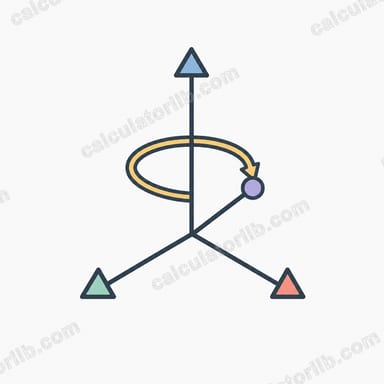
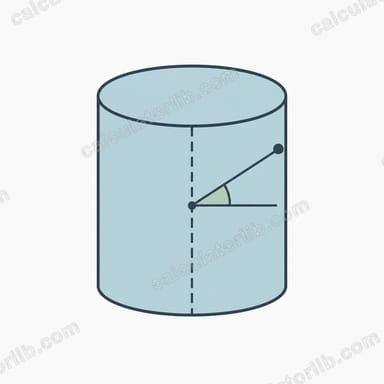
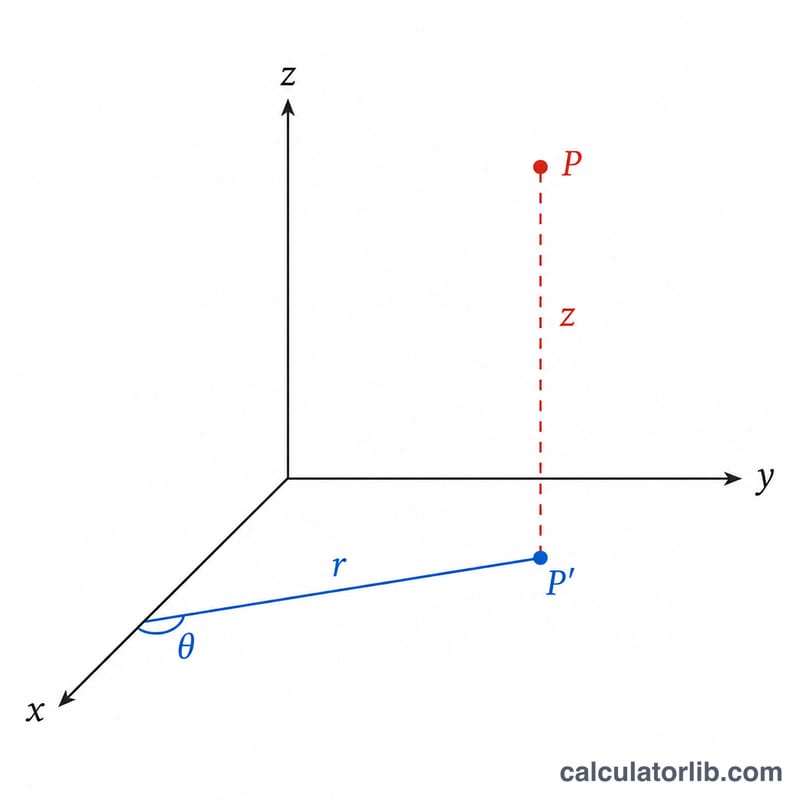
Cylindrical coordinates describe a point in 3D space using a radius r, an angle θ, and a height z. They extend 2D polar coordinates by simply keeping the Cartesian z-axis. This system is ideal for problems with rotational symmetry around an axis — pipes, cylinders, electromagnetic fields, and fluid flow.
How to Use This Calculator
Pick a conversion direction. For Cartesian → Cylindrical, enter the x, y, and z values; the tool returns r, θ (in degrees), and z. For Cylindrical → Cartesian, enter r, θ (degrees), and z to get x, y, and z. The angle is computed with the two-argument arctangent (atan2) so the correct quadrant is always chosen.
The Formula Explained
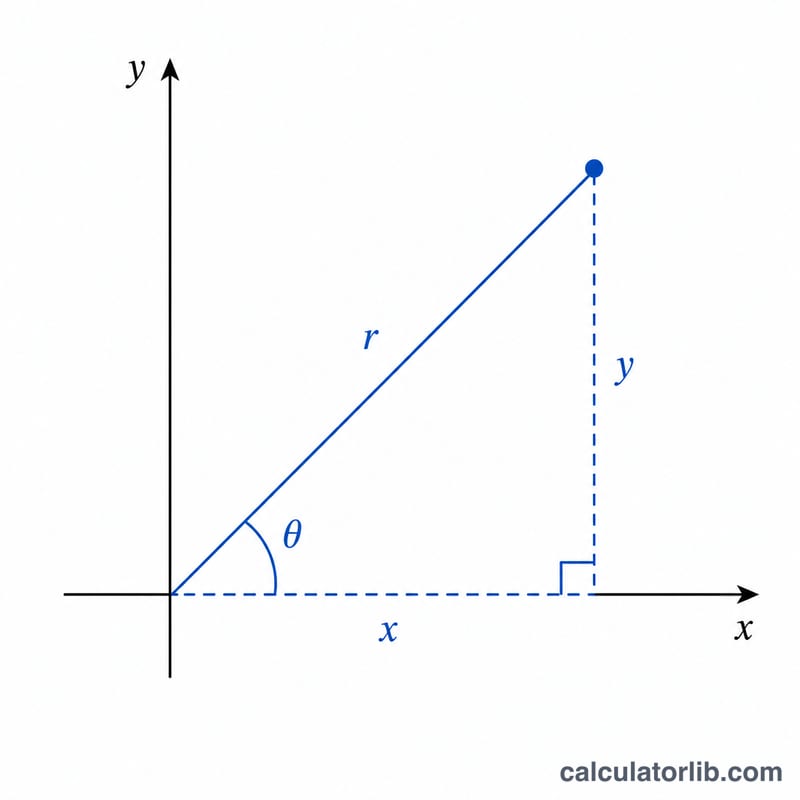
The radius is the straight-line distance from the z-axis: $$r = \sqrt{x^{2} + y^{2}}$$ The angle uses $$\theta = \operatorname{atan2}(y,\ x)$$ which returns a value between −180° and 180°, handling all four quadrants and the axes correctly. The height \(z\) is identical in both systems. The inverse is $$x = r\cos\theta \qquad y = r\sin\theta$$
Worked Example
Convert the Cartesian point (3, 4, 5). The radius is $$\sqrt{3^{2} + 4^{2}} = \sqrt{25} = 5$$ The angle is \(\operatorname{atan2}(4, 3) \approx 53.13°\). The height stays 5. So the cylindrical coordinates are (5, 53.13°, 5).
More Worked Examples: Other Quadrants and Reverse Conversion
The formulas used are \(r=\sqrt{x^2+y^2}\), \(\theta=\operatorname{atan2}(y,x)\), \(z=z\) for Cartesian to cylindrical, and \(x=r\cos\theta\), \(y=r\sin\theta\) for the reverse. The angle is given here in the range -180° to 180°. Using atan2 rather than a plain arctan(y/x) puts the angle in the correct quadrant.
Example 1: Cartesian (-2, 2, 1), second quadrant
- Radius: \(r=\sqrt{(-2)^2+2^2}=\sqrt{4+4}=\sqrt{8}=2\sqrt{2}\approx\) 2.828
- Angle: \(\theta=\operatorname{atan2}(2,-2)=135^\circ\). Since x < 0 and y > 0, the point is in quadrant II. A plain \(\arctan(2/-2)=-45^\circ\) would be wrong, because it lands in quadrant IV.
- Height: \(z=1\).
Result: \((r,\theta,z)=(2\sqrt{2},\,135^\circ,\,1)\).
Example 2: Cartesian (-3, -3, 4), third quadrant
- Radius: \(r=\sqrt{(-3)^2+(-3)^2}=\sqrt{9+9}=\sqrt{18}=3\sqrt{2}\approx 4.243\)
- Angle: \(\theta=\operatorname{atan2}(-3,-3)=-135^\circ\). Adding 360° gives the equivalent \(225^\circ\).
- Height: \(z=4\).
Result: \((r,\theta,z)\approx(4.243,\,-135^\circ,\,4)\), or equivalently \((4.243,\,225^\circ,\,4)\).
Example 3: Cylindrical (4, 120°, -2) to Cartesian
- x-coordinate: \(x=r\cos\theta=4\cos 120^\circ=4\cdot(-0.5)=-2\)
- y-coordinate: \(y=r\sin\theta=4\sin 120^\circ=4\cdot\frac{\sqrt{3}}{2}=2\sqrt{3}\approx 3.464\)
- Height: \(z=-2\).
Result: \((x,y,z)\approx(-2,\,3.464,\,-2)\). Check: \(\sqrt{(-2)^2+3.464^2}=\sqrt{4+12}=4=r\).
Common Angles and Quadrant Reference Table
For a point with radius r > 0, the Cartesian components are \(x=r\cos\theta\) and \(y=r\sin\theta\). The table gives the values per unit r.
| θ (degrees) | θ (radians) | cos θ | sin θ | Sign of x | Sign of y |
|---|---|---|---|---|---|
| 0° | 0 | 1 | 0 | + | 0 |
| 30° | π/6 | √3/2 ≈ 0.866 | 1/2 = 0.5 | + | + |
| 45° | π/4 | √2/2 ≈ 0.707 | √2/2 ≈ 0.707 | + | + |
| 60° | π/3 | 1/2 = 0.5 | √3/2 ≈ 0.866 | + | + |
| 90° | π/2 | 0 | 1 | 0 | + |
| 120° | 2π/3 | -1/2 = -0.5 | √3/2 ≈ 0.866 | − | + |
| 135° | 3π/4 | -√2/2 ≈ -0.707 | √2/2 ≈ 0.707 | − | + |
| 180° | π | -1 | 0 | − | 0 |
| -90° | -π/2 | 0 | -1 | 0 | − |
| 270° | 3π/2 | 0 | -1 | 0 | − |
Axis and origin cases
| Cartesian condition | θ from atan2(y, x) |
|---|---|
| x > 0, y = 0 | 0° |
| x = 0, y > 0 | 90° |
| x < 0, y = 0 | 180° |
| x = 0, y < 0 | -90° (equivalently 270°) |
| x = 0, y = 0 (origin or any point on the z-axis) | Undefined, since r = 0; by convention set to 0° |
Angle ranges: atan2 returns values in -180° to 180°. To convert to the 0° to 360° range, add 360° to any negative angle (for example, -90° becomes 270°). To go back, subtract 360° from any angle above 180°. Both ranges describe the same direction.
Glossary of Terms and Conventions
- r (radial distance)
- The perpendicular distance from the point to the z-axis, \(r=\sqrt{x^2+y^2}\). By the usual convention r ≥ 0.
- θ (azimuthal angle)
- The angle measured counterclockwise from the positive x-axis to the projection of the point onto the xy-plane. Physics texts and ISO 80000-2 often call this angle φ instead of θ.
- z (height or axial coordinate)
- The signed distance from the xy-plane. It is identical to the Cartesian z.
- z-axis
- The line where x = 0 and y = 0. Every point on it has r = 0, and its angle θ is undefined.
- xy-plane
- The plane where z = 0. It contains the reference direction (the +x axis) from which θ is measured.
- atan2(y, x)
- A two-argument arctangent that uses the signs of both y and x to return the angle in the correct quadrant, normally in the range -180° to 180° (-π to π radians).
Cylindrical vs. spherical coordinates
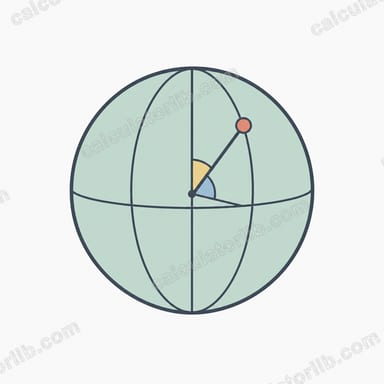
Cylindrical coordinates (r, θ, z) use the distance from the z-axis, the azimuthal angle, and the height. Spherical coordinates use the distance ρ from the origin, a polar angle measured from the +z axis, and an azimuthal angle. Conventions differ between fields. In mathematics, θ is often the azimuth and φ the polar angle. In physics and ISO 80000-2, θ is the polar angle and φ the azimuth. Always check which convention a source uses.
Multiple representations
The same point can be written in many ways, because \((r,\theta,z)\) and \((r,\theta+360^\circ k,z)\) give the same location for any integer k. Some conventions also allow negative r, with \((-r,\theta+180^\circ,z)\) describing the same point, but this calculator uses r ≥ 0.
FAQ
Why use atan2 instead of arctan(y/x)? Plain arctan loses quadrant information and is undefined when x = 0. atan2 handles every case correctly.
Are angles in degrees or radians? This calculator displays and accepts θ in degrees for convenience; internally it converts to radians for the trig functions.
What if x and y are both zero? The point is on the z-axis, so r = 0 and θ is conventionally 0°.