What is the exponential integral En(x)?
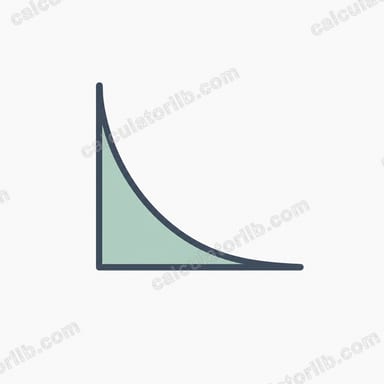
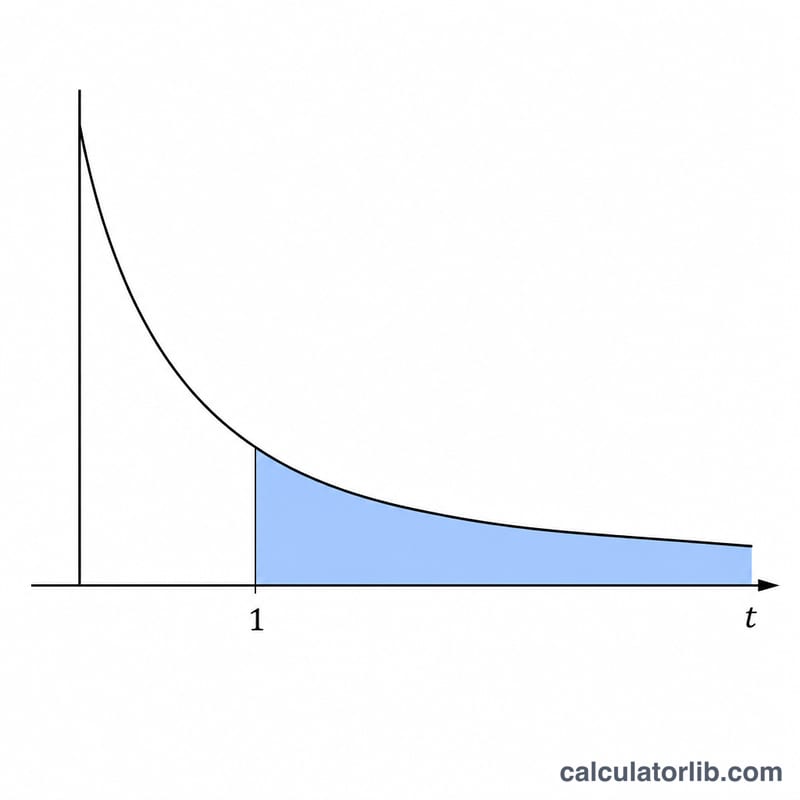
The exponential integral of order n, written En(x), is the definite integral of e-xt/tn taken from t = 1 to infinity. It appears throughout physics and engineering: radiative transfer, neutron transport, heat conduction, and antenna theory all use these functions. For a fixed integer order n it is a smooth, positive, monotonically decreasing function of x that tends to zero as x grows large. This calculator builds a full table of (x, En(x)) pairs and a line graph so you can study the curve at a glance.
How to use this calculator
Enter four numbers: the order n (a non-negative integer such as 0, 1, 2, 3), the initial value of x where the table begins, the increment (step) added to x for each successive row, and the number of repetitions (how many rows to generate). The tool computes \(x_i = \text{initialX} + i \cdot \text{step}\) for \(i = 0\) to rows-1 and evaluates En(xi) at each point. With the defaults (n = 2, start 0, step 0.02, 101 rows) you get x running from 0.00 to 2.00 in steps of 0.02.
The formula explained
En(x) is evaluated with the classic numerical recipe: $$E_{\text{n}}(x_i) = \int_{1}^{\infty} \frac{e^{-x_i\,t}}{t^{\,\text{n}}}\, dt, \qquad x_i = \text{Initial }x + i \cdot \text{Step}, \quad i = 0,\dots,\text{Rows}-1$$ for x > 1 a Lentz continued-fraction expansion converges quickly, while for 0 < x ≤ 1 a power-series expansion is used. Special values are handled directly: \(E_0(x) = e^{-x}/x\), and \(E_n(0) = 1/(n-1)\) for \(n \ge 2\). The case \(E_1(0)\) diverges to infinity and is flagged in the table rather than printed as a number.
Worked example
Take n = 2 and x = 1. Using the identity \(E_2(x) = e^{-x} - x \cdot E_1(x)\) with \(E_1(1) \approx 0.2193839\), we get $$E_2(1) = 0.3678794 - 0.2193839 = 0.1484955$$ The calculator returns the same value. At x = 0, \(E_2(0) = 1/(2-1) = 1\), and at x = 2, \(E_2(2) \approx 0.0375343\) — the curve is clearly decreasing.
Reference values of E_n(x) for common n and x
The generalized exponential integral is \(E_n(x)=\int_1^\infty \frac{e^{-xt}}{t^n}\,dt\). The table lists values (rounded) for orders n = 0 to 3. Values for n ≥ 2 follow from the recurrence in the next section.
| n | x = 0.5 | x = 1 | x = 2 | x = 5 |
|---|---|---|---|---|
| 0 | 1.2130613 | 0.3678794 | 0.0676676 | 0.0013476 |
| 1 | 0.5597736 | 0.2193839 | 0.0489005 | 0.0011483 |
| 2 | 0.3266439 | 0.1484955 | 0.0375343 | 0.0009965 |
| 3 | 0.2216044 | 0.1096920 | 0.0301334 | 0.0008778 |
For example, the calculator should give \(E_1(1)\approx\) 0.2193839.
Behavior at x = 0
- \(E_1(0)\) diverges (to +∞), so x = 0 cannot be tabulated for n = 1.
- For n ≥ 2, \(E_n(0)=\frac{1}{n-1}\): \(E_2(0)=1\), \(E_3(0)=0.5\).
- For n = 0, \(E_0(x)=\frac{e^{-x}}{x}\), which also diverges at x = 0.
Key identities and recurrence relations
| Property | Formula |
|---|---|
| Recurrence (n ≥ 1) | \(n\,E_{n+1}(x)=e^{-x}-x\,E_n(x)\) |
| Derivative | \(E_n'(x)=-E_{n-1}(x)\) |
| Order zero | \(E_0(x)=\dfrac{e^{-x}}{x}\) |
| Value at zero (n ≥ 2) | \(E_n(0)=\dfrac{1}{n-1}\) |
| Large-x asymptotic | \(E_n(x)\sim \dfrac{e^{-x}}{x+n}\) |
| Series for n = 1 | \(E_1(x)=-\gamma-\ln x-\sum_{k=1}^{\infty}\dfrac{(-x)^k}{k\cdot k!}\) |
Here \(\gamma\approx0.5772157\) is the Euler–Mascheroni constant.
Worked check of the recurrence
Using \(E_1(1)=0.2193839\) and \(e^{-1}=0.3678794\):
$$E_2(1)=e^{-1}-1\cdot E_1(1)=0.3678794-0.2193839=0.1484955$$
and with n = 2:
$$E_3(1)=\frac{e^{-1}-1\cdot E_2(1)}{2}=\frac{0.3678794-0.1484955}{2}=0.1096920$$
Forward recurrence loses accuracy for large x, because \(e^{-x}\) and \(x\,E_n(x)\) nearly cancel. Good software uses series or continued fractions instead.
Interpreting the table and graph
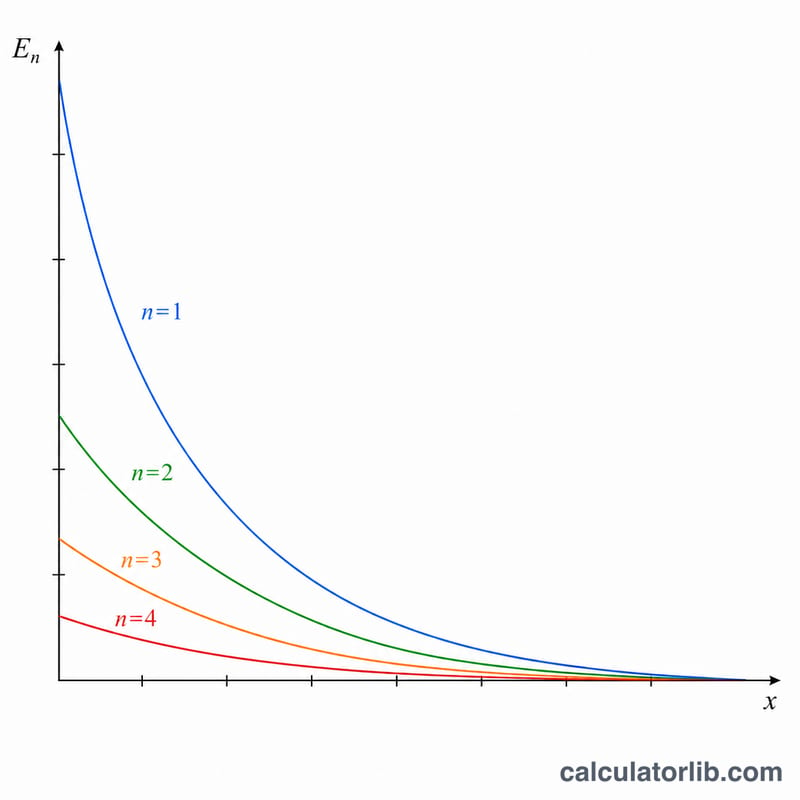
- Monotonic decrease: since \(E_n'(x)=-E_{n-1}(x)<0\) for x > 0, every curve falls as x grows.
- Ordering by n: for x > 0 and \(t>1\), \(t^{-n}\) shrinks as n grows, so higher orders lie below lower ones: \(E_0>E_1>E_2>E_3\) at the same x. The table above shows this.
- Near x = 0: \(E_1(x)\) diverges logarithmically, roughly \(-\ln x-\gamma\), so the n = 1 curve rises steeply on the left. For n ≥ 2 the curve stays finite and approaches \(1/(n-1)\).
- Large x: the curves decay roughly like \(e^{-x}/(x+n)\). On a linear axis they quickly look flat near zero, and a logarithmic y-axis would show them as nearly straight lines.
- Positive outputs: for x > 0 the integrand is positive, so every tabulated value is positive.
- Applications: \(E_n\) appears in radiative transfer (flux and intensity through a plane-parallel atmosphere as a function of optical depth, usually \(E_2\) and \(E_3\)) and in neutron transport and shielding calculations.
- Why x ≤ 0 is not supported: at x = 0, \(E_1(0)\) is infinite, so that row is flagged rather than given a number. For x < 0 the defining integral diverges, and the function exists only by analytic continuation (complex-valued for n = 1). A table with a positive start value and step avoids these cases. If the step is negative, make sure every x stays above 0.
FAQ
Can n be a fraction? No. This tool is defined only for non-negative integer orders; non-integer n lies outside its domain.
Why does a row say "diverges"? \(E_1(0)\) is mathematically infinite (the integral does not converge there), so that single row is marked as divergent instead of showing a misleading number.
What about negative x? For \(n \ge 1\) the integral generally diverges for x < 0, so the calculator only returns finite values for \(x \ge 0\).