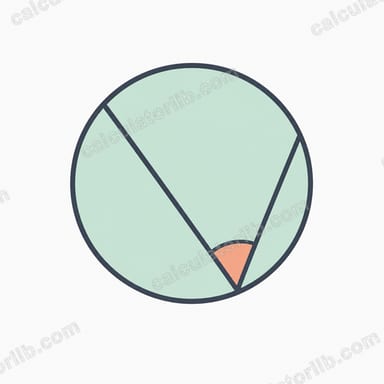
What Is an Inscribed Angle?
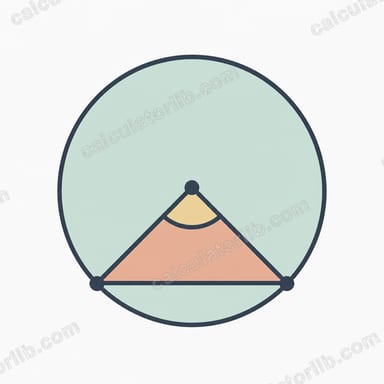
An inscribed angle is an angle formed by two chords of a circle that share a common endpoint (the vertex) on the circle. The Inscribed Angle Theorem states that an inscribed angle is always exactly half of the central angle that subtends the same arc. This calculator instantly converts a central angle into its corresponding inscribed angle.

How to Use the Calculator
Enter the central angle in degrees — the angle measured at the center of the circle between the two radii drawn to the arc's endpoints. The calculator divides that value by 2 to give the inscribed angle that opens onto the same arc from a point on the circumference.
The Formula Explained
The relationship is simple and exact: $$\theta_{\text{inscribed}} = \frac{\text{Central Angle}}{2}$$. Because every inscribed angle that subtends the same arc has the same measure, you only need the central angle to find them all. A direct consequence is Thales' theorem: an angle inscribed in a semicircle (central angle 180°) is always a right angle (90°).

Worked Example
Suppose an arc has a central angle of 120°. The inscribed angle subtending the same arc is $$120 \div 2 = 60°$$ Any point you pick on the major arc will see the chord under this same \(60°\) angle.
Common Central Angles and Their Inscribed Angles
The inscribed angle theorem says an inscribed angle is half the central angle that subtends the same arc: \(\theta_{\text{inscribed}} = \frac{ \theta_{\text{central}} }{2}\). The table lists common values and the fraction of the full circle (360°) that each arc covers.
| Central angle | Inscribed angle | Arc as fraction of circle |
|---|---|---|
| 30° | 15° | 1/12 |
| 45° | 22.5° | 1/8 |
| 60° | 30° | 1/6 |
| 90° | 45° | 1/4 |
| 120° | 60° | 1/3 |
| 180° | 90° | 1/2 (semicircle) |
| 240° | 120° | 2/3 |
| 270° | 135° | 3/4 |
| 360° | 180° | 1 (full circle) |
Example: for a central angle of 90°, \(\theta_{\text{inscribed}} = \frac{90^\circ}{2} = 45^\circ\).
Interpreting Your Result
- Central angle under 180°: the arc is a minor arc and the inscribed angle is acute (under 90°).
- Central angle exactly 180°: the chord is a diameter and the inscribed angle is exactly 90°. This is Thales' theorem: any angle inscribed in a semicircle is a right angle.
- Central angle over 180°: the arc is a major arc and the inscribed angle is obtuse (between 90° and 180°).
Since the central angle ranges from 0° to 360°, the inscribed angle always falls between 0° and 180°.
The opposite arc: a chord is seen at one angle from points on one arc and at the supplementary angle from points on the other arc. If the inscribed angle from one side is \(\alpha\), then from the opposite arc it is \(180^\circ - \alpha\). For example, a 100° central angle gives an inscribed angle of 50° from points on the major arc, and \(180^\circ - 50^\circ = 130^\circ\) from points on the minor arc. This is why opposite angles of a cyclic quadrilateral (one whose four vertices lie on a circle) add up to 180°.
FAQ
Does the inscribed angle change if I move the vertex? No — as long as the vertex stays on the same arc and subtends the same chord, the inscribed angle is constant.
What is the inscribed angle for a diameter? A diameter has a central angle of 180°, so the inscribed angle is 90° — a right angle.
Can the central angle exceed 360°? No. A central angle ranges from 0° to 360°, so inscribed angles range from 0° to 180°.