What is Maximum Heart Rate?
Maximum heart rate (MHR) is the highest number of times your heart can beat in one minute during all-out physical effort. It is a key reference point for setting safe and effective exercise intensities. Because measuring it directly requires a maximal stress test, most people estimate it from their age using a simple formula.
How to use this calculator
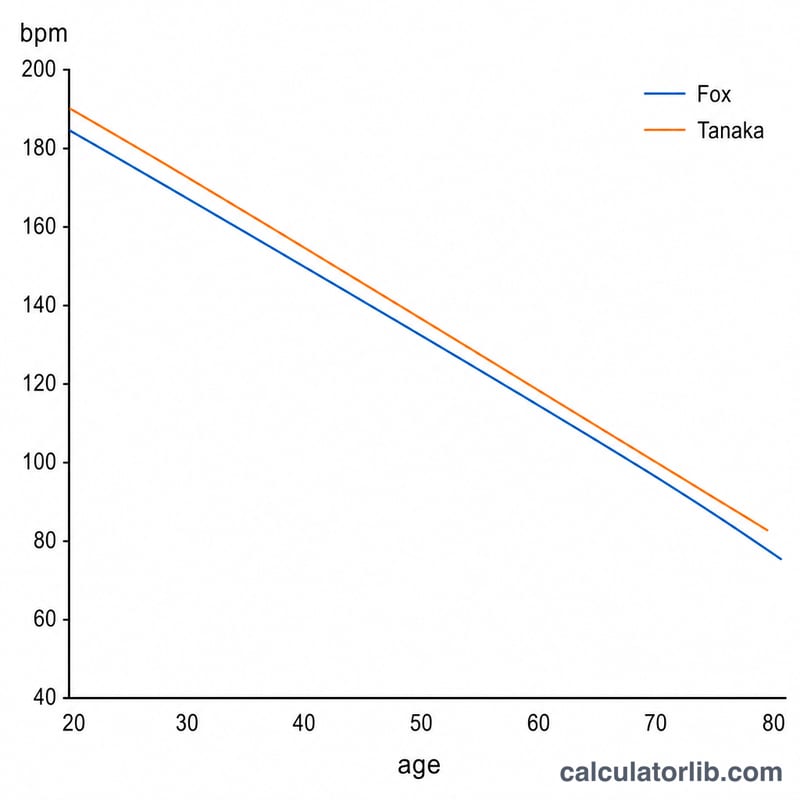
Enter your age in years and choose a formula. The Fox formula (\(220 - \text{age}\)) is the most widely known and quick to remember. The Tanaka formula (\(208 - 0.7 \times \text{age}\)) is based on a large meta-analysis and tends to be more accurate, particularly for adults over 40. The calculator returns your estimated MHR plus common training zones at 50%, 70%, and 85% of that value.
The formula explained
Fox: $$\text{MHR} = 220 - \text{age}$$ Tanaka: $$\text{MHR} = 208 - 0.7 \times \text{age}$$ Training zones are calculated as a percentage of MHR. For example, the moderate "fat-burn" zone is roughly 70% of MHR, while vigorous cardio sits around 85%.
Worked example
For a 40-year-old using the Fox formula: $$\text{MHR} = 220 - 40 = 180 \text{ bpm}$$ The 70% zone is \(180 \times 0.70 = 126\) bpm, and the 85% zone is \(180 \times 0.85 = 153\) bpm. Using Tanaka instead: $$208 - 0.7 \times 40 = 208 - 28 = 180 \text{ bpm}$$
Fox vs Tanaka MHR by Age
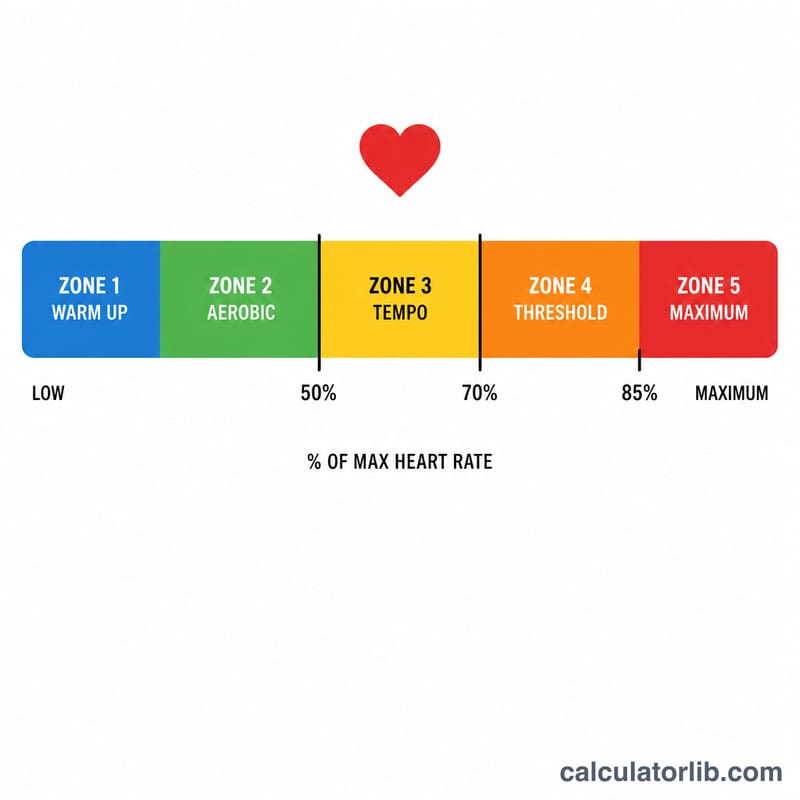
The Fox formula is \(\text{MHR} = 220 - \text{age}\). The Tanaka formula is \(\text{MHR} = 208 - 0.7 \times \text{age}\). The two lines cross at age 40, where both give 180 bpm. Fox gives the higher value below 40, and Tanaka gives the higher value above 40.
| Age (years) | Fox MHR (bpm) | Tanaka MHR (bpm) | Difference |
|---|---|---|---|
| 20 | 200 | 194 | Fox higher by 6 |
| 30 | 190 | 187 | Fox higher by 3 |
| 40 | 180 | 180 | Equal (0) |
| 50 | 170 | 173 | Tanaka higher by 3 |
| 60 | 160 | 166 | Tanaka higher by 6 |
| 70 | 150 | 159 | Tanaka higher by 9 |
Example for age 70 with Tanaka: \(208 - 0.7 \times 70 = 208 - 49 = 159\) bpm. With Fox: \(220 - 70 = 150\) bpm. Fox falls by 1 bpm per year of age, while Tanaka falls by 0.7 bpm per year, so the gap widens with age.
Heart Rate Training Zones Reference
Zones are expressed as a percentage of estimated MHR. Naming and boundaries vary by source (for example the American Heart Association, the American College of Sports Medicine, and various coaching systems), so treat the labels below as one common scheme rather than a universal standard.
| Zone (% of MHR) | Common name | Typical perceived exertion |
|---|---|---|
| 50–60% | Very light / warm-up | Very easy; you can talk or sing without effort |
| 60–70% | Light / aerobic base | Comfortable; full conversation is easy |
| 70–80% | Moderate aerobic | Breathing is deeper; you can speak in short sentences |
| 80–90% | Hard / threshold | Uncomfortable; you can say only a few words at a time |
| 90–100% | Maximum | Very hard; sustainable only for short efforts |
This calculator reports heart rates at the 50%, 70% and 85% cut points of the estimated MHR. These roughly match the boundaries used in AHA/ACSM-style moderate and vigorous intensity ranges, and they do not match every zone scheme in the table above.
Interpreting Your Result
- It is an estimate. Both formulas describe population averages. For an individual, the actual MHR typically differs from the estimate by a standard deviation of roughly 10–12 bpm. Two people of the same age can therefore have maximum heart rates that differ by 20 bpm or more.
- Many factors affect real MHR. These include genetics, body size, and the type of exercise. Medications such as beta-blockers lower the achievable heart rate, so age-based estimates may not apply to people who take them.
- MHR declines with age. Fox models a decline of 1 bpm per year and Tanaka about 0.7 bpm per year. Tanaka was derived from a larger analysis that included older adults, which is why the two formulas diverge at older ages.
- MHR is not a fitness measure. A higher or lower MHR does not mean you are more or less fit. Training does not substantially change it. Fitness shows up more in resting heart rate, in how quickly the heart rate recovers, and in the pace you can sustain at a given heart rate.
- Zones are guidelines. Under AHA and ACSM intensity categories, moderate intensity is roughly 50–70% of MHR and vigorous intensity roughly 70–85%. Perceived exertion, the talk test, or a measured maximum from a supervised test can give a better picture than any formula.
This is general information, not medical advice.
FAQ
Which formula should I use? Tanaka is generally considered more accurate across ages; Fox is fine for a fast estimate. Both are population averages and can be off by ±10–12 bpm for any individual.
Is this a substitute for a medical test? No. These are estimates only. For precise figures or if you have a heart condition, consult a healthcare professional.
How do I use the zones? Aim for 50–70% for general fitness and fat burning, and 70–85% for improving cardiovascular endurance.