What this calculator does
The Multiplying Negative Numbers Calculator multiplies any two numbers — positive, negative, whole, or decimal — and clearly shows the resulting sign. It is a quick way to check homework or to understand why the answer is positive or negative when negative signs are involved.
How to use it
Enter the first number and the second number, then read the product. The result table tells you how many of your factors were negative and whether the product is positive or negative. You can enter decimals such as -2.5 as well as whole numbers.
The formula explained
Multiplication of magnitudes is unchanged by signs — you simply multiply the absolute values. The sign is decided by counting the negative factors:
- \((-a) \times (-b) = ab\) — two negatives give a positive.
- \((-a) \times b = -(ab)\) — one negative gives a negative.
- \(a \times b = ab\) — no negatives stay positive.
In general, the sign equals \((-1)\) raised to the number of negative factors: an even count yields a positive result, an odd count yields a negative result.

Worked example
Multiply \(-6 \times -7\). The magnitudes give $$6 \times 7 = 42.$$ There are two negative factors (an even count), so the product is positive: \(-6 \times -7 = 42\). By contrast, \(-6 \times 7\) has one negative factor, so the result is \(-42\).

Sign Rules Quick Reference
The sign of a product depends only on how many negative factors it contains. Multiply the absolute values, then apply the sign using the table below. These rules hold for all real numbers.
| Case | Sign of product | Example |
|---|---|---|
| (+) × (+) | + | \(3 \times 6 = 18\) |
| (+) × (−) | − | \(3 \times (-6) = -18\) |
| (−) × (+) | − | \((-3) \times 6 = -18\) |
| (−) × (−) | + | \((-3) \times (-6) = 18\) |
| 3 negative factors (odd count) | − | \((-2) \times (-3) \times (-4) = -24\) |
| 4 negative factors (even count) | + | \((-1) \times (-2) \times (-3) \times (-4) = 24\) |
| Any factor is zero | 0 (neither positive nor negative) | \((-7) \times 0 = 0\) |
Short rule: an odd number of negative factors gives a negative product; an even number gives a positive product. If any factor is zero, the product is zero regardless of signs.
Example with the calculator: \((-12) \times (-5) = 60\), which is 60.
Comparing Different Sign Scenarios
The table below keeps the same magnitudes while changing signs, showing that only the count of negative factors affects the sign of the result.
| Inputs | Negative factors | Product | Sign of result |
|---|---|---|---|
| \(4 \times 5\) | 0 | 20 | Positive |
| \(-4 \times 5\) | 1 | -20 | Negative |
| \(4 \times -5\) | 1 | -20 | Negative |
| \(-4 \times -5\) | 2 | 20 | Positive |
| \(-2.5 \times 4\) | 1 | -10 | Negative |
| \(-2.5 \times -4\) | 2 | 10 | Positive |
| \(0 \times -9\) | 1 | 0 | Zero (no sign) |
Notice that swapping the order of the factors does not change the product (multiplication is commutative), and that decimals follow exactly the same sign rules as whole numbers. For example, \(-2.5 \times 4 = -(2.5 \times 4) = -10\).
FAQ
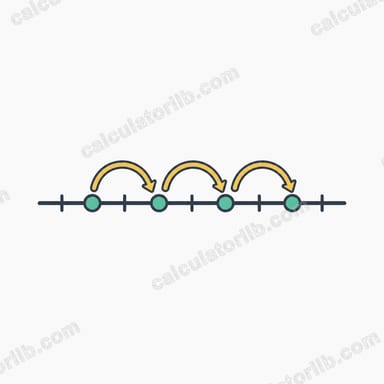
Why do two negatives make a positive? Multiplying by a negative reverses direction on the number line; reversing twice returns to the original direction, which is positive.
What if one number is zero? Any number times zero is zero, which has no sign.
Does it work with decimals? Yes — enter values like -3.2 and the calculator multiplies and signs them correctly.