What is the Period and Frequency Calculator?
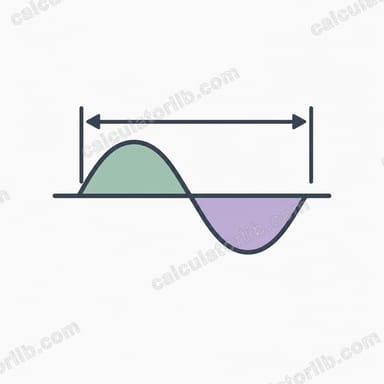
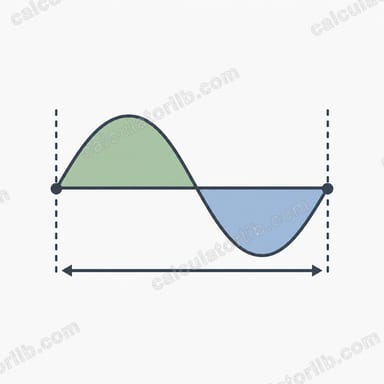
This calculator converts between two fundamental properties of any repeating motion or wave: the period (T) and the frequency (f). The period is the time it takes to complete one full cycle, measured in seconds. The frequency is how many cycles happen each second, measured in hertz (Hz). They are exact reciprocals of one another, so knowing one immediately gives you the other.
How to use it
Pick whether you want to find the period or the frequency. If you choose Period (from frequency), enter the frequency in hertz and the tool returns the period in seconds. If you choose Frequency (from period), enter the period in seconds and it returns the frequency in hertz. The result panel also shows the angular frequency \(\omega = 2\pi f\) in radians per second, which is handy for oscillation and simple harmonic motion problems.
The formula explained
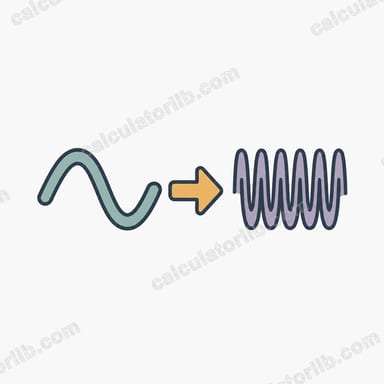
The core relationship is $$T = \frac{1}{f}$$ and equivalently $$f = \frac{1}{T}$$ Because they are reciprocals, doubling the frequency halves the period. The angular frequency adds a factor of \(2\pi\) to express the rate in radians: $$\omega = 2\pi f = \frac{2\pi}{T}$$

Worked example
A musical note A4 vibrates at 440 Hz. Its period is $$T = \frac{1}{440} \approx 0.002273 \text{ seconds}$$ or about 2.27 milliseconds. Conversely, if a pendulum has a period of 2 seconds, its frequency is $$f = \frac{1}{2} = 0.5 \text{ Hz}$$ and its angular frequency is $$\omega = 2\pi \times 0.5 \approx 3.1416 \text{ rad/s}$$
Frequency and Period Unit Conversion Table
Period and frequency are reciprocals of one another, so every frequency scale has a matching time scale: \(T = 1/f\) and \(f = 1/T\), with \(T\) in seconds and \(f\) in hertz (Hz, equal to one cycle per second). Angular frequency follows as \(\omega = 2\pi f = 2\pi / T\) in radians per second. The two tables below give the SI multiples used on each side of that relationship.
Frequency units
| Unit | Symbol | Value in hertz | Reciprocal period scale |
|---|---|---|---|
| hertz | Hz | 1 Hz | 1 Hz ↔ 1 s |
| kilohertz | kHz | 103 Hz | 1 kHz ↔ 1 ms |
| megahertz | MHz | 106 Hz | 1 MHz ↔ 1 µs |
| gigahertz | GHz | 109 Hz | 1 GHz ↔ 1 ns |
| terahertz | THz | 1012 Hz | 1 THz ↔ 1 ps |
| revolutions per minute | RPM (min-1) | 1 RPM = 1/60 Hz | RPM = f × 60; T = 60/RPM seconds |
| radians per second | rad/s | 1 rad/s = 1/(2π) Hz | ω = 2πf = 2π/T |
Time (period) units
| Unit | Symbol | Value in seconds | Reciprocal frequency scale |
|---|---|---|---|
| second | s | 1 s | 1 s ↔ 1 Hz |
| millisecond | ms | 10-3 s | 1 ms ↔ 1 kHz |
| microsecond | µs | 10-6 s | 1 µs ↔ 1 MHz |
| nanosecond | ns | 10-9 s | 1 ns ↔ 1 GHz |
| picosecond | ps | 10-12 s | 1 ps ↔ 1 THz |
Worked conversion
A 2.4 GHz Wi-Fi carrier: first express the frequency in hertz, then take the reciprocal.
$$T = \frac{1}{f} = \frac{1}{2.4 \times 10^{9}\ \text{Hz}} = 4.1667 \times 10^{-10}\ \text{s} = 0.4167\ \text{ns}$$Because 1 GHz pairs with 1 ns, the shortcut is to read the prefix pair directly: 2.4 GHz is \(1/2.4 = 0.4167\) of a nanosecond. Going the other way, a 20 ms period gives \(f = 1/0.020 = 50\) Hz, and the same oscillation has an angular frequency of \(\omega = 2\pi \times 50 \approx 314.16\) rad/s. Keep the units consistent before dividing — mixing milliseconds with hertz is the single most common source of error in these conversions.
Typical Frequencies and Periods of Common Oscillations
The values below are nominal reference figures drawn from widely documented physics, audio and radio conventions — they are not outputs of this calculator and not measurements of any specific device. Real hardware varies: mains frequency drifts by a fraction of a hertz, radio channels are spread across bands, and musical tuning references differ between orchestras. Each row shows the frequency \(f\), the matching period \(T = 1/f\), and the angular frequency \(\omega = 2\pi f\).
| Oscillation | Frequency f | Period T = 1/f | Angular frequency ω = 2πf |
|---|---|---|---|
| Seconds pendulum (one swing per second, period of a full cycle) | 0.5 Hz | 2 s | ≈ 3.14 rad/s |
| Lower limit of nominal human hearing | 20 Hz | 50 ms | ≈ 126 rad/s |
| Mains power, 50 Hz regions (most of Europe, Asia, Africa, Australia) | 50 Hz | 0.02 s (20 ms) | ≈ 314.16 rad/s |
| Mains power, 60 Hz regions (North America, parts of South America, Japan east/west split) | 60 Hz | ≈ 16.67 ms | ≈ 376.99 rad/s |
| Musical note A4 at concert-pitch A = 440 Hz (ISO 16) | 440 Hz | 0.0022727 s (≈ 2.273 ms) | ≈ 2764.6 rad/s |
| Upper limit of nominal human hearing | 20 kHz | 50 µs | ≈ 1.257 × 10⁵ rad/s |
| Quartz watch tuning-fork crystal (215 Hz) | 32,768 Hz | ≈ 30.52 µs | ≈ 2.059 × 10⁵ rad/s |
| AM broadcast carrier, mid-band | ≈ 1 MHz | 1 µs | ≈ 6.283 × 10⁶ rad/s |
| FM broadcast carrier, mid-band | ≈ 100 MHz | 10 ns | ≈ 6.283 × 10⁸ rad/s |
| Wi-Fi 2.4 GHz band carrier | 2.4 GHz | ≈ 0.417 ns (417 ps) | ≈ 1.508 × 10¹⁰ rad/s |
| Visible green light, ≈ 550 nm in vacuum | ≈ 5.45 × 10¹⁴ Hz | ≈ 1.83 fs | ≈ 3.42 × 10¹⁵ rad/s |
Note that the human audible range inverts: the lowest audible frequency has the longest period (20 Hz → 50 ms), while the highest has the shortest (20 kHz → 50 µs). Individual hearing, especially at the top of the range, narrows with age. The 50 Hz versus 60 Hz split is a national-grid convention rather than a physical constant, so check the standard that applies where your equipment is used before sizing transformers, timing circuits or motor speeds. The green-light row is a single wavelength picked from the middle of the visible band, computed from \(f = c/\lambda\); any other colour gives a different figure.
Use the calculator above when you need an exact figure for your own value rather than one of these benchmarks — enter either \(f\) or \(T\) and the reciprocal plus \(\omega\) follow directly.
FAQ
What units does this use? Frequency is in hertz (cycles per second) and period is in seconds. For kilohertz multiply Hz by 1000; for milliseconds divide seconds by 1000.
Can frequency be zero? No. A frequency of zero would mean an infinite period (no oscillation), so the tool guards against division by zero.
What is angular frequency for? Angular frequency \(\omega\) appears in trigonometric descriptions of waves like \(x(t) = A\cdot\sin(\omega t)\), making the math of oscillations cleaner.