What Is the Diameter of a Circle?
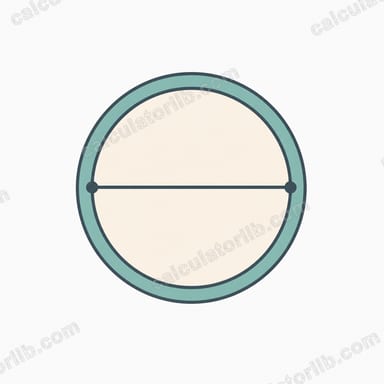
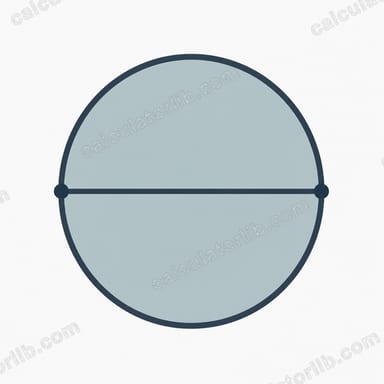
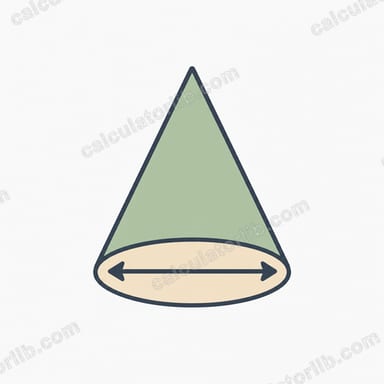
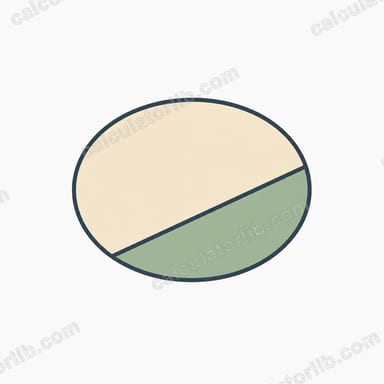
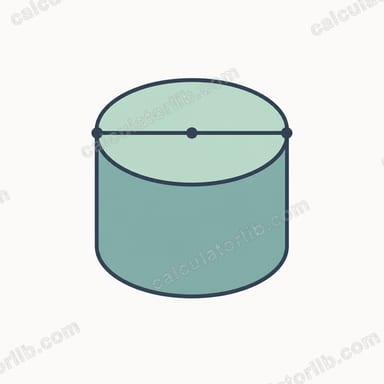
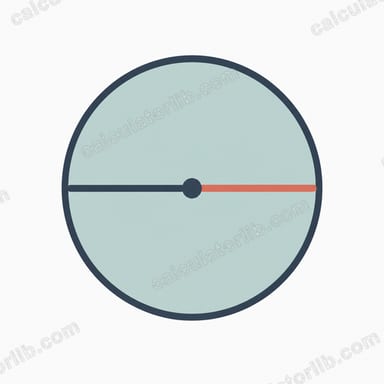
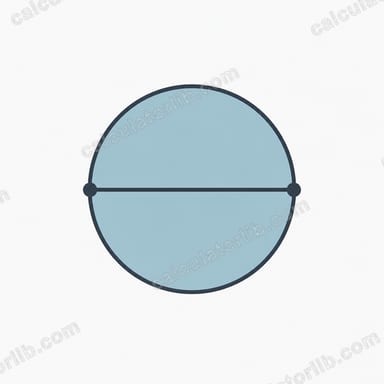
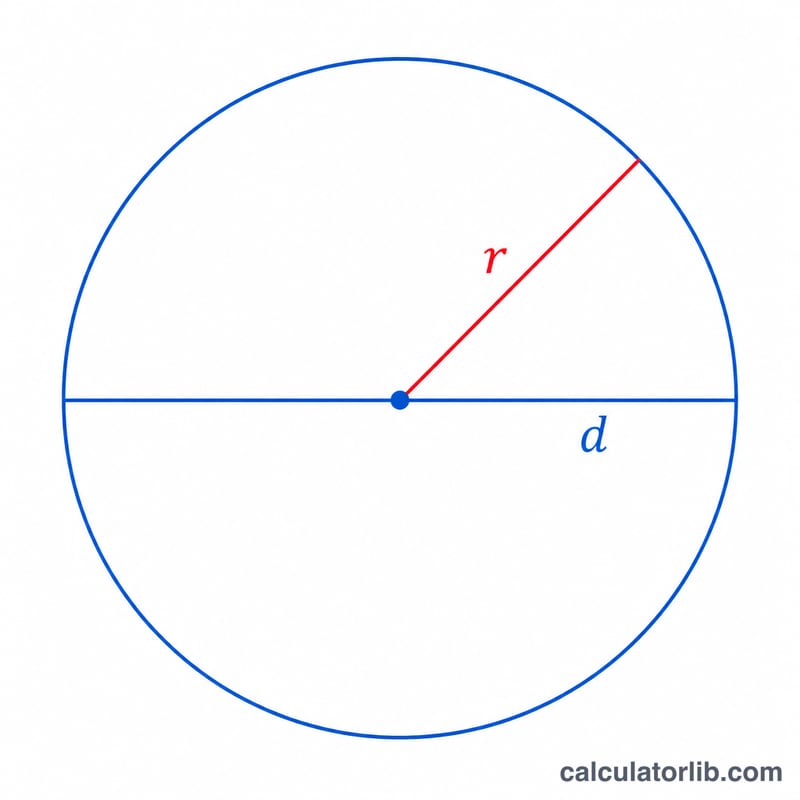
The diameter is the straight-line distance across a circle passing through its center — the longest chord you can draw. It equals exactly twice the radius. This calculator finds the diameter from whichever measurement you already know: the radius, the circumference (distance around), or the area (space inside).
How to Use This Calculator
Pick the value you know from the dropdown — radius, circumference, or area — then type that number into the value box. The calculator instantly returns the diameter along with the matching radius, circumference, and area so you have a full picture of the circle in any units (cm, in, m, etc.).
The Formula Explained
The relationships all stem from the constant \(\pi\) (≈ 3.14159):
- From radius: $$d = 2r$$
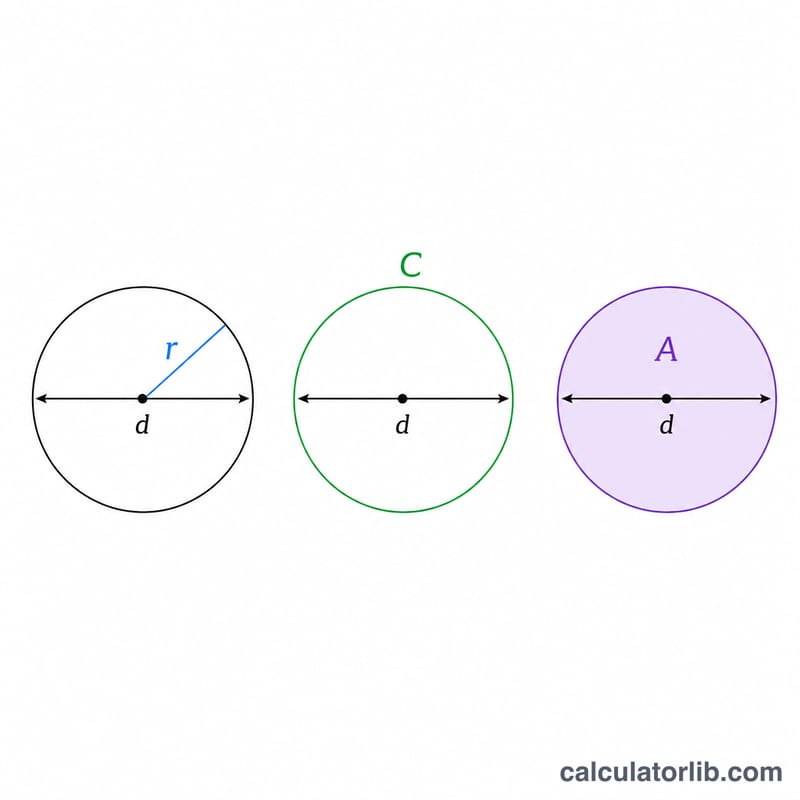
- From circumference: since \(C = \pi d\), we rearrange to $$d = \frac{C}{\pi}$$
- From area: since \(A = \pi r^2\) and \(r = d/2\), solving gives $$d = 2 \times \sqrt{\frac{A}{\pi}}$$
Worked Example
Suppose a circle has a circumference of 31.4159 cm. Dividing by \(\pi\) gives $$d = \frac{31.4159}{3.14159} \approx 10 \text{ cm}$$ The radius is therefore 5 cm and the area is \(\pi \times 5^2 \approx 78.54 \text{ cm}^2\). Likewise, a radius of 5 directly gives a diameter of \(2 \times 5 = 10\).
Diameter, Radius, Circumference and Area Compared
The table shows how the other circle measurements change as the diameter grows. Radius is \(r = d/2\), circumference is \(C = \pi d\), and area is \(A = \pi d^2/4\). All values are rounded to 2 decimals (lengths in cm, area in cm²).
| Diameter (cm) | Radius (cm) | Circumference (cm) | Area (cm²) |
|---|---|---|---|
| 1 | 0.50 | 3.14 | 0.79 |
| 2 | 1.00 | 6.28 | 3.14 |
| 5 | 2.50 | 15.71 | 19.63 |
| 10 | 5.00 | 31.42 | 78.54 |
| 20 | 10.00 | 62.83 | 314.16 |
Example: a radius of 5 cm gives \(d = 2 \times 5 = \)10 cm.
Scaling note: doubling the diameter doubles the circumference (10 cm → 20 cm takes it from 31.42 to 62.83 cm) but quadruples the area (78.54 → 314.16 cm²), because circumference grows with \(d\) while area grows with \(d^2\).
Value of Pi Used in the Calculation
Pi (π) is the ratio of a circle's circumference to its diameter. It is irrational, so its decimal expansion never ends or repeats. To 12 significant digits, \(\pi \approx 3.14159265359\).
| Approximation | Value | Relative error vs. true π |
|---|---|---|
| 3.14 | 3.14 | ≈ 0.051% (slightly too small) |
| 22/7 | ≈ 3.142857 | ≈ 0.040% (slightly too large) |
The relative error is computed as \(\left|\pi_{\text{approx}} - \pi\right| / \pi\). For example, for 3.14: \(0.00159265 / 3.14159265 \approx 0.000507\), or about 0.051%.
What the calculator uses: it uses the full-precision JavaScript constant Math.PI (3.141592653589793, double precision), not 3.14 or 22/7. Results may therefore differ slightly from hand calculations that use a rounded π. Note that the diameter from a radius (\(d = 2r\)) does not involve π at all; π matters only when starting from circumference (\(d = C/\pi\)) or area (\(d = 2\sqrt{A/\pi}\)).
More Worked Examples: Finding Diameter from Area and Real-World Objects
Example 1: Diameter from area
A circle has an area of 78.54 cm². Since \(A = \pi r^2\), the radius is \(r = \sqrt{A/\pi}\), and the diameter is \(d = 2r\).
- Divide the area by π: \(78.54 / 3.14159 \approx 25.00\) cm².
- Take the square root: \(r = \sqrt{25.00} = 5.00\) cm.
- Double the radius: \(d = 2 \times 5.00 = \) 10 cm.
Check: the circumference is \(\pi d \approx 31.42\) cm.
Example 2: Round table or pipe from circumference
A round table (or a pipe measured with a tape around its outside) has a circumference of 188.5 cm. Since \(C = \pi d\), the diameter is \(d = C/\pi\).
- Diameter: \(d = 188.5 / 3.14159 \approx 60.0\) cm.
- Radius: \(r = d/2 \approx 30.0\) cm.
- Area: \(A = \pi r^2 \approx 3.14159 \times 30^2 = 3.14159 \times 900 \approx 2{,}827\) cm², which is about 0.283 m².
So the table is about 60 cm (roughly 23.6 in) across. For a pipe, remember that a tape measures the outside diameter; the inside diameter is smaller by twice the wall thickness.
Common Circle Sizes: Diameter Unit Conversions
These conversions use exact definitions: 1 in = 25.4 mm = 2.54 cm, 1 ft = 12 in = 30.48 cm, and 1 m = 100 cm = 1000 mm. Values are rounded to 4 significant decimals where not exact.
| Diameter | Millimeters (mm) | Centimeters (cm) | Inches (in) | Feet (ft) |
|---|---|---|---|---|
| 1 in | 25.4 | 2.54 | 1 | 0.0833 |
| 2 in | 50.8 | 5.08 | 2 | 0.1667 |
| 6 in | 152.4 | 15.24 | 6 | 0.5 |
| 12 in (1 ft) | 304.8 | 30.48 | 12 | 1 |
| 30 cm | 300 | 30 | 11.811 | 0.9843 |
| 1 m | 1000 | 100 | 39.370 | 3.2808 |
Area units are squared. Length conversion factors must be squared for areas: 1 in² = 6.4516 cm² (2.54²), 1 cm² = 100 mm², and 1 ft² = 929.0304 cm² (30.48²). Convert the diameter to your preferred unit first, or convert the area using the squared factor, but do not mix the two.
FAQ
Is the diameter always twice the radius? Yes — for any circle the diameter is exactly \(2r\), by definition.
What units does this use? The calculator is unit-agnostic. Whatever units you enter (cm, m, in) the diameter comes out in the same units; area is in those units squared.
How do I get diameter from area? Take the area, divide by \(\pi\), take the square root, then multiply by 2: \(d = 2\sqrt{A/\pi}\).