Diameter = circumference ÷ π (π ≈ 3.14159). A circumference of 10 gives a diameter of 3.183, and a circumference of 31.4 gives 9.995.
What This Calculator Does
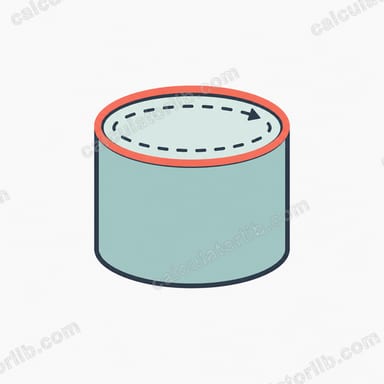
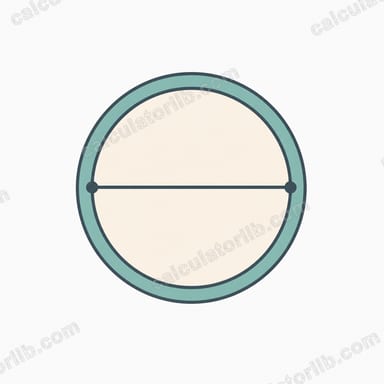
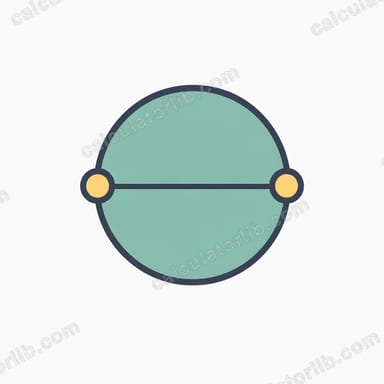
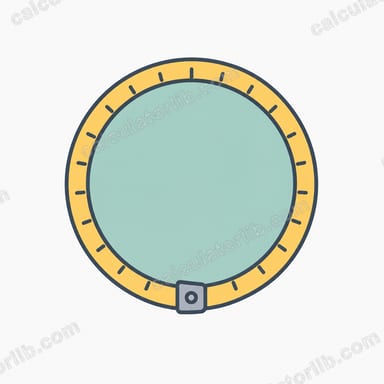
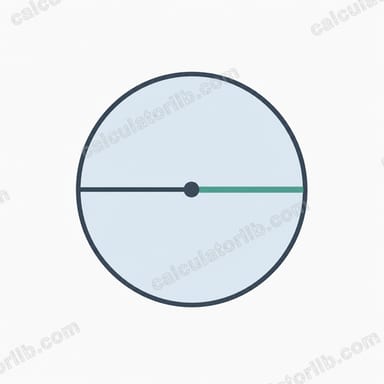
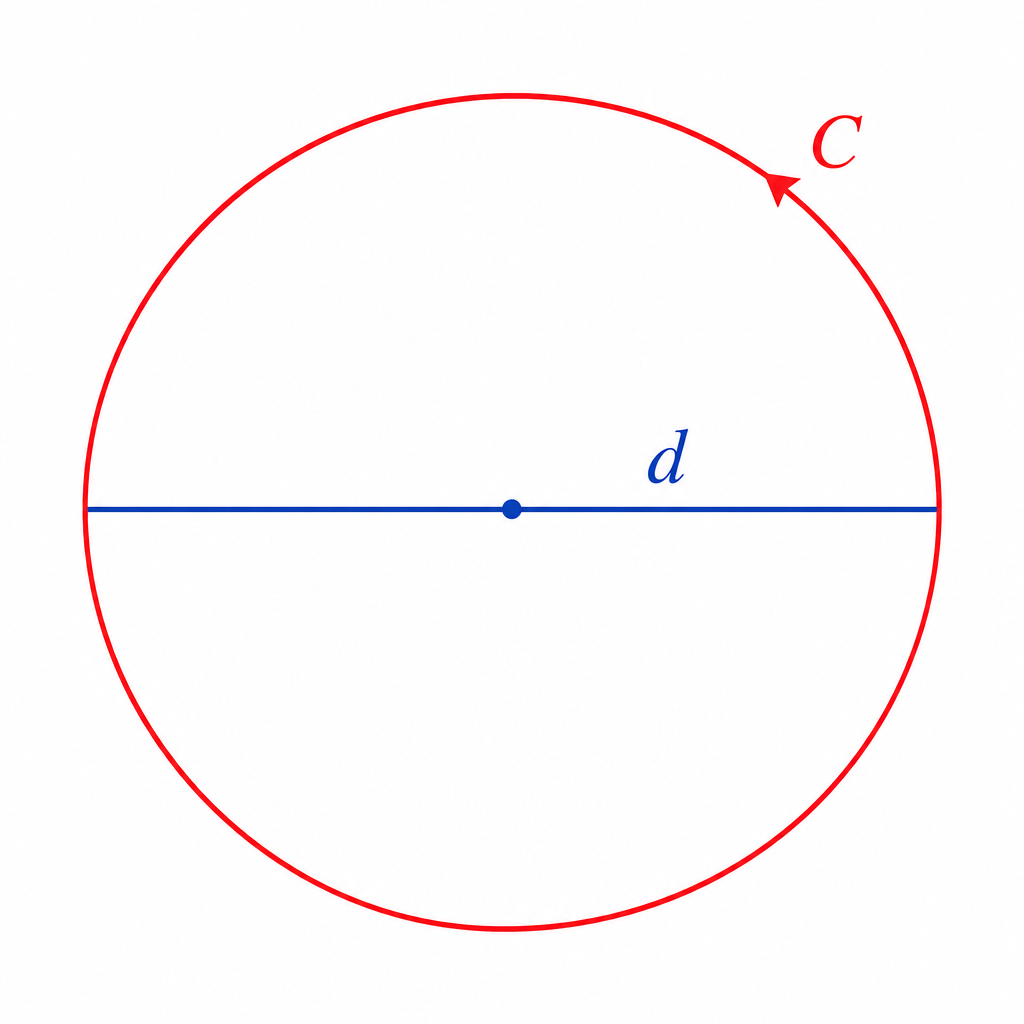
This tool finds the diameter of a circle when you already know its circumference. The circumference is the distance all the way around a circle, and the diameter is the straight-line distance across it through the center. Because the circumference is always π times the diameter, you can reverse the relationship to solve for diameter directly.
How to Use It
Enter the measured circumference of your circle in any unit (cm, inches, meters, etc.) and press calculate. The calculator returns the diameter in the same unit, plus the radius and the area as bonus values. Make sure your circumference value uses a single consistent unit.
The Formula Explained
The core relationship between circumference and diameter is \(C = \pi \times d\). Rearranging to isolate the diameter gives:
$$d = \frac{\text{Circumference (C)}}{\pi}$$
where \(\pi \approx 3.14159\). Once you have the diameter, the radius is simply \(r = d / 2\), and the area follows from \(A = \pi \times r^2\).
Worked Example
Suppose a circular table has a circumference of 31.4159 cm. Dividing by π: $$d = \frac{31.4159}{3.14159} \approx 10 \text{ cm}.$$ The radius is 5 cm, and the area is \(\pi \times 5^2 \approx 78.54\) cm². So the table is 10 cm across.
Common Circumference-to-Diameter Reference Values
Each row uses \(d = C/\pi\), \(r = d/2\) and \(A = \pi r^2 = C^2/(4\pi)\), with \(\pi \approx 3.14159265\). Values are rounded to 2 decimals. Lengths are in the same unit as C, and areas are in that unit squared.
| Circumference (C) | Diameter (d) | Radius (r) | Area (A) |
|---|---|---|---|
| 10 cm | 3.18 cm | 1.59 cm | 7.96 cm² |
| 20 cm | 6.37 cm | 3.18 cm | 31.83 cm² |
| 25 cm | 7.96 cm | 3.98 cm | 49.74 cm² |
| 50 cm | 15.92 cm | 7.96 cm | 198.94 cm² |
| 100 cm | 31.83 cm | 15.92 cm | 795.77 cm² |
| 12 in | 3.82 in | 1.91 in | 11.46 in² |
| 24 in | 7.64 in | 3.82 in | 45.84 in² |
| 36 in | 11.46 in | 5.73 in | 103.13 in² |
The ratio \(d/C = 1/\pi \approx 0.31831\) is the same for every circle. The diameter is always about 31.8% of the circumference.
Comparing Results Across Different Circumferences
The table shows \(d = C/\pi\) for three circumferences using three values of π. The percent difference is measured against the 3.14159265 result.
| C | π = 3.14 | π = 22/7 | π = 3.14159265 |
|---|---|---|---|
| 10 | 3.1847 | 3.1818 | 3.1831 |
| 50 | 15.9236 | 15.9091 | 15.9155 |
| 100 | 31.8471 | 31.8182 | 31.8310 |
| Difference vs. exact | +0.0507% | −0.0402% | 0% (reference) |
The percent difference is the same for every circumference. Rounding π scales the result by a fixed factor, so only the absolute error grows with size. At C = 100 the 3.14 result is about 0.016 too high, and the 22/7 result is about 0.013 too low.
Scaling effect: doubling the circumference doubles the diameter, since \(d\) is proportional to \(C\). The area depends on \(d^2\), so it quadruples. For example, going from C = 50 (area ≈ 198.94) to C = 100 (area ≈ 795.77) multiplies the area by 4.
Conventions and edge cases
Each case below was run through this calculator; the result column is what it actually returns.
| Case | Input | Result |
|---|---|---|
| Decimal value (2.5) | 2.5 | Diameter: 0.8 |
| Negative length | -5 | A length cannot be negative. Enter 0 or a positive number. |
| Typical value (10) | 10 | Diameter: 3.18 |
| Zero: a degenerate circle | 0 | Diameter: 0 |
Checked on 2026-11-08
FAQ
What is the difference between diameter and radius? The diameter passes through the center and touches both sides; the radius is half that, measured from the center to the edge.
Can I use any unit? Yes. The diameter comes out in whatever unit you entered the circumference in.
Why divide by π? Because circumference equals π times diameter, dividing the circumference by π reverses the operation and recovers the diameter.