What Is the Money Doubling Time Calculator?
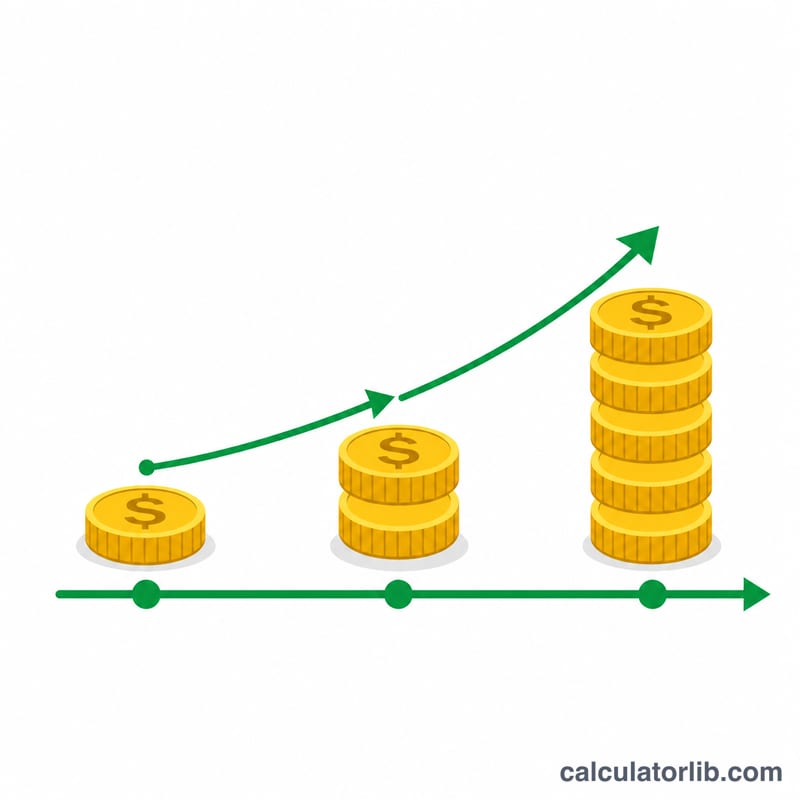
This calculator tells you roughly how long it takes an investment or deposit to double in value at a fixed annual compound interest rate. It uses the famous Rule of 72 for a quick estimate and the exact logarithmic formula for a precise answer. It works for any currency and any country since it relies on pure compound-interest math.
How to Use It
Enter your expected annual interest rate as a percentage (for example, enter 6 for 6%). The calculator returns two numbers: the Rule of 72 estimate and the mathematically exact doubling time. Compare them to see how close the shortcut is at your rate.
The Formula Explained
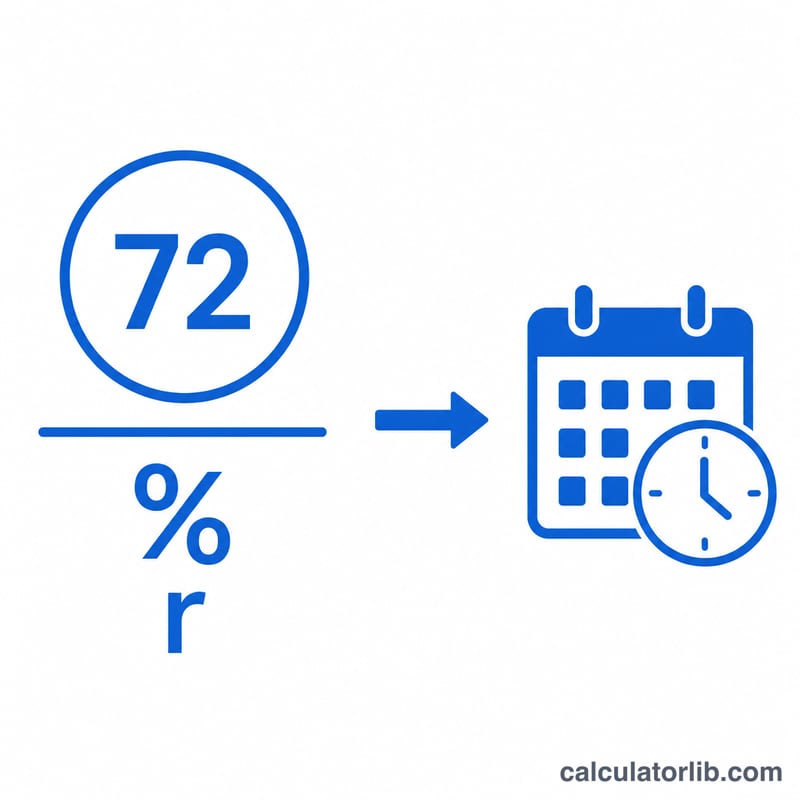
The Rule of 72 says: years to double ≈ 72 ÷ rate%. So at 8%, money doubles in about \(72/8 = 9\) years. The exact version comes from solving \(2 = (1 + r)^{t}\) for \(t\), giving
$$t = \frac{\ln 2}{\ln(1 + r)}$$where \(r\) is the rate written as a decimal (6% = 0.06). The Rule of 72 is most accurate for rates between roughly 6% and 10%.
Worked Example
Suppose you earn 6% per year. Rule of 72:
$$\frac{72}{6} = 12 \text{ years}$$Exact:
$$\frac{\ln 2}{\ln(1.06)} = \frac{0.6931}{0.0583} \approx 11.9 \text{ years}$$The estimate is within about a tenth of a year — close enough for quick mental math.
Rule of 72 vs. Exact Doubling Time at Common Rates
The Rule of 72 estimates doubling time as \(72 \div r\), where \(r\) is the annual rate in percent. The exact time for annual compounding is \(t = \ln 2 \div \ln(1+r)\), with \(r\) as a decimal. The table compares the two. The difference column is the Rule of 72 estimate minus the exact value.
| Annual rate | Rule of 72 (years) | Exact (years) | Difference (years) |
|---|---|---|---|
| 1% | 72.00 | 69.66 | +2.34 |
| 2% | 36.00 | 35.00 | +1.00 |
| 3% | 24.00 | 23.45 | +0.55 |
| 4% | 18.00 | 17.67 | +0.33 |
| 6% | 12.00 | 11.90 | +0.10 |
| 8% | 9.00 | 9.01 | −0.01 |
| 10% | 7.20 | 7.27 | −0.07 |
| 12% | 6.00 | 6.12 | −0.12 |
| 18% | 4.00 | 4.19 | −0.19 |
| 24% | 3.00 | 3.22 | −0.22 |
The rule is most accurate near 8%. At low rates it overestimates the time, and at high rates it underestimates it. Both calculations assume one compounding period per year and a constant rate, with no fees, taxes, or inflation.
How to Calculate Doubling Time by Hand
- Convert the percent to a decimal. Divide the rate by 100. For example, 5% becomes \(r = 0.05\).
- Get a quick estimate with the Rule of 72. Divide 72 by the percentage rate: \(72 \div 5 = 14.4\) years.
- Find the logarithms. \(\ln 2 \approx 0.6931\) and \(\ln(1.05) \approx 0.04879\).
- Divide. $$t = \frac{\ln 2}{\ln(1+r)} = \frac{0.6931}{0.04879} \approx 14.21 \text{ years}$$ The estimate of 14.4 years is close to the exact 14.21.
- Optionally adjust the estimate to improve accuracy:
- For low rates (about 2% or less) or daily compounding, use 70 or 69.3 in place of 72. For continuous compounding the exact formula is \(t = 69.3 \div r\). At 5% that gives \(69.3 \div 5 = 13.86\) years.
- For rates above 8%, use \(\dfrac{72 + (r-8)/3}{r}\), where \(r\) is in percent. At 24%, \(\dfrac{72 + 16/3}{24} \approx 3.22\) years, matching the exact value.
Tripling time: the same approach works for any growth multiple. Replace \(\ln 2\) with \(\ln 3 \approx 1.0986\). At 5%, tripling takes \(1.0986 \div 0.04879 \approx 22.52\) years. The quick equivalent is the "Rule of 114" (\(114 \div r\)).
Central bank policy rates today
The latest official policy rates of major central banks, updated automatically — the benchmark that bank deposit and loan rates follow.
- Federal Reserve · United States
- 3.75–4.00%
- As of
- 2026-11-13
- Change in 1 year
- 0 pp
Latest change Up +25 bp Federal Reserve changed its rate on 2026-09-17: from 3.50–3.75% to 3.75–4.00%.
| Central bank | Policy rate | As of | Change in 1 year |
|---|---|---|---|
| Banco Central do Brasil (Selic) · Brazil | 13.75% | 2026-11-16 | −1.25 pp |
| Banco de México · Mexico | 6.25% | 2026-11-10 | −1.00 pp |
| Federal Reserve · United States | 3.75–4.00% | 2026-11-13 | 0 pp |
| ECB | 2.50% | 2026-11-16 | +0.50 pp |
| Sveriges Riksbank · Sweden | 2.00% | 2026-11-16 | +0.25 pp |
| Saudi Central Bank (SAMA) · Saudi Arabia | 4.50% | 2026-10-29 | 0 pp |
| Reserve Bank of Australia · Australia | 4.60% | 2026-10-31 | +1.00 pp |
| Central Bank of the Republic of Türkiye · Türkiye | 36.00% | 2026-11-06 | −3.50 pp |
| Bank of Russia · Russia | 14.00% | 2026-11-10 | −2.50 pp |
| People’s Bank of China · China | 3.00% | 2026-11-10 | 0 pp |
| Bank of Canada · Canada | 2.50% | 2026-11-13 | +0.25 pp |
| Reserve Bank of India · India | 5.50% | 2026-10-19 | 0 pp |
| Bank of England · United Kingdom | 4.00% | 2026-11-16 | 0 pp |
| Bank of Japan · Japan | 1.25% | 2026-11-10 | +0.75 pp |
| Bank of Korea · South Korea | 3.00% | 2026-11-02 | +0.50 pp |
Federal Reserve: key rates and overnight market rates
The rates that frame monetary policy and the overnight market rate they steer, each with the date of its latest published value.
| Rate | Level | As of | Change in 1 year |
|---|---|---|---|
| Federal funds target range | 3.75–4.00% | 2026-11-13 | 0 pp |
| Effective federal funds rate (EFFR) | 3.88% | 2026-11-13 | 0 pp |
| Secured Overnight Financing Rate (SOFR) | 3.90% | 2026-11-13 | −0.10 pp |
Each rate keeps the date of its own latest published value; overnight market rates are published on the next business day.
Latest figure: 2026-11-13 Data last updated 2026-11-16 · current
Source: Banco Central do Brasil ODbL; Bank for International Settlements (BIS) Terms of permitted use of BIS statistics; Federal Reserve Bank of New York New York Fed Terms of Use; Board of Governors of the Federal Reserve System Public domain (U.S. government work); European Central Bank ECB reuse policy; Sveriges Riksbank Riksbank open data terms; The World Bank Group CC BY 4.0; Reserve Bank of Australia 2026 RBA copyright terms (Cash Rate); Bank of Canada Bank of Canada terms of use; Bank of England Open Government Licence v3.0
The one-year change is computed by CalculatorLib from these data. The EFFR and SOFR are subject to the Terms of Use posted at newyorkfed.org. The New York Fed is not responsible for publication of the EFFR and SOFR by CalculatorLib, does not sanction or endorse any particular republication, and has no liability for your use.
Source details and methodology
- Banco Central do Brasil
- Bank for International Settlements (BIS) — Central bank policy rates
- Federal Reserve Bank of New York — Reference rates (EFFR, SOFR)
- Board of Governors of the Federal Reserve System
- European Central Bank
- Sveriges Riksbank
- The World Bank Group — World Development Indicators (FR.INR.LEND, FR.INR.RINR)
- Reserve Bank of Australia 2026
- Bank of Canada
- Bank of England
FAQ
Why 72 and not 70? 72 is chosen because it divides evenly by many common rates (2, 3, 4, 6, 8, 9, 12), making mental math easy. The "true" constant is closer to 69.3 for continuous compounding.
Does it account for taxes or inflation? No. It assumes a fixed nominal rate with annual compounding. For real (inflation-adjusted) growth, use your rate minus inflation.
What rate should I use? Use the effective annual yield you actually expect from your savings account, bond, or investment.