What is the Fibonacci sequence?
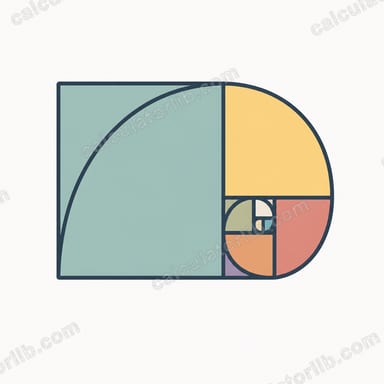
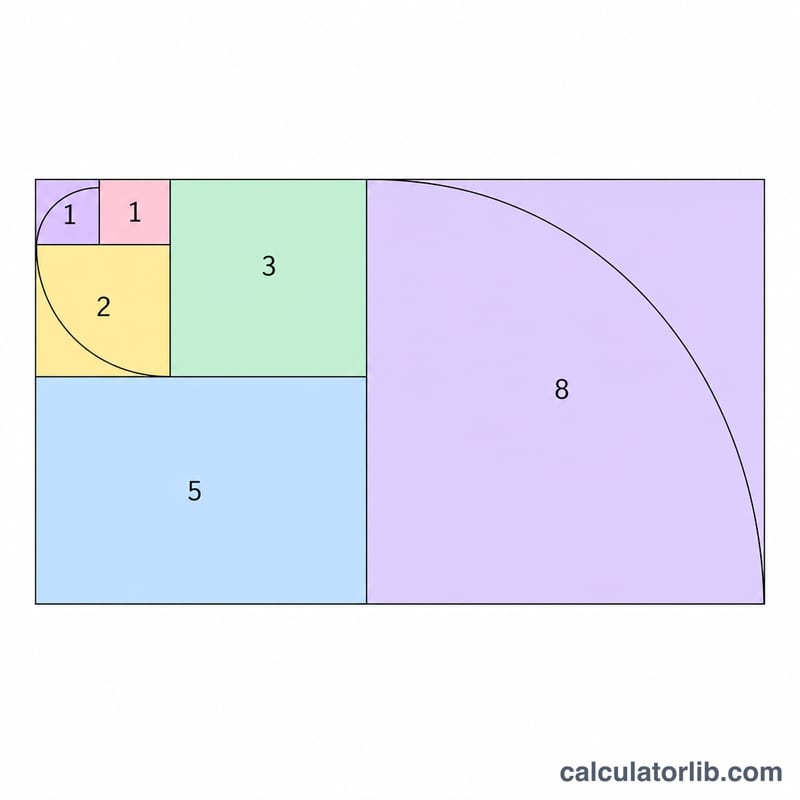
The Fibonacci sequence is a series of integers in which every number is the sum of the two preceding ones, starting from 0 and 1: 0, 1, 1, 2, 3, 5, 8, 13, 21, 34, 55, and so on. It appears throughout mathematics and nature, from spiral shells and sunflower seed heads to the golden ratio. This calculator can return a single Fibonacci number \(F_n\) for any index \(n\), or generate the whole sequence between a start and end index.
How to use this calculator
Choose a mode in the Generate dropdown. Select one Number and enter an index \(n\) to get the single value \(F_n\) together with its recurrence step. Select a Sequence and enter a Start \(n\) and End \(n\) to list every Fibonacci number across that inclusive range. Indices may be positive or negative; supported range is from -200 to 200.
The formula explained
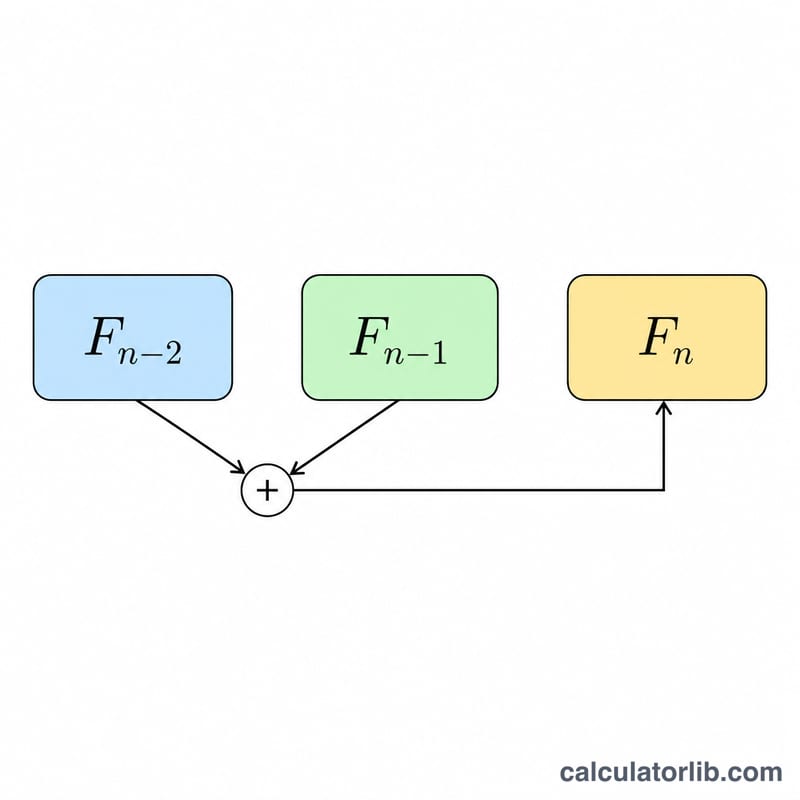
The defining rule is the recurrence $$F_n = F_{n-1} + F_{n-2}, \quad F_0 = 0, \; F_1 = 1$$ For exact results with large \(n\) this tool iterates using arbitrary-precision integers rather than the floating-point Binet formula, which loses accuracy beyond about \(n = 71\). Negative indices follow the negafibonacci rule \(F_{-n} = (-1)^{n+1} F_n\), so \(F_{-1} = 1\), \(F_{-2} = -1\), \(F_{-3} = 2\), \(F_{-4} = -3\), and so on.
Worked example
To find \(F_{15}\), iterate the sequence up to index 15: 0, 1, 1, 2, 3, 5, 8, 13, 21, 34, 55, 89, 144, 233, 377, 610. So $$F_{15} = 610 = F_{14} + F_{13} = 377 + 233 = 610$$
Fibonacci Numbers Reference Table (F0 to F30 and Negative Indices)
The Fibonacci sequence is defined by \(F_0 = 0\), \(F_1 = 1\) and \(F_n = F_{n-1} + F_{n-2}\). The table lists the first 31 terms.
| n | Fn | n | Fn | n | Fn |
|---|---|---|---|---|---|
| 0 | 0 | 11 | 89 | 22 | 17711 |
| 1 | 1 | 12 | 144 | 23 | 28657 |
| 2 | 1 | 13 | 233 | 24 | 46368 |
| 3 | 2 | 14 | 377 | 25 | 75025 |
| 4 | 3 | 15 | 610 | 26 | 121393 |
| 5 | 5 | 16 | 987 | 27 | 196418 |
| 6 | 8 | 17 | 1597 | 28 | 317811 |
| 7 | 13 | 18 | 2584 | 29 | 514229 |
| 8 | 21 | 19 | 4181 | 30 | 832040 |
| 9 | 34 | 20 | 6765 | ||
| 10 | 55 | 21 | 10946 |
Negative indices
The sequence extends backwards using \(F_{-m} = (-1)^{m+1} F_m\). Odd \(m\) gives a positive value and even \(m\) gives a negative value.
| n | Fn | Sign rule (-1)m+1, m = |n| |
|---|---|---|
| -1 | 1 | m = 1, sign + |
| -2 | -1 | m = 2, sign − |
| -3 | 2 | m = 3, sign + |
| -4 | -3 | m = 4, sign − |
| -5 | 5 | m = 5, sign + |
| -6 | -8 | m = 6, sign − |
| -7 | 13 | m = 7, sign + |
| -8 | -21 | m = 8, sign − |
| -9 | 34 | m = 9, sign + |
| -10 | -55 | m = 10, sign − |
How to Compute Fibonacci Numbers by Hand
- Start with the two seed values \(F_0 = 0\) and \(F_1 = 1\).
- Add the previous two terms to get the next: \(F_2 = F_1 + F_0 = 1\), \(F_3 = F_2 + F_1 = 2\), \(F_4 = 3\), \(F_5 = 5\), and so on.
- Repeat until you reach index n. For \(n = 10\): 0, 1, 1, 2, 3, 5, 8, 13, 21, 34, 55, so \(F_{10} = 34 + 21 =\) 55.
- For a negative index, compute \(m = |n|\), find \(F_m\), then apply the sign \((-1)^{m+1}\). Example: \(F_{-7} = (-1)^{8} F_7 = (+1)(13) =\) 13. Another: \(F_{-6} = (-1)^{7} F_6 = -8\).
- Sanity check with the golden ratio: \(F_n \approx \varphi^n/\sqrt{5}\). For \(n = 10\), \(\varphi^{10} \approx 122.99\) and \(122.99 / 2.23607 \approx 55.0\), which matches. Also \(F_{n+1}/F_n\) should be close to 1.618 for larger n.
- For very large n, use fast doubling instead of adding term by term: \(F_{2k} = F_k\,(2F_{k+1} - F_k)\) and \(F_{2k+1} = F_k^2 + F_{k+1}^2\). Check with \(k = 5\): \(F_{10} = F_5(2F_6 - F_5) = 5 \times (16 - 5) = 55\).
Values grow fast: \(F_{100}\) already has 21 digits, so exact integer arithmetic is needed for large n (this calculator supports n from −200 to 200).
FAQ
Does it support negative indices? Yes. It uses the negafibonacci extension, producing alternating-sign results such as \(F_{-6} = -8\).
How large can n be? The supported range is -200 to 200. \(F_{200}\) has 42 digits and is computed exactly with arbitrary-precision integers.
Why not just use Binet's formula? Binet's closed form \(F_n = \frac{\varphi^n - \psi^n}{\sqrt{5}}\) is elegant for display, but double-precision rounding makes it unreliable for large \(n\), so exact integer iteration is used for the answer.