What is Percent by Mass (%w/w)?
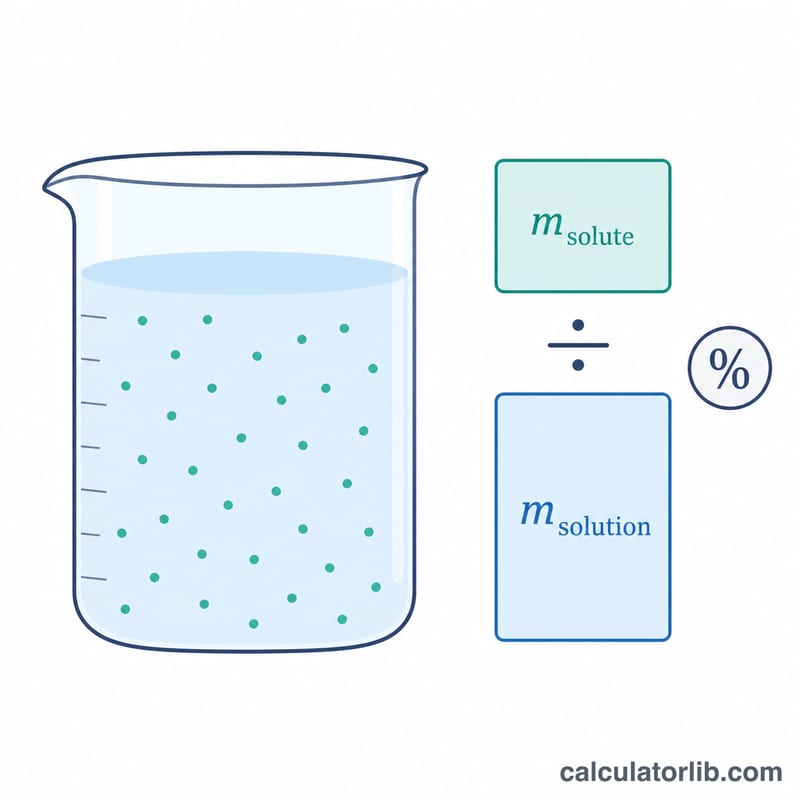
Percent by mass, often written as %w/w (weight/weight) or %m/m (mass/mass), expresses the concentration of a solution as the mass of solute divided by the total mass of the solution, multiplied by 100. It is one of the most common ways to report concentration because it is independent of temperature and does not depend on the density of the solution. A 10% w/w salt solution contains 10 grams of salt in every 100 grams of solution.
How to Use This Calculator
Enter the mass of the solute (the dissolved substance) and the mass of the entire solution. Make sure both values use the same unit of mass — grams are typical, but any consistent unit works. The calculator divides the solute mass by the solution mass and multiplies by 100 to return the percent by mass, and also reports the mass of solvent (solution mass minus solute mass).
The Formula Explained
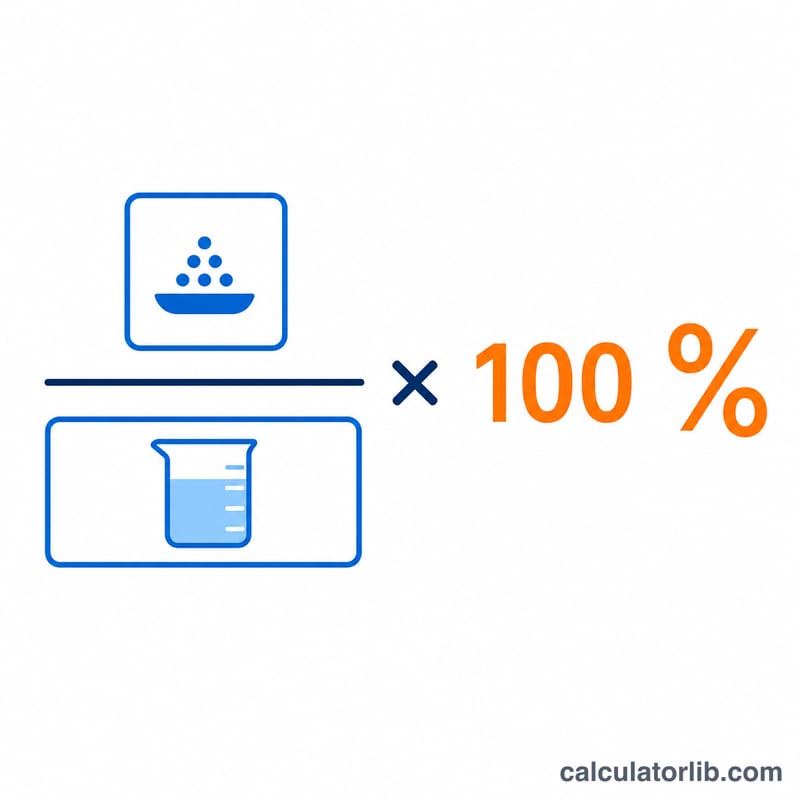
The equation is: $$\%\,\text{w/w} = \frac{\text{Mass of Solute (g)}}{\text{Mass of Solution (g)}} \times 100$$ The "mass of solution" is the total mass, equal to the solute plus the solvent (for example, sugar plus water). A common mistake is to divide by the mass of solvent instead of the mass of solution — always use the total.
Worked Example
Suppose you dissolve 25 g of sodium chloride in enough water to make 200 g of solution. The percent by mass is $$(25 \div 200) \times 100 = 12.5\%\ \text{w/w}.$$ The mass of solvent (water) is \(200 - 25 = 175\) g.
Common %w/w Concentrations in Practice
Percent by mass (%w/w) is the grams of solute per 100 g of total solution. The values below are approximate typical values; actual products vary by manufacturer, grade and region, so always check the label or the safety data sheet.
| Solution | Approximate typical concentration | Notes |
|---|---|---|
| Normal saline | 0.9% w/v | 0.9 g NaCl per 100 mL of solution (volume basis), not per 100 g. Because the density is close to 1.0 g/mL, the w/w value is numerically similar (about 0.9%). |
| Household bleach (NaOCl) | ~5–6% w/w | Strength varies by product and country; some are higher or lower. |
| White vinegar (acetic acid) | ~5% acetic acid | Commonly labeled 5% acidity; some products differ. |
| Concentrated hydrochloric acid (HCl) | ~37% w/w | Typical laboratory-grade concentrated acid. |
| Concentrated sulfuric acid (H2SO4) | ~98% w/w | Typical laboratory-grade concentrated acid. |
| Concentrated nitric acid (HNO3) | ~68–70% w/w | Typical laboratory-grade concentrated acid. |
| Seawater | ~3.5% dissolved salts by mass | Average open-ocean salinity of about 35 g per kg; it varies by location. |
| Hydrogen peroxide (household) | ~3% | Usually sold as a 3% solution; the basis (w/w or w/v) may vary by label. |
w/w vs. w/v: %w/w divides by the mass of the solution (g solute per 100 g solution). %w/v divides by the volume (g solute per 100 mL solution). The two agree closely only when the solution density is near 1 g/mL, as in dilute aqueous solutions. For concentrated acids the difference is large.
Converting %w/w to Other Concentration Units
| Target unit | Conversion | Unit notes |
|---|---|---|
| ppm (mg/kg) | 1% w/w = 10,000 ppm; ppm = %w/w × 10,000 | Mass-based ppm (mg solute per kg solution). |
| %w/v (g/100 mL) | %w/v = %w/w × density | Density in g/mL. |
| Molarity (mol/L) | M = (%w/w × 10 × density) / molar mass | Density in g/mL; molar mass in g/mol. |
| Molality (mol/kg solvent) | m = (%w/w × 10) / (molar mass × (100 − %w/w)/100) | Molar mass in g/mol; the denominator is the solvent mass in kg per 1000 g of solution. |
Example using density
Concentrated HCl is about 37% w/w with a density of about 1.18 g/mL (approximate typical values) and a molar mass of 36.46 g/mol.
- %w/v: \(37 \times 1.18 = 43.66\) g per 100 mL.
- Molarity: \(\dfrac{37 \times 10 \times 1.18}{36.46} = \dfrac{436.6}{36.46} \approx 11.98\) mol/L, about 12 M.
- Molality: \(\dfrac{37 \times 10}{36.46 \times 0.63} = \dfrac{370}{22.97} \approx 16.1\) mol/kg.
Molarity depends on density (and temperature), while %w/w and molality do not depend on volume.
Comparing Different Solute and Solution Masses
Solvent mass = solution mass − solute mass, and \(\%\,\text{w/w} = \dfrac{\text{solute}}{\text{solution}} \times 100\).
| Solute mass (g) | Solution mass (g) | Solvent mass (g) | %w/w |
|---|---|---|---|
| 5 | 100 | 95 | 5% |
| 10 | 100 | 90 | 10% |
| 10 | 200 | 190 | 5% |
| 25 | 200 | 175 | 12.5% |
| 50 | 250 | 200 | 20% |
Doubling the solute at a fixed solution mass doubles the percentage (5 g → 10 g in 100 g). Putting the same 10 g of solute into twice as much solution halves it (10% → 5%). Note that the denominator is the total solution mass, not the solvent mass alone. Using the solvent mass instead would give a different value, for example 5 g in 95 g of solvent is 5.26%, not 5%.
FAQ
Is %w/w the same as %w/v? No. %w/w uses mass of solution in the denominator, while %w/v uses volume of solution (grams per 100 mL).
Why use mass of solution, not solvent? By convention concentration is referenced to the total solution. Dividing by solvent gives a different, non-standard ratio.
Does temperature affect %w/w? No. Because mass does not change with temperature, %w/w is temperature-independent, unlike volume-based measures.