What Is the Sphere Density Calculator?
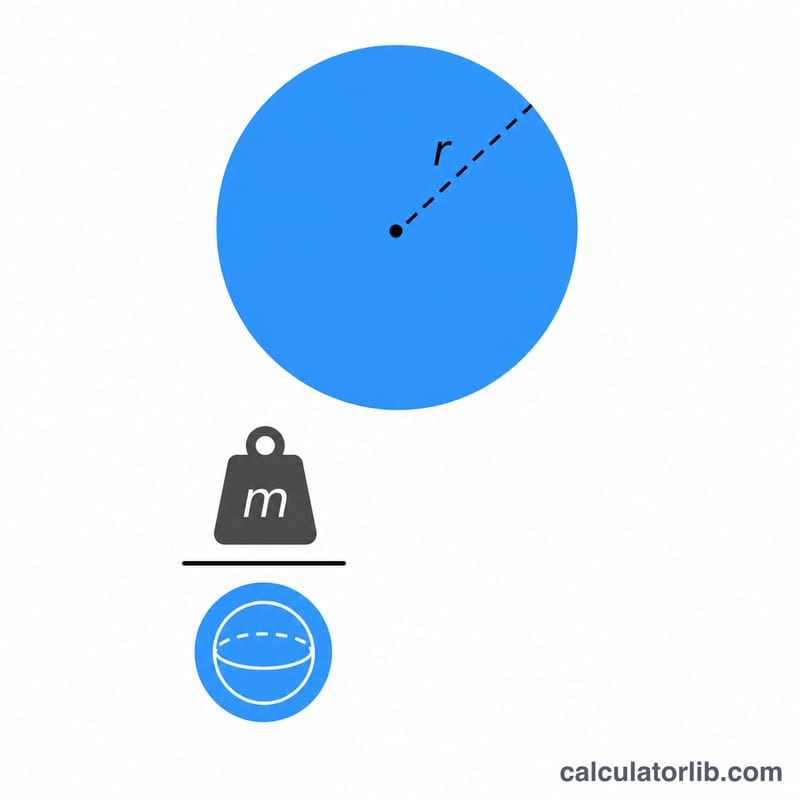
This calculator finds the density of a solid sphere from two measurements: its mass and its radius. Density tells you how much mass is packed into a given amount of space, and for a sphere it is simply the mass divided by the spherical volume. The tool is universal — it works with any consistent set of units (for example grams and centimetres, or kilograms and metres), and the resulting density is expressed in mass per unit volume.
How to Use It
Enter the sphere's mass and its radius, then read off the density and the computed volume. Make sure both inputs use compatible units so the answer is meaningful: if mass is in grams and radius in centimetres, density comes out in g/cm³. The radius must be greater than zero.
The Formula Explained
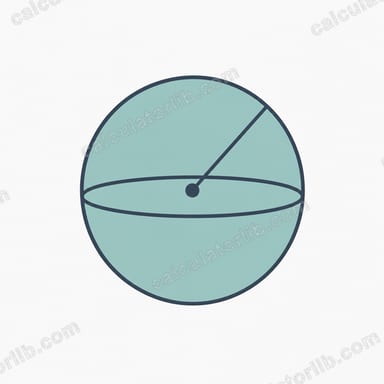
The volume of a sphere is \(V = \frac{4}{3}\cdot\pi\cdot r^{3}\). Density is mass per volume, so combining the two gives:
$$\rho = \frac{m}{\frac{4}{3}\cdot\pi\cdot r^{3}}$$
Because the radius is cubed, even a small change in radius dramatically changes the volume — and therefore the density. Measure the radius carefully for accurate results.
Worked Example
Suppose a metal ball has a mass of 100 g and a radius of 3 cm. Its volume is $$\frac{4}{3}\cdot\pi\cdot 3^{3} = \frac{4}{3}\cdot\pi\cdot 27 \approx 113.0973 \text{ cm}^{3}.$$ The density is \(100 \div 113.0973 \approx 0.8842\) g/cm³. That low value tells you this particular object is lighter than water for its size.
Densities of Common Materials
Typical densities at about 20 °C. Use these to compare against the result from the sphere density calculator.
| Material | Density (g/cm³) | Density (kg/m³) |
|---|---|---|
| Water (about 4 °C to 20 °C) | 1.00 | 1000 |
| Ice (about 0 °C) | 0.917 | 917 |
| Oak wood (typical, air-dried) | 0.75 | 750 |
| Rubber (typical) | 1.1 | 1100 |
| Glass (typical soda-lime) | 2.5 | 2500 |
| Aluminium | 2.70 | 2700 |
| Iron / steel | 7.87 | 7870 (steel is often quoted as about 7850) |
| Copper | 8.96 | 8960 |
| Silver | 10.49 | 10490 |
| Lead | 11.34 | 11340 |
| Gold | 19.32 | 19320 |
These are approximate values. Real densities vary with temperature, alloy composition, purity, moisture content (for wood) and the exact formulation (for glass and rubber).
Density Unit Conversions
| From | To | Factor |
|---|---|---|
| 1 g/cm³ | kg/m³ | 1000 |
| 1 kg/m³ | g/cm³ | 0.001 |
| 1 g/cm³ | lb/ft³ | ≈ 62.428 |
| 1 lb/ft³ | kg/m³ | ≈ 16.0185 |
| 1 g/cm³ | lb/in³ | ≈ 0.03613 |
Length conversions for the radius
- 1 in = 2.54 cm
- 1 m = 100 cm
Because the volume depends on \(r^3\), convert the radius before calculating. A unit conversion applied to the radius changes the volume by the cube of the factor: 1 m³ = 1,000,000 cm³. Keep mass and radius in a consistent system, such as grams with centimetres (giving g/cm³) or kilograms with metres (giving kg/m³).
Interpreting Your Result
Example: a sphere with mass 500 g and radius 3 cm has volume \(V = \frac{4}{3}\pi (3)^3 \approx 113.10\ \text{cm}^3\), so \(\rho = \frac{500}{113.10} \approx\) 4.421 g/cm³.
- Compare with water. Water is 1 g/cm³ (1000 kg/m³). A result below 1 means the sphere would float in water; above 1 means it would sink.
- Match to a material. Compare your value with the reference table. A result near 2.70 g/cm³ suggests aluminium, near 7.87 suggests iron or steel, and near 19.32 suggests gold. A match is only a hint, since different materials and alloys can overlap in density.
- Lower than expected? If the sphere is supposed to be one solid material but the result is noticeably lower than the table value, it may contain hidden voids or air pockets, or be hollow, or be made of a different material. The example above (4.42 g/cm³) lies between aluminium and iron, so it could be a mixed or partly hollow object rather than a pure solid metal.
- Radius errors are amplified. Since density depends on \(1/r^3\), a small error in the radius matters. For example, a 2% overestimate of the radius makes the computed density about 6% too low, because \(1.02^3 \approx 1.061\). Measure the diameter carefully, ideally several times, and halve it.
FAQ
Do I need a specific unit system? No. Any consistent pair works; the density unit is whatever mass unit per cubed length unit you used.
Does this work for hollow spheres? No — this assumes a solid sphere filling its full volume. For a hollow shell you would subtract the inner volume.
What if I only know the diameter? Divide the diameter by two to get the radius before entering it.