What is the Tree Value Calculator?
This calculator estimates how much usable lumber a tree or log contains and what that volume is worth. It uses the Doyle log rule, one of the most widely used scaling formulas in North American forestry for estimating board-foot volume from a log's small-end diameter and length. A board foot is a unit of lumber equal to 144 cubic inches (12 in \(\times\) 12 in \(\times\) 1 in).
How to use it
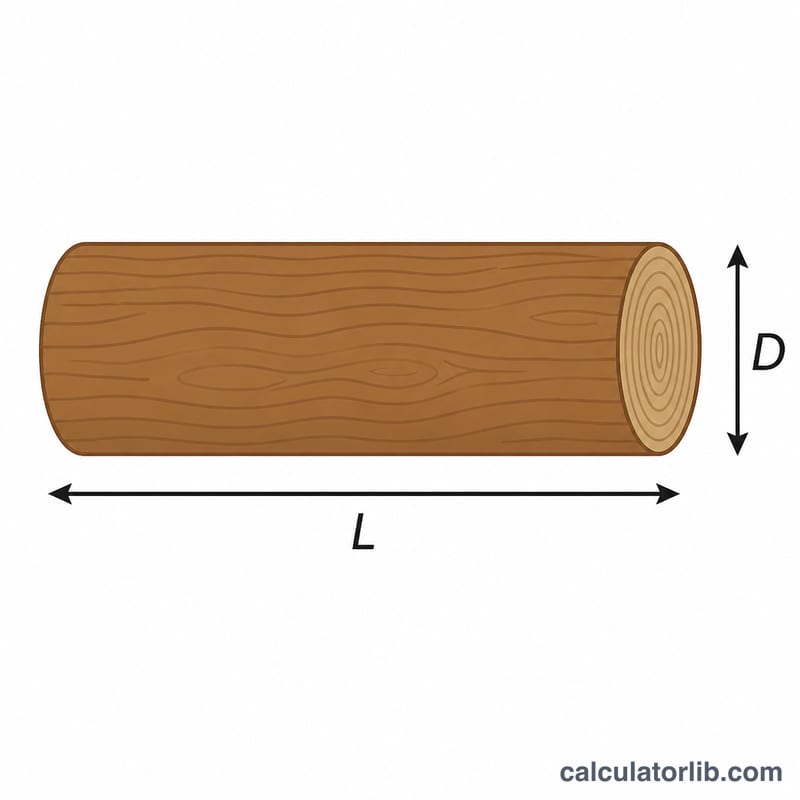
Enter three values: the diameter measured inside the bark at the small end of the log (in inches), the merchantable log length (in feet), and the current price you can get per board foot (in dollars). The calculator returns the estimated board-foot volume and the total dollar value.
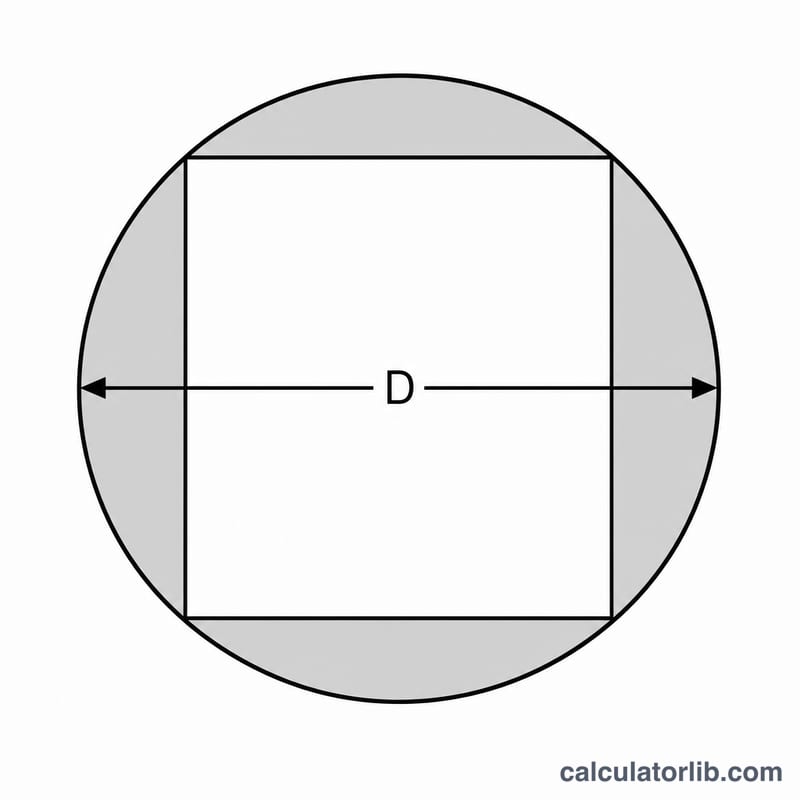
The formula explained
The Doyle rule is: $$\text{Board feet} = \left(\frac{D - 4}{4}\right)^{2} \times L$$ where \(D\) is the small-end diameter in inches and \(L\) is the log length in feet. The "− 4" accounts for slab and edging waste, and the squaring reflects how cross-sectional area scales with diameter. Multiply the resulting board feet by your price per board foot to get the value.
Worked example
For a log with a 16-inch small-end diameter and 16 feet of length: $$\left(\frac{16 - 4}{4}\right)^{2} = \left(\frac{12}{4}\right)^{2} = 3^{2} = 9$$ multiply by 16 = 144 board feet. At $0.50 per board foot, the value is $$144 \times \$0.50 = \$72.00$$
Doyle Board Foot Volume by Diameter and Length
The Doyle log rule is used mainly in the United States, especially in parts of the South, Midwest and East. It estimates the board feet in a log from its small-end diameter inside bark (D, in inches) and its length (L, in feet):
$$\text{Board feet} = \left(\frac{D-4}{4}\right)^{2} \times L$$
The table applies this formula directly. Doyle is the standard for logs 12 inches and larger. Smaller logs are often scaled from published tables or priced a different way, because Doyle tends to underestimate their lumber yield. Values are rounded to a half board foot where needed.
| Small-end diameter (in) | 8 ft | 10 ft | 12 ft | 16 ft |
|---|---|---|---|---|
| 8 | 8 | 10 | 12 | 16 |
| 10 | 18 | 22.5 | 27 | 36 |
| 12 | 32 | 40 | 48 | 64 |
| 14 | 50 | 62.5 | 75 | 100 |
| 16 | 72 | 90 | 108 | 144 |
| 18 | 98 | 122.5 | 147 | 196 |
| 20 | 128 | 160 | 192 | 256 |
| 22 | 162 | 202.5 | 243 | 324 |
| 24 | 200 | 250 | 300 | 400 |
| 26 | 242 | 302.5 | 363 | 484 |
| 28 | 288 | 360 | 432 | 576 |
| 30 | 338 | 422.5 | 507 | 676 |
Example of reading the table: a 16-inch log that is 12 feet long gives \(\left(\frac{16-4}{4}\right)^{2} \times 12 = 3^{2} \times 12 = 108\) board feet.
Value Comparison Across Log Sizes and Prices
Value is board feet multiplied by the price per board foot. The prices below ($0.25, $0.50 and $1.00 per board foot) are illustrative only. Real prices vary widely by species, grade, region and market, and whether the price is stumpage or delivered.
| Log (small-end diameter × length) | Doyle board feet | Value at $0.25/bf | Value at $0.50/bf | Value at $1.00/bf |
|---|---|---|---|---|
| 12 in × 16 ft | 64 | $16.00 | $32.00 | $64.00 |
| 16 in × 16 ft | 144 | $36.00 | $72.00 | $144.00 |
| 18 in × 12 ft | 147 | $36.75 | $73.50 | $147.00 |
| 20 in × 12 ft | 192 | $48.00 | $96.00 | $192.00 |
| 24 in × 16 ft | 400 | $100.00 | $200.00 | $400.00 |
Worked example, 24 in × 16 ft at $0.50/bf:
$$\left(\frac{24-4}{4}\right)^{2} \times 16 = 5^{2} \times 16 = 400 \text{ bf}$$
$$400 \times \$0.50 = \$200.00$$
The value of this log is $200.
Doubling the diameter more than doubles the board feet, since the diameter term is squared. A 24-inch log has 400 bf, while a 12-inch log of the same length has only 64 bf, about 6 times less. This is why larger, higher-grade logs often bring higher prices per board foot as well.
Key Terms in Log Scaling
- Board foot (bf): A unit of lumber volume equal to a board 1 inch thick, 12 inches wide and 12 inches long (144 cubic inches).
- Doyle log rule: A formula-based log rule, \(\left(\frac{D-4}{4}\right)^{2} \times L\), that estimates board feet from small-end diameter and length. It is widely used in parts of the United States. It tends to underestimate yield from small logs and to be more generous for large ones.
- Small-end diameter inside bark (DIB): The diameter, in inches, measured across the narrow end of the log without the bark. It is the diameter used in the formula.
- Merchantable length: The usable length of the log or stem that can be cut into sound product, normally in 2-foot increments, excluding the rotten, crooked or too-small top. A trim allowance is often added to each log.
- Log scale vs. lumber tally: The log scale is the estimated board feet in the log, calculated before sawing from a rule. The lumber tally is the actual board feet of lumber sawn from it. The two differ, and the difference is called overrun or underrun.
- Stumpage vs. delivered log price: Stumpage is the price paid to the landowner for standing timber. The delivered price is paid for logs at the mill, and includes the cost of felling, skidding and hauling. Delivered prices are higher than stumpage.
- Log grade: A quality classification based on the diameter, length, straightness, knots and other defects. Higher grades yield more clear lumber and bring higher prices per board foot.
Other common log rules are the Scribner rule, based on diagrams of boards drawn in a circle and common in the western United States, and the International 1/4-inch rule, which is formula-based, assumes a 1/4-inch saw kerf, and is generally regarded as close to actual sawmill yield. The same log can scale differently under each rule, so always confirm which rule a buyer uses. This calculator gives general estimates, not a formal timber appraisal.
FAQ
Why does the Doyle rule undervalue small logs? The fixed 4-inch deduction is a large fraction of a small log's diameter, so it overstates waste on logs under about 16 inches. Other rules (Scribner, International 1/4") may estimate higher for small logs.
Which diameter should I measure? Always use the diameter inside the bark at the smaller end of the log.
Is this a precise appraisal? No. It is an estimate. Actual value depends on species, grade, defects, taper, and local mill pricing. Use it for planning, not for binding sales.