What This Calculator Does
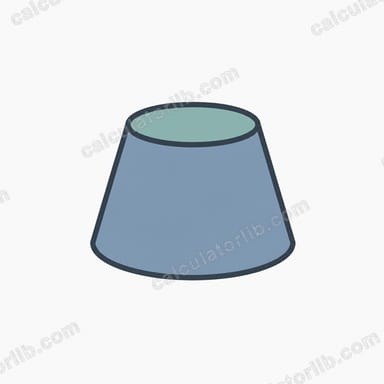
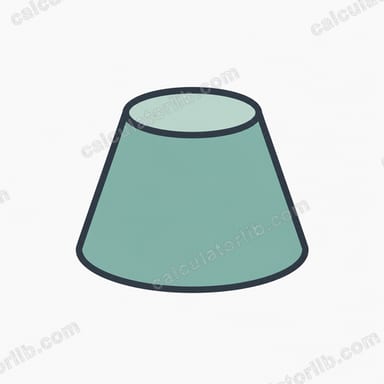
A frustum of a cone is the shape you get when you slice the top off a cone with a cut parallel to the base — think of a bucket, a lampshade, or a paper coffee cup. This calculator finds the total surface area of that shape, including the curved side and both circular ends. You supply three measurements and it returns the full area instantly, along with the slant height it computes along the way.
The Inputs
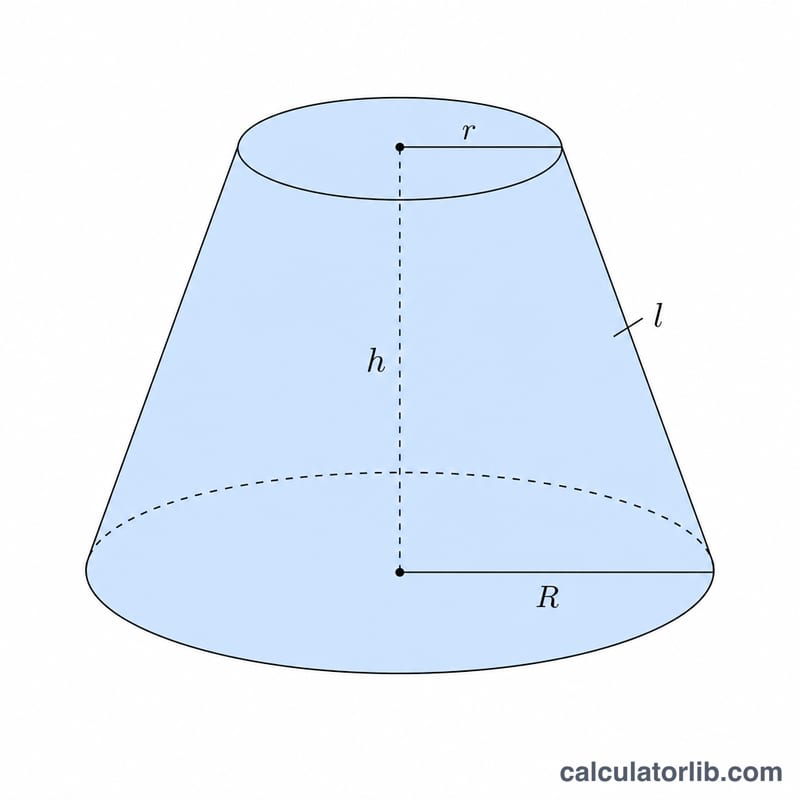
- Top Radius (\(r\)): the radius of the smaller circular face at the top.
- Bottom Radius (\(R\)): the radius of the larger circular face at the bottom.
- Height (\(h\)): the straight vertical distance between the two faces (not the slanted edge).
All three should be entered in the same unit (cm, m, inches, etc.), and the result will be in those units squared.
The Formula
The calculator uses:
$$A = \pi(R + r)s + \pi R^{2} + \pi r^{2}$$
Here \(s\) is the slant height, which is not entered directly — it is derived from the height and the difference in radii using the Pythagorean theorem:
$$s = \sqrt{h^{2} + (R - r)^{2}}$$
The first term, \(\pi(R + r)s\), is the curved lateral surface area. The two remaining terms, \(\pi R^{2}\) and \(\pi r^{2}\), are the areas of the bottom and top circles. Adding all three gives the total surface area.
Worked Example
Suppose a bucket has a top radius of 3, a bottom radius of 5, and a height of 8.
- Slant height: \(s = \sqrt{8^{2} + (5 - 3)^{2}} = \sqrt{64 + 4} = \sqrt{68} \approx 8.246\)
- Lateral area: \(\pi(5 + 3)(8.246) \approx 207.3\)
- Bottom area: \(\pi(5^{2}) \approx 78.54\)
- Top area: \(\pi(3^{2}) \approx 28.27\)
- Total area \(\approx 314.1\) square units
How to Calculate Frustum Surface Area by Hand
A frustum of a cone (a truncated cone) has three surfaces: the sloping side and the two parallel circular faces. Work through them one at a time, keeping every length in the same unit.
- Identify the three dimensions. Measure the bottom radius \(R\), the top radius \(r\), and the perpendicular height \(h\) in one consistent unit (all cm, or all inches — never a mix). If your measurements are diameters, halve them first: \(R = D_{\text{bottom}}/2\) and \(r = D_{\text{top}}/2\).
- Compute the radius difference \(R - r\). Use the absolute value; the sign does not matter because this term is squared in the next step, so swapping \(R\) and \(r\) gives the same slant height.
- Compute the slant height. $$s = \sqrt{h^{2} + (R - r)^{2}}$$ This is the hypotenuse of a right triangle whose legs are the vertical height and the horizontal overhang.
- Compute the lateral (curved) area: \(A_{\text{lat}} = \pi (R + r)\,s\).
- Compute the bottom cap: \(A_{\text{bottom}} = \pi R^{2}\).
- Compute the top cap: \(A_{\text{top}} = \pi r^{2}\).
- Add all three parts: $$A = \pi (R + r)\sqrt{h^{2} + (R - r)^{2}} + \pi R^{2} + \pi r^{2}$$
- State the answer in squared units — cm², m², in² — matching the unit you measured in.
Worked example
Take \(R = 6\) cm, \(r = 4\) cm, \(h = 9\) cm.
- \(R - r = 6 - 4 = 2\) cm
- \(s = \sqrt{9^{2} + 2^{2}} = \sqrt{81 + 4} = \sqrt{85} = 9.2195\) cm
- Lateral: \(\pi (6 + 4)(9.2195) = \pi \times 92.195 = 289.64\) cm²
- Bottom cap: \(\pi \times 6^{2} = 113.10\) cm²
- Top cap: \(\pi \times 4^{2} = 50.27\) cm²
- Total: \(289.64 + 113.10 + 50.27 = \) 453.00 cm²
Two things that go wrong
Substituting the slant height for the vertical height in step 3. If someone hands you the measurement taken along the sloping side, that value is \(s\) — do not put it in place of \(h\) inside the square root, or you will inflate the slant height and the lateral area. To go the other way, recover the true height with \(h = \sqrt{s^{2} - (R - r)^{2}}\).
Rounding \(s\) too early. Carry at least 3–4 decimal places for the slant height, because it is multiplied by \(\pi (R + r)\) — rounding \(\sqrt{85}\) to 9.2 instead of 9.2195 shifts the lateral area by more than half a square centimetre in the example above. Round only the final total.
Surface Area Across Common Frustum Shapes
All dimensions below are in centimetres, so slant heights are in cm and areas in cm². Areas are computed with \(\pi = 3.14159\) and rounded at the end.
| Object / shape | R (bottom radius, cm) | r (top radius, cm) | h (height, cm) | Slant height s (cm) | Lateral area (cm²) | Total area (cm²) |
|---|---|---|---|---|---|---|
| Tapered drinking cup | 4 | 3 | 12 | 12.042 | 264.8 | 343.3 |
| Shallow lampshade | 20 | 12 | 15 | 17.000 | 1709.0 | 3418.0 |
| Steep flower pot | 15 | 10 | 20 | 20.616 | 1619.1 | 2640.2 |
| Near-cylindrical tub | 10 | 9.5 | 10 | 10.012 | 613.4 | 1211.1 |
Spot-check of the first row: \(s = \sqrt{12^{2} + 1^{2}} = \sqrt{145} = 12.042\), lateral \(= \pi(4 + 3)(12.042) = 264.8\), caps \(= \pi(16) + \pi(9) = 50.27 + 28.27\), total \(= 343.3\) cm². The last row shows how a frustum with \(R \approx r\) behaves almost like a cylinder, since \(s \to h\) when the radius difference vanishes.
Takeaway: total area grows roughly with the square of the radii but only linearly with height — doubling both radii roughly quadruples the area, while doubling the height less than doubles it. At the other extreme, as the top radius approaches zero the frustum becomes a full cone and the formula collapses to \(A = \pi R (R + s)\).
Key Terms and Variables
- Frustum (of a cone) — the portion of a cone lying between its base and a plane cut parallel to that base; the pointed tip has been removed, leaving two parallel circular faces.
- Bottom radius, \(R\) — the radius of the larger (lower) circular face, in length units (cm, m, in). Half the bottom diameter.
- Top radius, \(r\) — the radius of the smaller (upper) circular face, in the same length units. Half the top diameter.
- Height, \(h\) — the perpendicular distance between the two parallel faces, measured along the axis. This is not the distance measured along the sloping side.
- Slant height, \(s\) — the distance along the sloping surface from the edge of one circular face to the edge of the other: \(s = \sqrt{h^{2} + (R - r)^{2}}\), in length units. Always \(s \geq h\), with equality only when \(R = r\).
- Lateral (curved) surface area — the sloping side alone, \(\pi (R + r)s\), in squared units. This is the figure you want for material such as a cone sleeve or shade fabric, with no ends included.
- Total surface area, \(A\) — the lateral area plus both circular caps: \(A = \pi (R + r)s + \pi R^{2} + \pi r^{2}\), in squared units (cm², m², in²).
- Axis — the straight line joining the centres of the two circular faces. This calculator assumes a right frustum, in which the axis is perpendicular to both faces.
- \(\pi\) (pi) — the circle constant, the ratio of a circle's circumference to its diameter, approximately 3.14159.
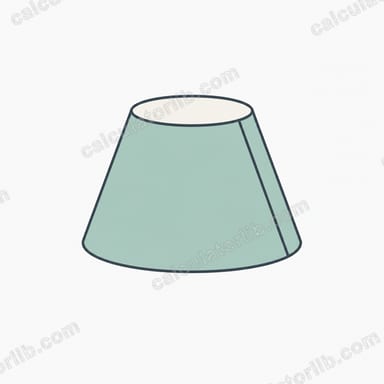
Limitation: for an oblique frustum — one whose axis is not perpendicular to the circular faces, so the solid leans to one side — these formulas do not apply. The sloping distance then varies around the rim, and the lateral area requires integration rather than a single slant height. The cap formulas \(\pi R^{2}\) and \(\pi r^{2}\) still hold whenever both faces are genuine circles.
FAQ
Do I need to enter the slant height? No. The calculator computes the slant height for you from the height and the two radii, so you only provide the three vertical and radial measurements.
What if both radii are the same? If the top and bottom radii are equal, the shape becomes a cylinder. The slant height then equals the height, and the formula still gives the correct total surface area.
Does this include the open top or bottom? This calculation includes both circular caps. If your object is open (like an open bucket), subtract the area of the open face — for example, subtract \(\pi r^{2}\) to exclude an open top.