What this calculator does
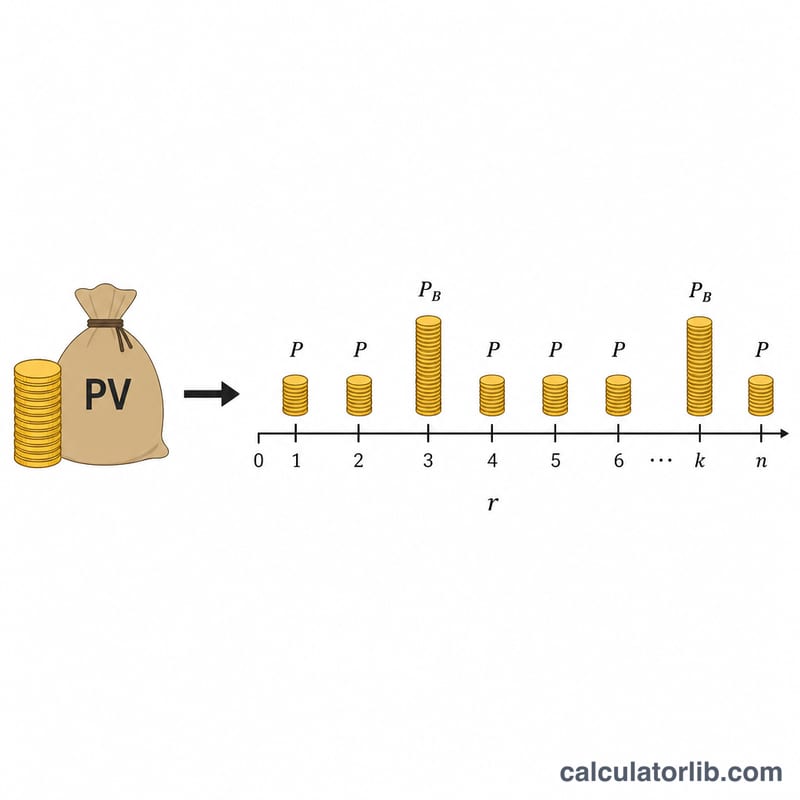
This tool is geared toward Japanese home and personal loans, where repayments are commonly split into a regular monthly amount plus two larger bonus-month payments per year. It works backwards from the repayments you can afford to the maximum loan principal (the "borrowable amount") under the equal-payment, amortizing method (genri-kinto). Amounts are entered in man-yen (units of 10,000 JPY); the result is also shown in plain yen for convenience.
How to use it
Enter the interest rate and pick whether it is an annual rate (divided by 12 to get a monthly rate) or already a monthly rate. Enter the repayment term in years, the monthly repayment, and the extra amount paid in each of the two bonus months per year (set this to 0 if you have no bonus payments). The calculator returns the maximum principal that those exact payments would pay off over the term.
The formula explained
The borrowable amount is the present value of two payment streams:
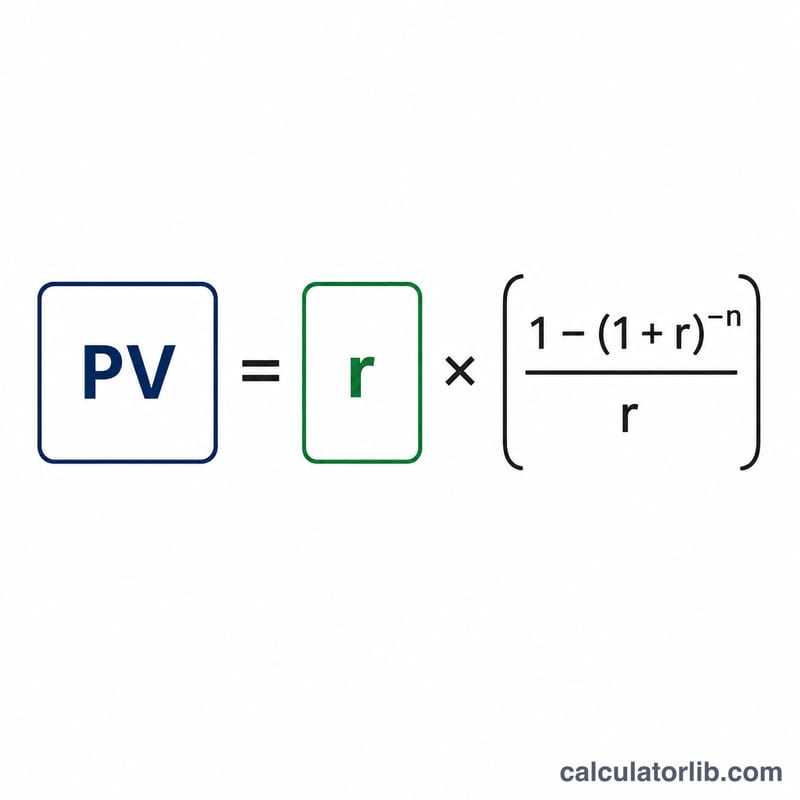
$$\text{Borrowable} = \text{PV}_{\text{monthly}} + \text{PV}_{\text{bonus}}$$The monthly stream uses the monthly rate \(i\) over \(n = \text{years} \times 12\) periods. The bonus stream is paid every six months, so it uses the equivalent six-month rate \(i_b = (1 + i)^6 - 1\) over \(\text{years} \times 2\) periods. Each stream's present value is
$$\text{PV} = \text{payment} \times \frac{1 - (1 + r)^{-n}}{r}$$and when the rate is zero we simply multiply payment by the number of periods.
Worked example
At 5% annual, 5-year term, 5 man-yen monthly and 10 man-yen per bonus month: \(i = 0.0041667\), \(n_m = 60\), \(i_b = 0.025263\), \(n_b = 10\). The monthly stream's present value is about 264.95 man-yen and the bonus stream's about 87.40 man-yen, for a borrowable amount near 352.35 man-yen, or about 3,523,500 JPY.
Borrowable Amount Under Different Scenarios
The table varies one factor at a time from a base case. The base case is a 2% annual rate, a 35-year term and a monthly repayment of 8 man-yen (1 man-yen = 10,000 yen) with no bonus-month repayment. The monthly repayment is fixed at 8 man-yen in every row. Amounts are in man-yen and use the equal-payment (genri-kinto) formula \(A = M\cdot\frac{1-(1+i)^{-n_M}}{i} + B\cdot\frac{1-(1+i_B)^{-n_B}}{i_B}\), where \(i\) is the annual rate divided by 12 and \(i_B=(1+i)^6-1\). The bonus rows use a bonus-month repayment of 10 man-yen, paid twice a year. Values are rounded to one decimal place.
| Annual rate | Term (years) | Bonus-month repayment B | Monthly portion | Bonus portion | Borrowable amount |
|---|---|---|---|---|---|
| 1% | 35 | 0 | 2,834.0 | 0 | 2,834.0 |
| 2% (base) | 35 | 0 | 2,415.0 | 0 | 2,415.0 |
| 5% | 35 | 0 | 1,585.1 | 0 | 1,585.1 |
| 2% | 20 | 0 | 1,581.4 | 0 | 1,581.4 |
| 2% | 30 | 0 | 2,164.4 | 0 | 2,164.4 |
| 2% | 35 | 10 | 2,415.0 | 501.0 | 2,916.0 |
Worked check for the last row: \(i = 0.02/12 = 0.0016667\), \(n_M = 420\), \((1+i)^{-420}\approx 0.49687\). The monthly factor is \((1-0.49687)/0.0016667 \approx 301.875\), so \(8 \times 301.875 \approx 2{,}415.0\). The six-month rate is \(i_B \approx 0.0100418\) with \(n_B = 70\), giving a bonus factor of \(0.50313/0.0100418 \approx 50.103\) and \(10 \times 50.103 \approx 501.0\). Total: \(2{,}415.0 + 501.0 \approx 2{,}916.0\) man-yen.
Takeaways: a lower rate and a longer term both raise the borrowable amount for the same repayment, and the bonus-month repayment adds a further portion.
Key Terms and Japanese Loan Vocabulary
- Genri-kinto (元利均等返済)
- The equal-payment (annuity) method. Principal plus interest is paid in the same total amount each period. Early payments are mostly interest, and the principal share grows over time.
- Man-yen (万円)
- A unit of 10,000 yen. 8 man-yen is 80,000 yen, and 2,415 man-yen is 24,150,000 yen.
- Bonus-month repayment (ボーナス払い)
- An extra repayment made in the two bonus months of the year, usually in addition to the regular monthly repayment. This calculator assumes two such payments per year, six months apart.
- Monthly rate vs annual rate
- The annual rate (年利) is the quoted nominal percentage. The monthly rate is the annual rate divided by 12, and as a decimal fraction divided by 1200 when the rate is entered as a percentage: \(i = r/1200\).
- Annuity factor
- The multiplier \(\frac{1-(1+i)^{-n}}{i}\), which converts a level payment into the present value of \(n\) such payments.
- Present value
- The value today of future payments, discounted at the loan rate. For a loan, the present value of all repayments equals the principal.
- Borrowable principal (借入可能額)
- The maximum loan amount \(A\) whose scheduled repayments equal the stated monthly and bonus-month amounts at the given rate and term.
- Repayment term (返済期間)
- The number of years of repayment. It gives \(n_M = 12 \times\) years monthly payments and \(n_B = 2 \times\) years bonus payments.
- Equivalent six-month rate \(i_B\)
- \(i_B = (1+i)^6 - 1\) is the interest growth over six months with monthly compounding. Bonus payments are six months apart, so this rate is used to discount them.
Interpreting the Borrowable Amount
The result is the principal whose present value equals the stated repayments. In other words, it is the loan that the given monthly and bonus-month repayments would exactly pay off at the entered rate and term under the equal-payment method. It is a mathematical result, not a loan offer or an approval.
- What is excluded: The figure does not include arrangement fees, guarantee fees, loan or life insurance premiums, taxes, or the down payment (頭金) and other purchase costs.
- Lender differences: Lenders may differ in rounding (such as truncating to whole yen), in how they set the rate (fixed, variable or stepped) and in how they treat bonus months. Actual figures can differ slightly from this calculation.
- Effect of bonus-month repayments: A larger share of bonus-month repayment raises the borrowable principal for the same monthly amount. It also concentrates payments in two months of the year. In the 2%, 35-year example, adding 10 man-yen in each bonus month raised the amount from about 2,415.0 to about 2,916.0 man-yen.
- Total interest: Total repayments minus principal equals total interest. In the same example, total repayments are \(8 \times 420 + 10 \times 70 = 4{,}060\) man-yen. The interest is \(4{,}060 - 2{,}916.0 \approx 1{,}144\) man-yen.
This is general information about how the calculation works, not financial advice. Rates, rules and fees vary by lender and country, and this tool follows the Japanese equal-payment convention.
Central bank policy rates today
The latest official policy rates of major central banks, updated automatically — the benchmark that bank deposit and loan rates follow.
- Bank of Japan · Japan
- 1.25%
- As of
- 2026-11-10
- Change in 1 year
- +0.75 pp
Latest change Up +25 bp Bank of Japan changed its rate on 2026-09-24: from 1.00% to 1.25%.
| Central bank | Policy rate | As of | Change in 1 year |
|---|---|---|---|
| Banco Central do Brasil (Selic) · Brazil | 13.75% | 2026-11-16 | −1.25 pp |
| Banco de México · Mexico | 6.25% | 2026-11-10 | −1.00 pp |
| Federal Reserve · United States | 3.75–4.00% | 2026-11-13 | 0 pp |
| ECB | 2.50% | 2026-11-16 | +0.50 pp |
| Sveriges Riksbank · Sweden | 2.00% | 2026-11-16 | +0.25 pp |
| Saudi Central Bank (SAMA) · Saudi Arabia | 4.50% | 2026-10-29 | 0 pp |
| Reserve Bank of Australia · Australia | 4.60% | 2026-10-31 | +1.00 pp |
| Central Bank of the Republic of Türkiye · Türkiye | 36.00% | 2026-11-06 | −3.50 pp |
| Bank of Russia · Russia | 14.00% | 2026-11-10 | −2.50 pp |
| People’s Bank of China · China | 3.00% | 2026-11-10 | 0 pp |
| Bank of Canada · Canada | 2.50% | 2026-11-13 | +0.25 pp |
| Reserve Bank of India · India | 5.50% | 2026-10-19 | 0 pp |
| Bank of England · United Kingdom | 4.00% | 2026-11-16 | 0 pp |
| Bank of Japan · Japan | 1.25% | 2026-11-10 | +0.75 pp |
| Bank of Korea · South Korea | 3.00% | 2026-11-02 | +0.50 pp |
Latest figure: 2026-11-10 Data last updated 2026-11-16 · current
Source: Banco Central do Brasil ODbL; Bank for International Settlements (BIS) Terms of permitted use of BIS statistics; Board of Governors of the Federal Reserve System Public domain (U.S. government work); European Central Bank ECB reuse policy; The World Bank Group CC BY 4.0; Sveriges Riksbank Riksbank open data terms; Reserve Bank of Australia 2026 RBA copyright terms (Cash Rate); Bank of Canada Bank of Canada terms of use; Bank of England Open Government Licence v3.0
The one-year change is computed by CalculatorLib from these data.
Source details and methodology
- Banco Central do Brasil
- Bank for International Settlements (BIS) — Central bank policy rates
- Board of Governors of the Federal Reserve System
- European Central Bank
- The World Bank Group — World Development Indicators (FR.INR.DPST, FR.INR.LEND, FR.INR.RINR, FR.INR.LNDP)
- Sveriges Riksbank
- Reserve Bank of Australia 2026
- Bank of Canada
- Bank of England
FAQ
Are the results exact? No. Rounding and fraction-handling rules vary by lender, so treat the figure as a reference estimate.
What if there is no bonus payment? Enter 0 for the bonus amount; only the monthly stream is counted.
Annual or monthly rate? Most quoted loan rates are annual; pick "Annual rate" so it is divided by 12 into a monthly rate.