What This Calculator Does
When an investment, account balance, or any quantity drops by a certain percentage, you need a larger percentage gain to climb back to where you started. This is because the gain is applied to a smaller base. This calculator tells you exactly what percent increase is required to fully recover from any percentage loss.
How to Use It
Enter the percentage you lost (for example, 20 for a 20% drop) and press calculate. The tool shows the required percent gain to break even, along with the recovery multiplier — the factor your reduced value must be multiplied by to return to the original.
The Formula Explained
The required gain is given by:
$$\text{gain\%} = \frac{\text{loss\%}}{100 - \text{loss\%}} \times 100$$
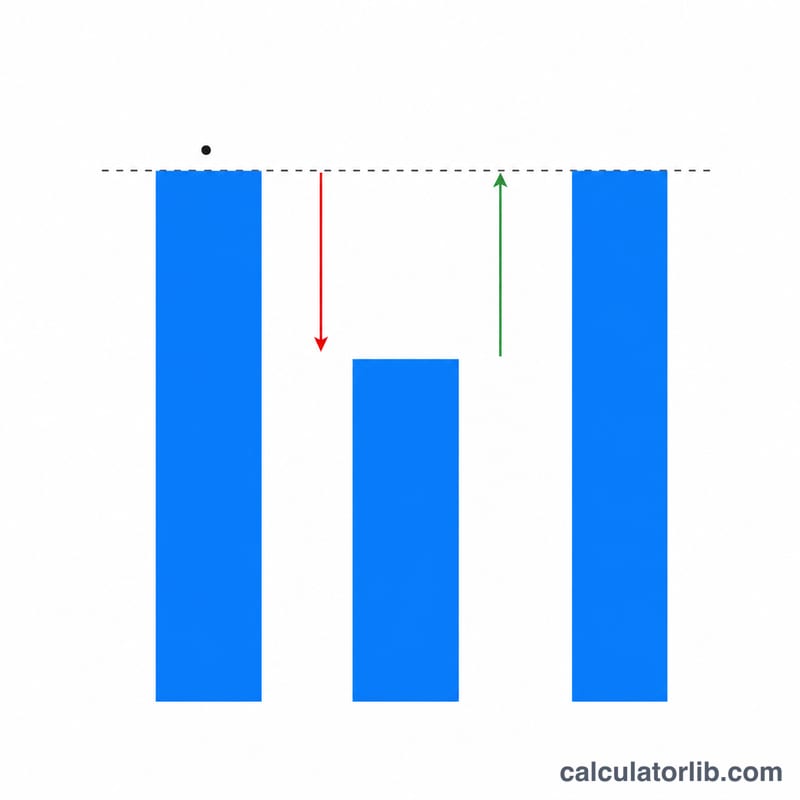
If you lose L percent, you keep (100 − L) percent of the original value. To get from that smaller base back to 100, you must gain L relative to (100 − L), which is always more than L itself. The bigger the loss, the more dramatically the required gain grows — a 50% loss needs a 100% gain, and a 90% loss needs a 900% gain.
Worked Example
Suppose a stock falls 20%. Plugging in: $$\text{gain\%} = \frac{20}{100 - 20} \times 100 = \frac{20}{80} \times 100 = 25\%.$$ So after a 20% loss you need a 25% gain just to break even. The recovery multiplier is \(100 / 80 = 1.25\times\).
Required Recovery Gain by Loss Size
The gain needed to get back to the starting value is \(\text{Gain} = \frac{L}{100 - L} \times 100\), where \(L\) is the percentage loss. The recovery multiplier is the factor by which the reduced value must be multiplied to return to the original, \(\frac{100}{100 - L}\).
| Loss (%) | Required gain (%) | Recovery multiplier |
|---|---|---|
| 5 | 5.26 | 1.0526× |
| 10 | 11.11 | 1.1111× |
| 20 | 25.00 | 1.25× |
| 25 | 33.33 | 1.3333× |
| 33.3 | 49.93 | 1.4993× |
| 50 | 100.00 | 2× |
| 60 | 150.00 | 2.5× |
| 75 | 300 | 4× |
| 90 | 900 | 10× |
| 95 | 1,900 | 20× |
| 99 | 9,900 | 100× |
Example: after a 25% loss, \(\frac{25}{100 - 25} \times 100 = \frac{25}{75} \times 100 = 33.33\%\). Check: 100 × 0.75 = 75, and 75 × 1.3333 = 100.
Interpreting Your Result
For any loss greater than 0%, the gain required to recover is always larger than the loss itself. This is because a percentage gain is applied to the reduced value, which is a smaller base than the original. A 50% loss leaves half the original amount, so the remainder must double (a 100% gain) to return to the start.
The relationship is not linear. Small losses need only slightly larger gains: a 5% loss needs about 5.26%, and a 10% loss needs about 11.11%. Deeper losses need disproportionately larger gains: 50% needs 100%, 75% needs 300%, and 90% needs 900%. As the loss approaches 100%, the required gain grows without limit, and a 100% loss cannot be recovered by any percentage gain because the base is zero.
The recovery multiplier equals \(\frac{1}{1 - r}\), where \(r\) is the loss as a decimal (for example, \(r = 0.25\) gives \(\frac{1}{0.75} = 1.3333\)). The required gain is that multiplier minus 1, expressed as a percentage.
The result is pure arithmetic of percentage change. It describes only the size of the gain needed to return to the original value and ignores the time it might take, fees, taxes, inflation, or any other costs.
FAQ
Why isn't the recovery gain the same as the loss? Because percentages are relative to the current value. After a loss your base is smaller, so the same dollar recovery represents a bigger percentage of that smaller base.
What happens at a 100% loss? A 100% loss means the value is zero, so no finite percentage gain can recover it. The calculator limits inputs below 100%.
Does this work for any quantity? Yes — it applies to investments, prices, weights, populations, or any value that drops by a percentage and needs to return to its original level.