
What this calculator does
Jurisdiction: United States. This tool estimates your annual property tax as a flat percentage of your home's assessed value, and optionally forecasts (or back-casts) that tax across several years when the assessed value rises by a fixed annual percentage. It is an estimate only and does not include special assessments, parcel taxes, voter-approved bonds, or exemptions (such as a homestead exemption) that may appear on a real tax bill.
How to use it
Enter the Assessed Value (the assessor's value of your property, often the most recent purchase price), the annual Tax Rate as a percent, and the Starting Tax Year used as the first row label. To project multiple years, set the Annual Increase (the percentage your assessed value rises each year) and the Number of Years. For a single flat estimate, leave the annual increase at 0 and years at 1.
The formula explained
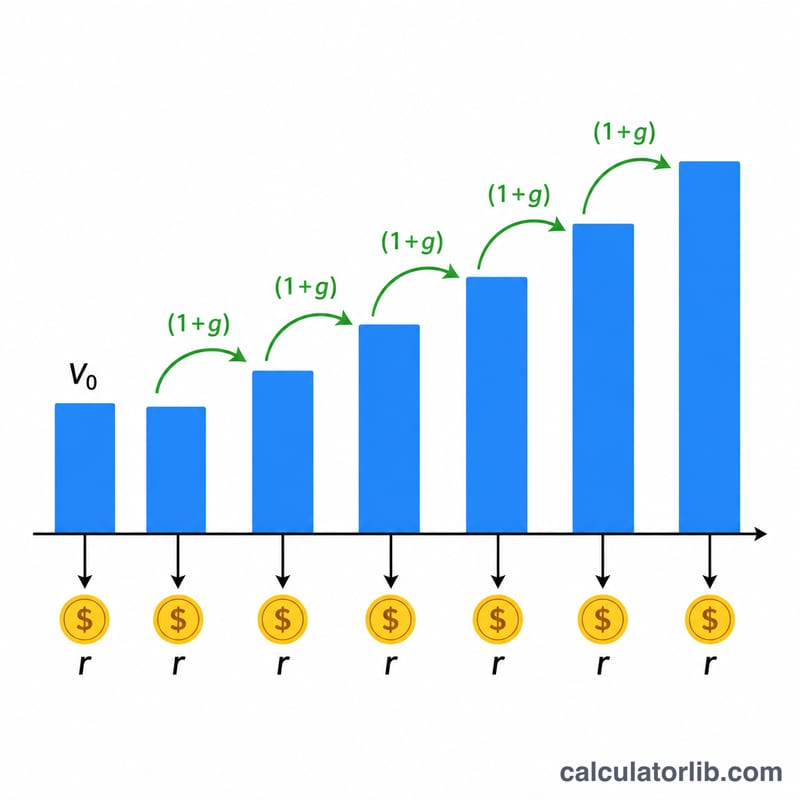
Let \(V_0\) be the assessed value, \(r = \text{taxRate} \div 100\), and \(g = \text{annualIncrease} \div 100\). For each year index \(i = 0, 1, \ldots, N-1\), the assessment value is \(V_0 \times (1 + g)^i\) and the property tax is that value \(\times\, r\):
$$\text{Property Tax}_i = V_0 \times (1 + g)^i \times r$$
The total taxes are the sum across all displayed years:
$$\text{Total} = \sum_{i=0}^{N-1} V_0 (1+g)^i \, r$$
The starting year is only a label and does not affect the math.
California Proposition 13 note
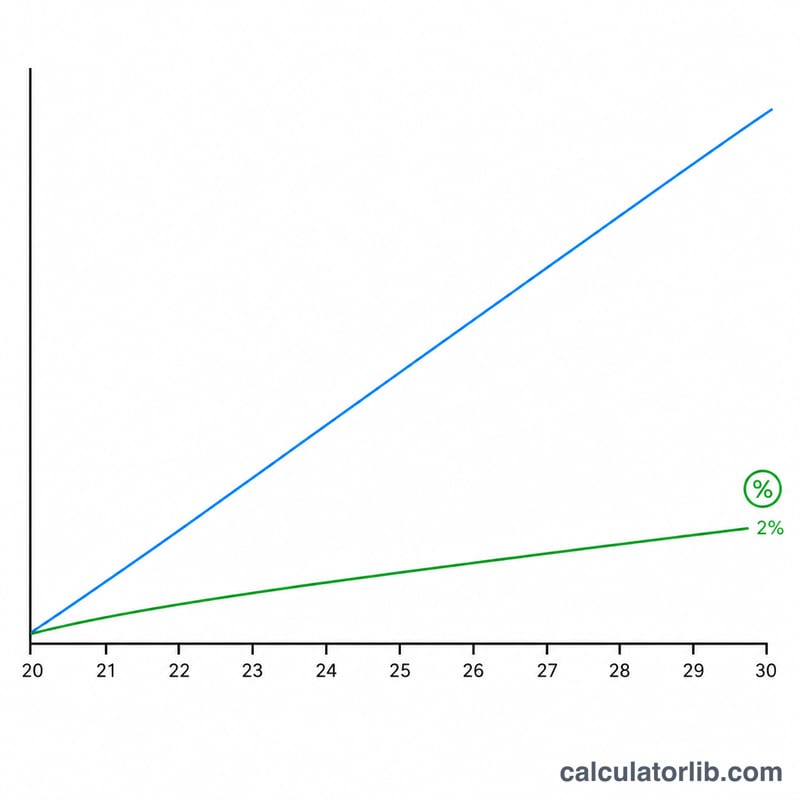
Under California's Proposition 13, a property's taxable assessed value can rise by no more than 2% per year (until a change of ownership or new construction triggers reassessment). To model this, set the Annual Increase to 2. Other jurisdictions and growth assumptions can be modeled with any value you choose.
Worked example
Assessed Value $500,000, Tax Rate 1.0%, Starting Year 2024, Annual Increase 2%, 3 years. Year 2024: $500,000 → tax $5,000.00. Year 2025: $510,000 → $5,100.00. Year 2026: $520,200 → $5,202.00. Total = $15,302.00.
$$500{,}000 \times (1.02)^0 \times 0.01 = 5{,}000.00$$
$$500{,}000 \times (1.02)^1 \times 0.01 = 5{,}100.00$$
$$500{,}000 \times (1.02)^2 \times 0.01 = 5{,}202.00$$
$$5{,}000.00 + 5{,}100.00 + 5{,}202.00 = 15{,}302.00$$
FAQ
Is the assessed value the same as market value? Not necessarily. The assessed value is set by your county assessor and can differ from the current market price, especially where annual increases are capped.
Does the starting tax year change the result? No. It is purely a row label for the output table; the math depends only on assessed value, rate, increase, and number of years.
Why is my real bill different? Real bills often add parcel taxes, special assessments, and bonds, and may subtract exemptions. This calculator models only the core value \(\times\) rate computation.