What this calculator does
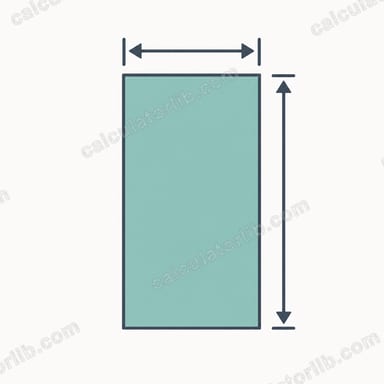
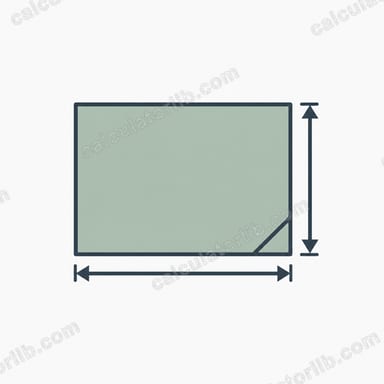
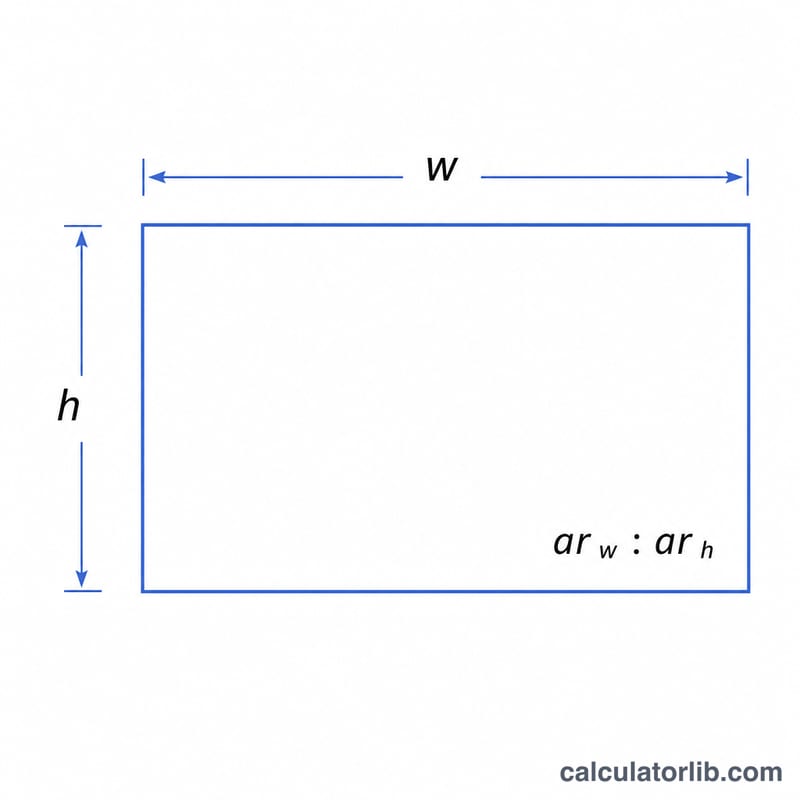
This tool computes the height of a rectangle when you already know its width and the aspect ratio you want to keep. Aspect ratio describes the proportional relationship between width and height — for example 16:9 for widescreen video, 4:3 for classic displays, or 3:2 for many photographs. By locking width and ratio, the height is fully determined.
How to use it
Enter the width in whatever units you like (pixels, cm, inches). Then enter the two parts of the aspect ratio: the width part (left of the colon) and the height part (right of the colon). For a 16:9 frame, use 16 as the aspect-width and 9 as the aspect-height. The calculator returns the matching height and the total area.
The formula explained
The governing equation is:
$$\text{Height} = \text{Width} \times \frac{\text{Aspect Ratio Height}}{\text{Aspect Ratio Width}}$$
Because the rectangle keeps the same proportions, the ratio of height to width must equal the ratio of the aspect numbers. Rearranging gives the height directly. The area is simply \(\text{width} \times \text{height}\).
Worked example
Suppose you have a banner that is 1920 px wide and you want it in 16:9. Then $$h = 1920 \times \frac{9}{16} = 1920 \times 0.5625 = \mathbf{1080 \text{ px}}.$$ The area is \(1920 \times 1080 = 2{,}073{,}600\) square pixels.
Common Aspect Ratios and Their Height Multipliers
An aspect ratio written as W:H means that for every W units of width there are H units of height. The height multiplier is simply H ÷ W, so \(\text{Height} = \text{Width} \times \frac{H}{W}\). Multiply any width by the value in the table to get the height.
| Aspect ratio (W:H) | Height per 1 unit of width | Typical uses |
|---|---|---|
| 1:1 | 1.0000 | Square social media posts, profile pictures, album art |
| 5:4 | 0.8000 | Some older 1280×1024 monitors, 8×10 in photo prints, portrait-style social posts (4:5 is the rotated version) |
| 4:3 | 0.7500 | Older standard-definition TV, many compact cameras, tablets |
| 3:2 | 0.6667 | 35 mm film and many DSLR/mirrorless photos, 6×4 in prints |
| 16:10 | 0.6250 | Some laptop and desktop monitors (e.g. 1920×1200) |
| 16:9 | 0.5625 | HD/4K video, most TVs and monitors, YouTube |
| 21:9 | 0.4286 (9 ÷ 21 = 0.428571…) | Ultrawide monitors and cinematic-style video; actual products are often slightly different, such as 64:27 or 43:18, and are marketed as 21:9 |
| 9:16 | 1.7778 | Vertical video such as phone stories and short-form clips |
| 2:1 | 0.5000 | Banner images, some wide web headers, some phone screens |
Multipliers are rounded to four decimals. For exact results, use the fraction H/W rather than the rounded decimal.
Height Comparison for a Fixed Width Across Ratios
The table below keeps the width fixed at 1920 px and shows how the height changes with the aspect ratio, using \(\text{Height} = 1920 \times \frac{H}{W}\).
| Aspect ratio | Calculation | Height (px) |
|---|---|---|
| 1:1 | 1920 × 1/1 | 1920 |
| 4:3 | 1920 × 3/4 | 1440 |
| 3:2 | 1920 × 2/3 | 1280 |
| 16:10 | 1920 × 10/16 | 1200 |
| 16:9 | 1920 × 9/16 | 1080 |
| 21:9 | 1920 × 9/21 = 17280 ÷ 21 = 822.857… | ≈ 823 |
Rounding note: only 21:9 gives a non-integer height at this width. Pixel dimensions must be whole numbers, so 822.857 is rounded to 823 px (or 822 px if you want an even number for video encoding). Rounding slightly changes the true ratio, so for exact proportions choose a width that divides evenly, for example a width that is a multiple of 21 for 21:9. The same method works for any unit, such as 1000 mm wide at 4:3, which gives 1000 × 3/4 = 750 mm.
FAQ
Can I use any units? Yes — the height comes out in the same unit you entered for width, since ratios are unitless.
What if I know the height and want the width? Swap the values: \(w = h \times \frac{\text{ar}_w}{\text{ar}_h}\).
What does an aspect-width of zero do? Division by zero is undefined, so the calculator returns 0 to avoid an error — enter a positive aspect-width.