What the Rent Calculator Does
This Rent Calculator helps you work out how much rent you can comfortably afford based on two simple inputs: your pre-tax monthly income and your total monthly debt payments. Instead of guessing, it applies several recognised affordability rules at once so you can compare a generous limit, a strict limit and a debt-adjusted limit side by side. The debt figures use US-style lending conventions (the 36% and 43% debt-to-income thresholds common to American mortgage and rental underwriting), so it is most directly applicable in the United States, though the logic works anywhere.
The Inputs You Provide
- Your Pre-tax Monthly Income — your gross monthly earnings before taxes are deducted.
- Your Monthly Debt Payments — total recurring debt obligations, including car loans, student loans and credit card minimum payments.
The Formulas Used
The calculator runs three scenarios from your numbers:
- 30% Rule: Max Rent = Income × 0.30 — the classic conservative benchmark.
- 40% Rule: Max Rent = Income × 0.40 — an upper limit used in some high-cost areas.
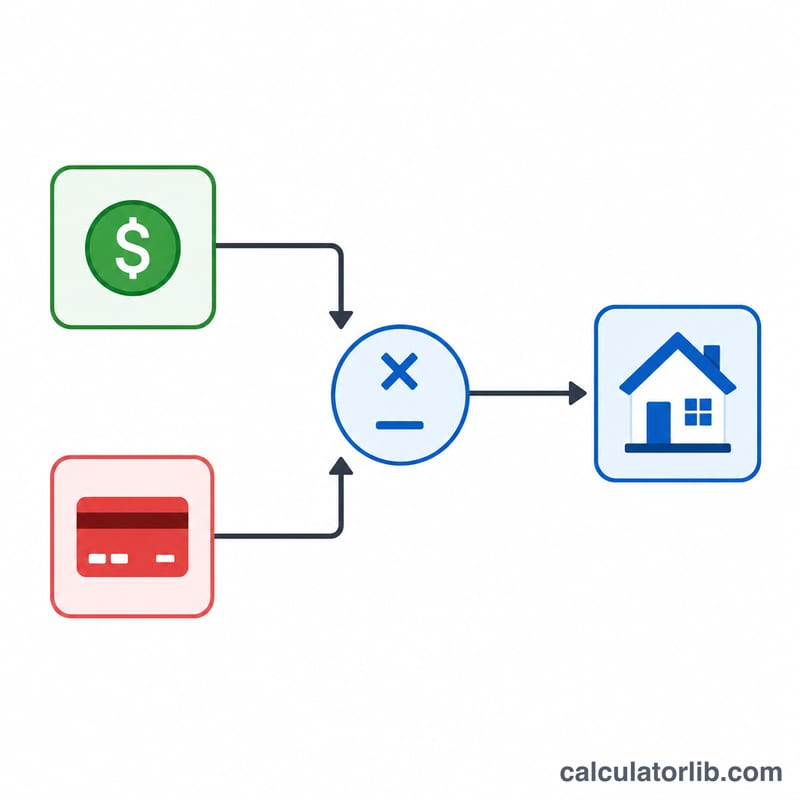
- Debt-Adjusted Max Rent: Max Rent = (Income × 0.36) − Monthly Debt — this reflects your real capacity after existing debt.
It also computes your debt-to-income ratio (Debt ÷ Income × 100) and assigns a status: Manageable, Caution (over 36%), High Risk (over 43%) or Not Recommended (when debt leaves no room for rent).
Worked Example
Suppose your pre-tax monthly income is $5,000 and your monthly debt payments total $600.
- 30% Rule: 5,000 × 0.30 = $1,500
- 40% Rule: 5,000 × 0.40 = $2,000
- Debt-Adjusted: (5,000 × 0.36) − 600 = 1,800 − 600 = $1,200
Your debt-to-income ratio is 600 ÷ 5,000 = 12%, well under 36%, so the status is Manageable. Since $1,200 falls between 20% and 40% of income, the recommendation is that this is a reasonable budget for your income.
Rent Affordability at Different Income and Debt Levels
The table compares three common ways to estimate rent from gross (pre-tax) monthly income. The 30% rule is \(0.30 \times \text{Income}\), the 40% rule is \(0.40 \times \text{Income}\), and the debt-adjusted rent used by this calculator is \(0.36 \times \text{Income} - \text{Debt}\). DTI here means existing monthly debt divided by gross monthly income, before adding any rent.
| Monthly income | Monthly debt | 30% rule rent | 40% rule rent | Debt-adjusted rent (income × 0.36 − debt) | DTI (debt ÷ income) | Status |
|---|---|---|---|---|---|---|
| $3,000 | $0 | $900 | $1,200 | $1,080 | 0% | Manageable |
| $4,000 | $500 | $1,200 | $1,600 | $940 | 12.5% | Manageable |
| $5,000 | $600 | $1,500 | $2,000 | $1,200 | 12% | Manageable |
| $6,500 | $1,200 | $1,950 | $2,600 | $1,140 | 18.5% | Manageable |
| $8,000 | $2,500 | $2,400 | $3,200 | $380 | 31.3% | Manageable (but very little room for rent) |
Worked example ($5,000 income, $600 debt): \(0.36 \times 5000 - 600 = 1800 - 600 = 1200\). The 30% rule would suggest $1,500, so existing debt lowers the suggested rent by $300.
Takeaway: the last row shows why debt matters. Income of $8,000 supports $2,400 under the 30% rule, but $2,500 of monthly debt leaves only $380 under the debt-adjusted formula. All figures are general budgeting estimates, not guarantees of what a landlord will approve.
Debt-to-Income Thresholds and Status Levels
| Debt-to-income ratio | Status | What it means |
|---|---|---|
| Up to 36% | Manageable | Total debt obligations are within the commonly cited comfortable range. |
| Over 36% up to 43% | Caution | Obligations are stretched; there is less margin for savings and emergencies. |
| Over 43% | High Risk | Obligations are heavy relative to income; unexpected costs could be hard to absorb. |
| Existing debt ≥ 36% of income | Not Recommended | The debt-adjusted formula leaves nothing (\(0.36 \times \text{Income} - \text{Debt} \le 0\)) for rent. |
The 36% and 43% figures come from US lending conventions. 36% is a widely used guideline for total debt-to-income, and 43% has historically been a common upper limit for qualifying for certain US mortgages. They are general benchmarks, not limits set by any specific lender or landlord, and requirements vary by country, lender and property. The Caution and High Risk bands are most relevant when you test a rent higher than the calculated maximum, because adding that rent to your existing debt pushes total obligations above 36% of income.
Key Terms Explained
- Gross (pre-tax) income
- Your income before taxes and payroll deductions. This calculator expects gross monthly income, which is annual gross pay divided by 12.
- Net income
- Take-home pay after taxes and deductions. Because net income is lower, a budget built on it may suggest a lower rent than the gross-based formula.
- Debt-to-income ratio (DTI)
- Monthly debt payments divided by gross monthly income, shown as a percentage. For example, \(600 \div 5000 = 12\%\).
- Monthly debt payments
- Minimum recurring payments on obligations such as car loans, student loans, credit cards (minimum payment), personal loans and child support or alimony. Everyday living costs such as utilities, groceries, insurance, phone and subscriptions are typically excluded. Rent itself is also left out, since it is what the tool solves for.
- The 30% rule
- A common rule of thumb that housing should cost no more than 30% of gross income. It ignores existing debt, so it can overstate what is affordable for people with large obligations.
- Debt-adjusted rent
- The tool's result: \(\text{Max Rent} = 0.36 \times \text{Monthly Income} - \text{Monthly Debt}\). It keeps rent plus other debt payments within 36% of gross income.
This is general information, not financial advice. Your own budget, savings goals and local rental market should guide your final decision.
Frequently Asked Questions
Why is the debt-adjusted rent lower than the 30% figure? Because it subtracts your existing debt from 36% of income. The more debt you carry, the less is left for rent — giving a more realistic picture than the flat 30% rule.
What if the debt-adjusted result is negative? That means your debt already exceeds your affordable housing budget. The tool flags this as "Not Recommended" and suggests reducing debt before renting.
Should I use gross or net income? Use pre-tax (gross) income, as that is what landlords and the 30%/36% rules are based on.