What the EAR Calculator Does
The Effective Annual Rate (EAR) calculator converts a quoted nominal (stated) annual interest rate into the true yearly rate you actually earn or pay once compounding is taken into account. Because interest charged or earned more often than once a year "earns interest on interest," the effective rate is always higher than the stated rate. This tool works for any investment, savings account, or loan worldwide — it is not country-specific.
The Inputs You Enter
- Annual rate (%) — the nominal or stated yearly interest rate (defaults to 6%).
- Compounding frequency — how often interest is applied. The calculator supports a wide range: annually (1), semi-annually (2), quarterly (4), bi-monthly (6), monthly (12), semi-monthly (24), bi-weekly (26), weekly (52), daily on a 360-day basis, daily on a 365-day basis, and continuous compounding.
Helpfully, the calculator displays the EAR for every compounding frequency at once, so you can compare options side by side.
The Formula
For a finite number of compounding periods n and nominal rate r (as a decimal):
$$\text{EAR} = \left(1 + \frac{r}{n}\right)^{n} - 1$$
For continuous compounding the calculator uses the exponential form: $$\text{EAR} = e^{r} - 1$$ Results are rounded to six decimal places and shown as a percentage.
Worked Example
Suppose you have a nominal rate of 6% compounded quarterly (\(n = 4\)):
- \(r = 0.06\), \(n = 4\)
- $$\text{EAR} = \left(1 + \frac{0.06}{4}\right)^{4} - 1 = (1.015)^{4} - 1$$
- $$\text{EAR} = 1.06136 - 1 = 0.06136$$ or about 6.1364%
So a 6% rate compounded quarterly truly yields 6.1364% per year. Compounded monthly it rises to about 6.1678%, and with continuous compounding to roughly 6.1837%.
EAR Across Compounding Frequencies and Rates
The table shows the effective annual rate for several nominal (stated) annual rates. Each value uses \(\text{EAR} = (1 + r/n)^n - 1\), where \(r\) is the nominal rate as a decimal and \(n\) is the number of compounding periods per year. The continuous column uses \(e^r - 1\). Values are rounded to four decimals, in percent.
| Nominal rate | Annual (n=1) | Quarterly (n=4) | Monthly (n=12) | Daily (n=365) | Continuous |
|---|---|---|---|---|---|
| 3% | 3.0000% | 3.0339% | 3.0416% | 3.0453% | 3.0455% |
| 6% | 6.0000% | 6.1364% | 6.1678% | 6.1831% | 6.1837% |
| 10% | 10.0000% | 10.3813% | 10.4713% | 10.5156% | 10.5171% |
| 15% | 15.0000% | 15.8650% | 16.0755% | 16.1798% | 16.1834% |
| 20% | 20.0000% | 21.5506% | 21.9391% | 22.1336% | 22.1403% |
Example of the substitution for 10% compounded monthly: \((1 + 0.10/12)^{12} - 1 = (1.008333…)^{12} - 1 \approx 1.104713 - 1 = 0.104713\), or about 10.4713%.
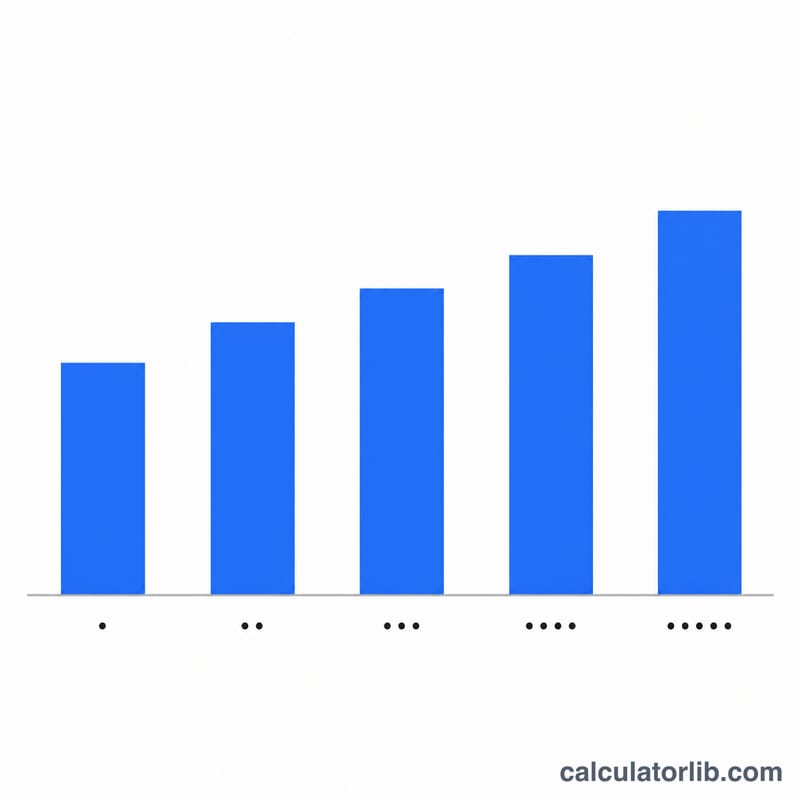
Notice that the step from annual to quarterly compounding adds far more than the step from monthly to daily, and the gain from daily to continuous is tiny.
Key Terms: Nominal Rate, EAR, APR and APY
- Nominal rate (stated rate)
- The annual interest rate quoted before the effect of compounding within the year is counted. Example: "12% compounded monthly".
- Compounding frequency
- How many times per year interest is calculated and added to the balance (\(n\)): 1 for annual, 2 semiannual, 4 quarterly, 12 monthly, 52 weekly, 365 daily.
- EAR (Effective Annual Rate)
- The rate that, compounded once per year, gives the same growth as the nominal rate compounded \(n\) times: \(\text{EAR} = (1 + r/n)^n - 1\).
- APY (Annual Percentage Yield)
- The term commonly used for deposit and savings products. It is the same quantity as EAR: the annual yield including compounding.
- APR (Annual Percentage Rate)
- A yearly rate that is generally quoted as a nominal figure and does not itself include the effect of intra-year compounding. Exact APR definitions, and whether fees are included, vary by country and regulation, so check the rules that apply where the product is offered.
- Continuous compounding
- The theoretical limit as \(n \to \infty\): \(\text{EAR} = e^r - 1\).
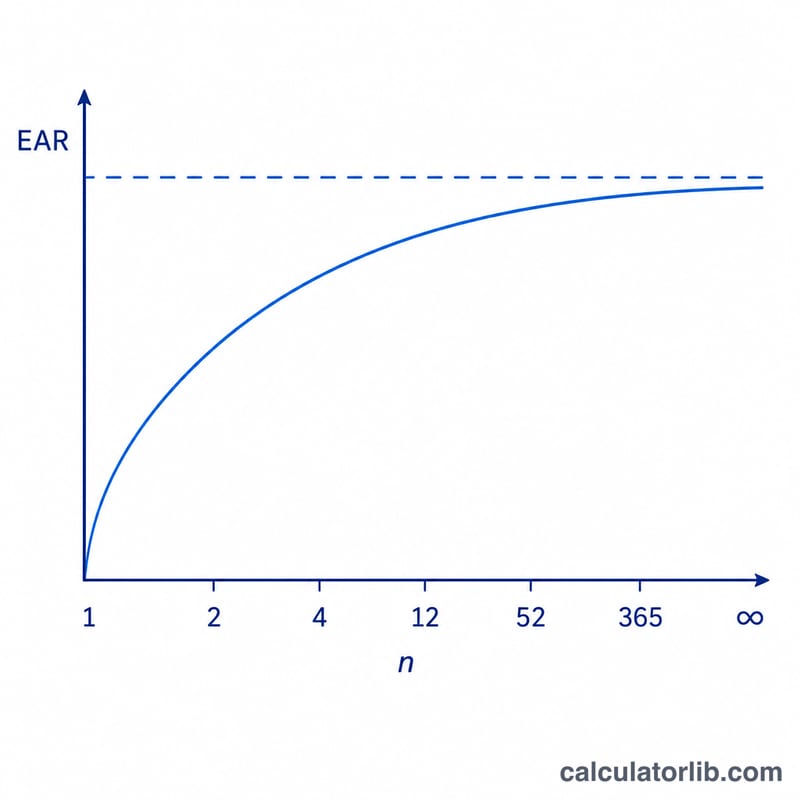
Relationship: for the same nominal rate, EAR ≥ nominal rate, with equality only when compounding is annual (\(n=1\)). EAR rises with \(n\) and approaches \(e^r - 1\).
Interpreting Your EAR Result
The difference between the EAR and the nominal rate is purely the effect of compounding: interest earned (or charged) in earlier periods itself earns interest in later periods. If the two figures are equal, compounding happens only once a year.
- Higher rates widen the gap. At 3% monthly compounding adds about 0.04 percentage points; at 20% it adds about 1.94 points.
- More frequent compounding raises EAR, with diminishing returns. Moving from annual to quarterly gives the biggest jump, while going from daily to continuous adds very little. The ceiling is \(e^r - 1\).
- EAR and APY are equivalent measures of annual yield, so either can be used to compare savings or investment products with different compounding schedules.
- The same measure applies to borrowing. For a loan or credit balance, the EAR shows the true annual cost of interest when compounding is more frequent than yearly. For an investment, it shows the true annual growth rate.
To compare two offers fairly, convert both to EAR first; the higher EAR means faster growth of a balance (better for savers, costlier for borrowers). EAR reflects only the interest rate and compounding; fees, taxes and changes in rates are not included.
This is general information, not professional financial advice.
Frequently Asked Questions
Why is EAR higher than the nominal rate? Because interest is added more than once per year and subsequent interest is calculated on the already-increased balance. The more frequent the compounding, the higher the EAR.
What does the 360 vs 365 daily option mean? Some institutions assume a 360-day year for daily compounding while others use the actual 365 days. The calculator shows both so you can match your lender's convention.
When should I use EAR? Use it to fairly compare loans or investments that quote different compounding frequencies — EAR puts them all on the same annual basis.