What Is the Sodium in Salt Calculator?
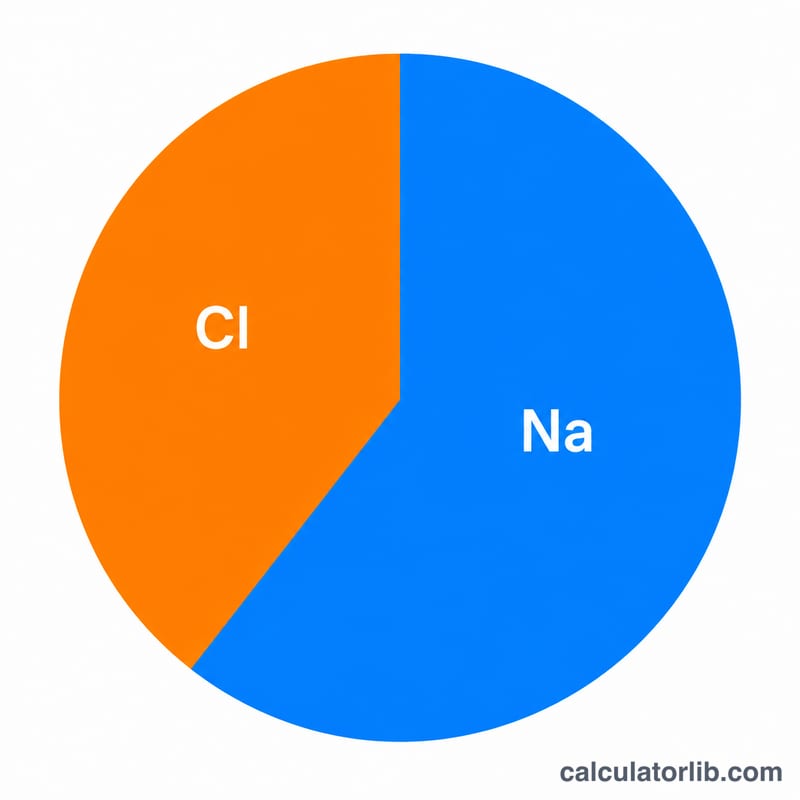
Table salt is chemically sodium chloride (NaCl). Because the sodium atom makes up only part of the molecule, salt is not 100% sodium. By mass, sodium accounts for roughly 39.3% of pure table salt. This calculator converts an amount of salt in grams into the equivalent amount of sodium in milligrams (mg) — the figure that matters most for health and nutrition guidelines.
How to Use It
Enter the amount of salt in grams and the calculator instantly returns the sodium content in milligrams. This is handy for reading food labels, planning low-sodium diets, or converting between the "salt" figures common on European packaging and the "sodium" figures common on US Nutrition Facts labels.
The Formula Explained
The conversion uses the mass fraction of sodium in sodium chloride:
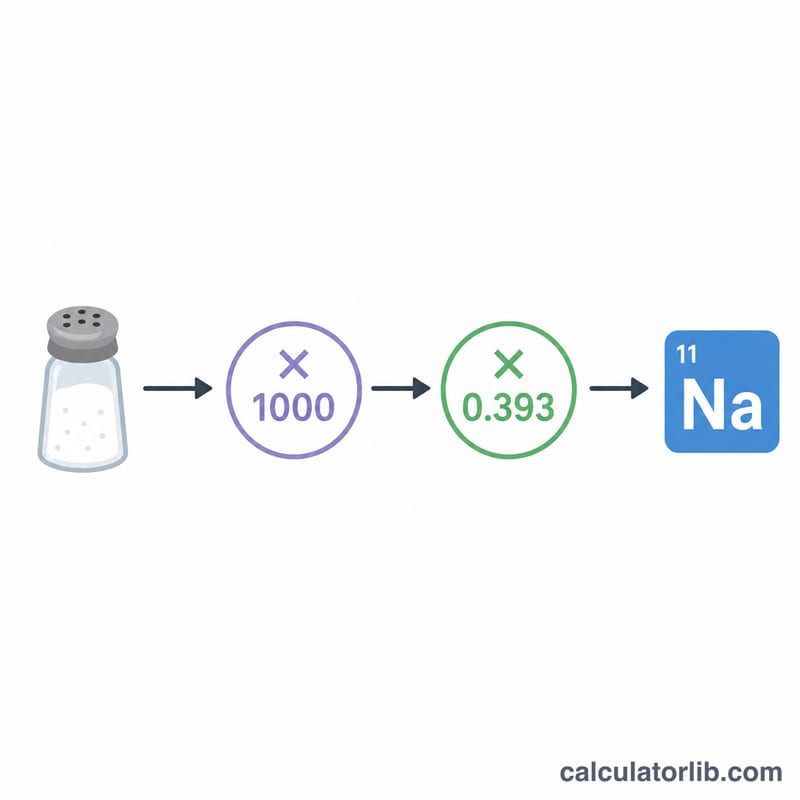
$$\text{Sodium (mg)} = \text{Salt (g)} \times 1000 \times 0.393$$
Multiplying grams by 1000 converts to milligrams, and the 0.393 factor accounts for sodium being about 39.3% of salt by weight. Equivalently, every 1 gram of salt ≈ 393 mg of sodium, and to reverse it, multiply sodium by about 2.5 to estimate salt.
Worked Example
Suppose a serving contains 5 grams of salt. Sodium \(= 5 \times 1000 \times 0.393 = 1{,}965\) mg of sodium. That is close to the World Health Organization's recommended daily limit of about 2,000 mg of sodium (≈ 5 g of salt) per day.
Salt to Sodium Quick Conversion Table
Sodium makes up about 39.3% of table salt (sodium chloride) by mass, so each gram of salt contains about 393 mg of sodium. The formula is \(\text{Sodium (mg)} = \text{Salt (g)} \times 1000 \times 0.393\).
| Salt | Sodium (mg) |
|---|---|
| 0.5 g | 196.5 mg |
| 1 g | 393 mg |
| 2 g | 786 mg |
| 2.5 g | 982.5 mg |
| 5 g | 1,965 mg |
| 6 g | 2,358 mg |
| 10 g | 3,930 mg |
| 1 level teaspoon of table salt (about 5.7-6 g) | about 2,300 mg (roughly 2,240-2,360 mg) |
Teaspoon weights vary with grain size: coarse or flaky salts weigh less per teaspoon than fine table salt, so they contain less sodium by volume.
Reverse: Sodium to Salt
To go from sodium to salt, multiply sodium by about 2.54 (that is, \(1 \div 0.393\)).
| Sodium (mg) | Salt equivalent (g) |
|---|---|
| 500 mg | about 1.27 g |
| 1,000 mg | about 2.54 g |
| 1,500 mg | about 3.81 g |
| 2,000 mg | about 5.08 g |
| 2,300 mg | about 5.84 g |
Recommended Daily Sodium and Salt Limits
The figures below are general population guidelines for adults, not personal targets. Individual needs differ.
| Source | Sodium per day | Approx. salt per day |
|---|---|---|
| World Health Organization (WHO), adults | under 2,000 mg | about 5 g |
| US Dietary Guidelines for Americans and FDA Daily Value (United States) | under 2,300 mg | about 5.8 g |
| American Heart Association (AHA), ideal limit for most adults (United States) | 1,500 mg | about 3.8 g |
These are upper limits, not goals to reach. The WHO and US figures apply to the general adult population, and the AHA's 1,500 mg is described as an ideal limit. This is general information, not professional advice; ask a doctor or registered dietitian about your own situation.
Interpreting Your Result
To see your result in context, divide it by the US FDA Daily Value (DV) for sodium, 2,300 mg:
$$\%\text{DV} = \frac{ \text{Sodium (mg)} }{2300} \times 100$$
For example, 5 g of salt gives 1,965 mg of sodium, and \(1965 \div 2300 \times 100 \approx 85\%\) of the DV. A 6 g portion gives 2,358 mg, about 103% of the DV.
The FDA's %DV guidance (United States) treats 5% DV or less as low and 20% DV or more as high for a nutrient per serving. For sodium, 5% DV is about 115 mg and 20% DV is about 460 mg.
- Label differences: US labels list sodium, while EU and many other regions list salt. Salt is about 2.5 times the sodium figure, so 1 g of sodium equals about 2.5 g of salt. Check which one a label shows before comparing.
- Salt-only conversion: The calculator assumes the sodium comes from sodium chloride. Other sodium sources, such as sodium bicarbonate (baking soda), monosodium glutamate (MSG) and sodium-based preservatives, are not included, so your total sodium intake may be higher.
This is general information, not medical advice. Consult a healthcare professional about your own sodium needs.
FAQ
Is salt the same as sodium? No. Salt (sodium chloride) contains both sodium and chloride; only about 39.3% of its weight is sodium.
How do I convert sodium back to salt? Multiply sodium (in grams) by about 2.5 to get salt in grams.
Why 39.3% and not 40%? It comes from atomic masses: sodium ≈ 23.0 and chloride ≈ 35.45, so \(23.0 \div 58.45 \approx 0.393\).