What Is the Thin Lens Equation?
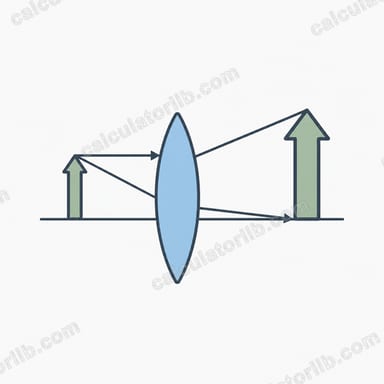
The thin lens equation describes how a lens forms an image. It connects three quantities: the focal length f of the lens, the distance from the object to the lens dₒ, and the distance from the lens to the image dₕ. This calculator solves for the image distance and the magnification, so you can predict where an image will appear and whether it is enlarged, reduced, upright, or inverted.
How to Use It
Enter the focal length and the object distance using consistent units (centimeters are common in optics problems). A converging (convex) lens has a positive focal length; a diverging (concave) lens has a negative focal length. The calculator returns the image distance and the magnification automatically.
The Formula Explained
The governing relationship is \(1/f = 1/d_o + 1/d_i\). Rearranged to find the image distance:
$$\frac{1}{d_i} = \frac{1}{f} - \frac{1}{d_o}$$The magnification is
$$M = -\frac{d_i}{d_o}$$A positive \(d_i\) means a real image forms on the opposite side of the lens; a negative \(d_i\) means a virtual image forms on the same side as the object. A negative \(M\) indicates an inverted image, while a positive \(M\) indicates an upright image.

Worked Example
Suppose a converging lens has \(f = 10\,\text{cm}\) and an object sits at \(d_o = 30\,\text{cm}\). Then
$$\frac{1}{d_i} = \frac{1}{10} - \frac{1}{30} = \frac{3}{30} - \frac{1}{30} = \frac{2}{30}$$so \(d_i = 15\,\text{cm}\). The magnification is \(M = -15/30 = -0.5\), meaning the image is real, inverted, and half the size of the object.

Image Characteristics by Object Position
The table below uses a converging (convex) thin lens with focal length \(f = 10\) cm. It uses the real-is-positive sign convention: \(\frac{1}{d_i} = \frac{1}{f} - \frac{1}{d_o}\) and magnification \(M = -\frac{d_i}{d_o}\).
| Object position | do (cm) | Computed di (cm) | Magnification M | Real / virtual | Upright / inverted | Enlarged / reduced |
|---|---|---|---|---|---|---|
| Beyond 2f | 30 | 15 | −0.5 | Real | Inverted | Reduced |
| At 2f | 20 | 20 | −1 | Real | Inverted | Same size |
| Between f and 2f | 15 | 30 | −2 | Real | Inverted | Enlarged |
| At f | 10 | No finite image (∞) | Undefined | Rays emerge parallel | — | — |
| Inside f | 5 | −10 | +2 | Virtual | Upright | Enlarged |
Example substitutions: for \(d_o = 30\) cm, \(\frac{1}{d_i} = \frac{1}{10} - \frac{1}{30} = \frac{2}{30}\), so \(d_i = 15\) cm and \(M = -\frac{15}{30} = -0.5\). For \(d_o = 5\) cm, \(\frac{1}{d_i} = \frac{1}{10} - \frac{1}{5} = -\frac{1}{10}\), so \(d_i = -10\) cm and \(M = -\frac{-10}{5} = +2\).
When \(d_o = f\), the term \(\frac{1}{f} - \frac{1}{d_o}\) equals zero, so \(d_i\) would be infinite. No image forms at a finite distance, because the refracted rays leave the lens parallel.
FAQ
What sign convention is used? Distances measured along the direction light travels are positive. Real images and converging lenses give positive values; virtual images and diverging lenses give negative ones.
What does negative magnification mean? A negative magnification means the image is inverted relative to the object. The absolute value tells you the size ratio.
Can I use it for mirrors? The mirror equation has the same form, so you can use it for thin mirrors too, keeping in mind the mirror sign conventions.