
What Is a Zero-Coupon Bond?
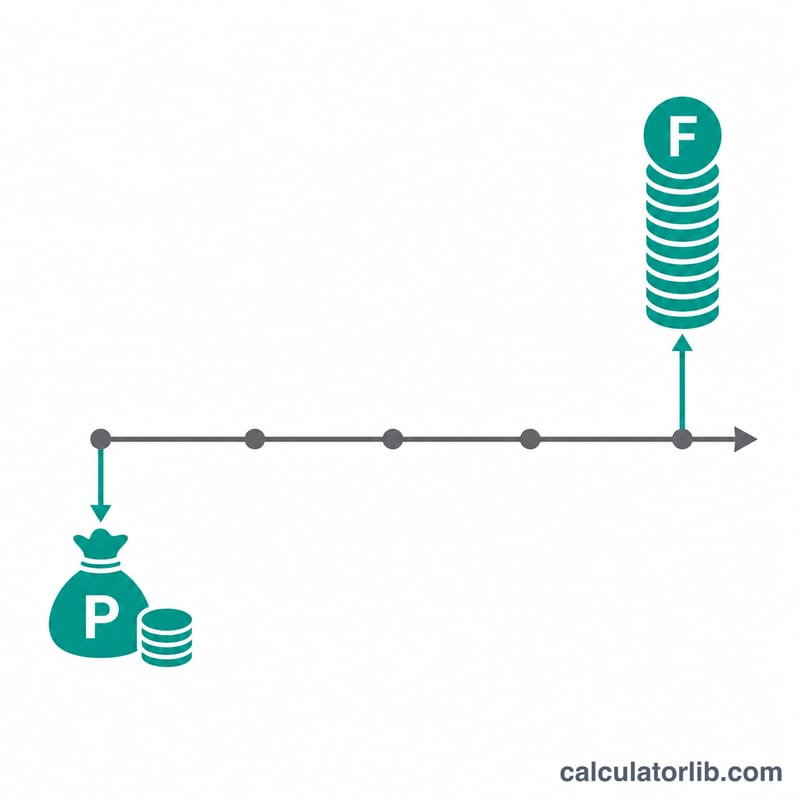
A zero-coupon bond pays no periodic interest (coupons). Instead it is bought at a discount and redeemed at its full face value at maturity. The investor's return comes entirely from the gap between the discounted purchase price and the amount received at maturity. This calculator finds that fair price by discounting the face value back to today using the required yield.
How to Use This Calculator
Enter the bond's face (maturity) value, the annual yield or required rate of return as a percentage, the number of years until maturity, and how often the yield compounds. The tool returns the bond's present value (price), the total discount from face value, and the number of compounding periods used.
The Formula Explained
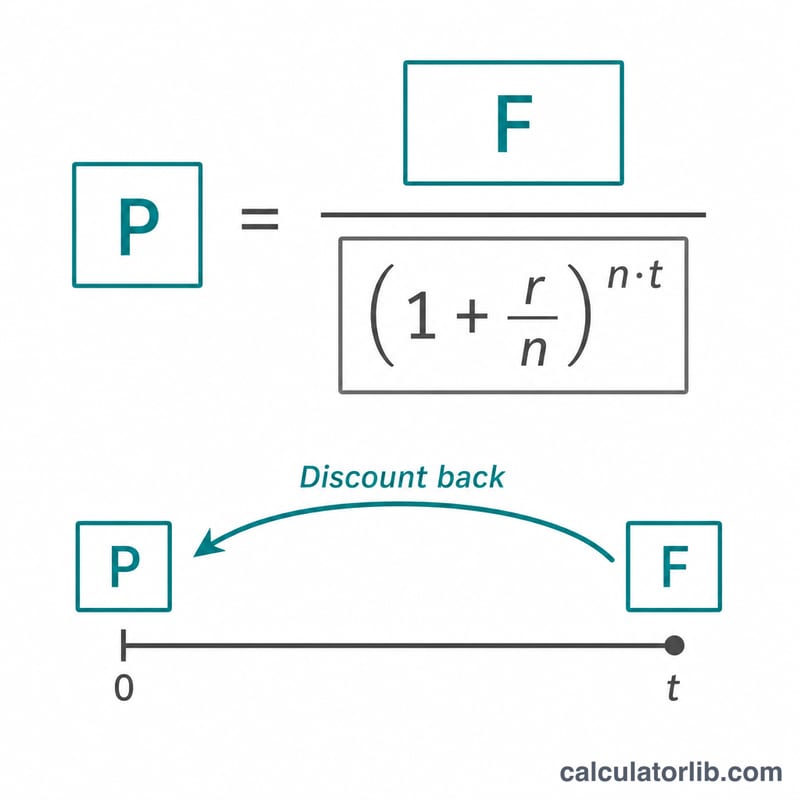
The price is the present value of a single future cash flow:
$$P = \dfrac{F}{\left(1 + \dfrac{r}{n}\right)^{n \cdot t}}$$
Here F is the face value, r is the annual yield as a decimal, n is the number of compounding periods per year, and t is the years to maturity. Higher yields, longer maturities, or more frequent compounding all push the price lower.
Worked Example
Suppose a bond has a $1,000 face value, a 5% annual yield compounded semi-annually, and 10 years to maturity. Then \(r/n = 0.05/2 = 0.025\) and \(n \cdot t = 2 \times 10 = 20\) periods. The price is $$P = \frac{1000}{(1.025)^{20}} = \frac{1000}{1.638616} \approx 610.27$$ The investor pays about $610.27 today and receives $1,000 in ten years — a discount of roughly $389.73.
FAQ
Why do zero-coupon bonds trade at a discount? Because they pay no interim interest, the only way to earn a return is to buy below face value, so the price is always less than the redemption amount.
What compounding frequency should I use? Match the convention quoted for the bond — many bonds use semi-annual compounding, but you can choose annual, quarterly, or monthly.
Does this include taxes? No. The accreted discount may be taxed as imputed interest in some jurisdictions; this tool computes the pre-tax market price only.