What this calculator does
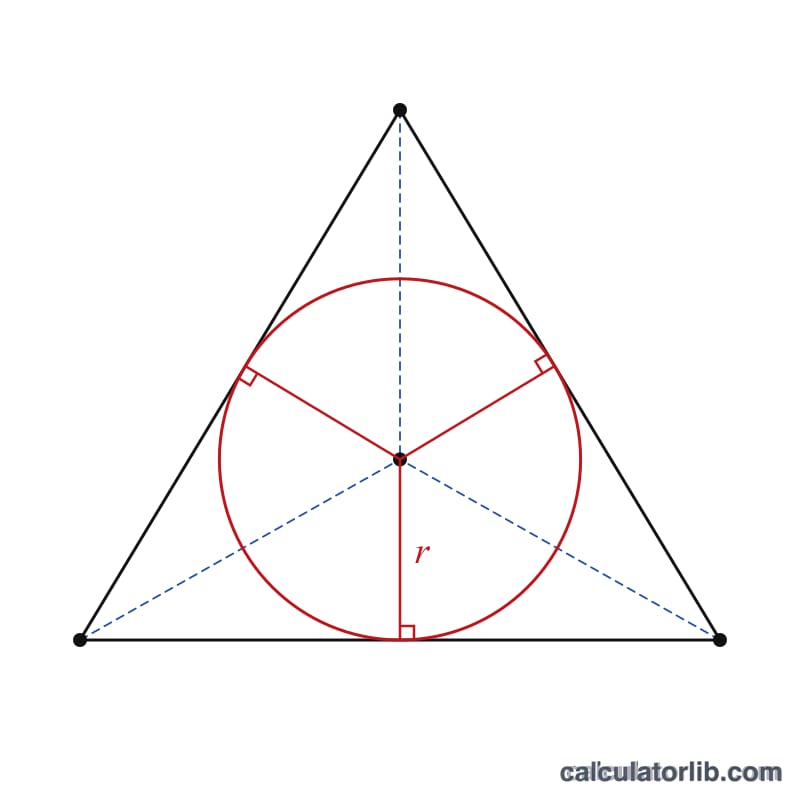
This tool finds the incircle (inscribed circle) of any triangle from its three side lengths. The incircle is the largest circle that fits inside a triangle, tangent to all three sides, and its center is the incenter. The calculator returns the incircle radius (r), diameter, the incircle area, the triangle area, and the ratio of the incircle area to the triangle area. All sides must be entered in the same unit "L"; radius and diameter come out in L and areas in L², with no unit conversion applied.

How to use it
Enter the three side lengths a, b and c. They must all be positive and satisfy the triangle inequality — each side must be strictly smaller than the sum of the other two. If they do not form a valid triangle, the calculator reports an error instead of a meaningless result.
The formula explained
First compute the semiperimeter \(s = (a + b + c) / 2\). Heron's formula gives the triangle area $$S_t = \sqrt{s(s-a)(s-b)(s-c)}$$ The incircle radius is simply the area divided by the semiperimeter: $$r = \frac{S_t}{s}$$ From there the diameter is \(\phi = 2r\), the incircle area is \(S_c = \pi r^{2}\), and the area ratio is \(S_c / S_t\).
Worked example
For the classic 3-4-5 right triangle: $$s = \frac{3+4+5}{2} = 6$$ $$S_t = \sqrt{6\cdot 3\cdot 2\cdot 1} = \sqrt{36} = 6$$ So \(r = 6/6 = 1\), diameter = 2, incircle area = \(\pi\cdot 1^{2} \approx 3.14159\), and the area ratio = \(3.14159 / 6 \approx 0.5236\).
Incircle Results for Different Triangle Shapes
The table compares triangles of broadly similar size (perimeters 11–18, in any consistent length unit). It uses \(s=\frac{a+b+c}{2}\), Heron's formula \(S_t=\sqrt{s(s-a)(s-b)(s-c)}\), \(r=\frac{S_t}{s}\), \(S_c=\pi r^2\) and the ratio \(\frac{S_c}{S_t}\).
| Sides (a, b, c) | Semiperimeter s | Triangle area St | Inradius r | Incircle area Sc | Ratio Sc/St |
|---|---|---|---|---|---|
| 6, 6, 6 (equilateral) | 9 | ≈ 15.588 | √3 ≈ 1.732 | 3π ≈ 9.425 | ≈ 0.6046 |
| 3, 4, 5 (right) | 6 | 6 | 1 | π ≈ 3.142 | ≈ 0.5236 |
| 5, 5, 6 (isosceles) | 8 | 12 | 1.5 | 2.25π ≈ 7.069 | ≈ 0.5890 |
| 1, 5, 5.9 (thin) | 5.95 | ≈ 1.183 | ≈ 0.199 | ≈ 0.124 | ≈ 0.105 |
Check of the thin triangle: \(s=5.95\), so \(S_t=\sqrt{5.95\cdot 4.95\cdot 0.95\cdot 0.05}\approx\sqrt{1.399}\approx 1.183\), and \(r=\frac{1.183}{5.95}\approx 0.199\). Since \(S_c=\pi r^2\) and \(S_t=rs\), the ratio simplifies to \(\frac{\pi r}{s}\approx\frac{\pi\cdot 0.199}{5.95}\approx 0.105\).
The more evenly the sides are balanced, the larger the ratio. Squeezing a triangle flat pushes it toward 0.
Interpreting the Incircle Ratio and Radius
The ratio is always below 1. The incircle lies entirely inside the triangle, so \(S_c<S_t\). Because \(S_t=rs\), the ratio is \(\frac{S_c}{S_t}=\frac{\pi r^2}{rs}=\frac{\pi r}{s}\). Its maximum is reached by the equilateral triangle:
$$\frac{S_c}{S_t}=\frac{\pi}{3\sqrt{3}}\approx 0.6046$$
Thin or nearly degenerate triangles (one side almost equal to the sum of the other two) have \(S_t\to 0\) and \(r\to 0\), so the ratio approaches 0.
- Roundness or compactness: a ratio close to 0.6046 means the triangle is close to equilateral. A low ratio means it is long, skinny or sliver-like.
- Larger r for a given perimeter means a more compact triangle, because \(r=\frac{S_t}{s}\) and, for a fixed perimeter, the area is largest for the equilateral triangle.
- Right triangles: with legs \(a, b\) and hypotenuse \(c\), \(r=\frac{a+b-c}{2}\). For 3-4-5 this gives \(\frac{3+4-5}{2}=1\), matching Heron's formula.
- Incircle vs. circumcircle: the incircle touches the three sides from inside, while the circumcircle passes through the three vertices. In an equilateral triangle the circumradius is \(R=2r\). For other triangles \(R\ge 2r\) (Euler's inequality).
Key Terms: Incircle, Incenter, Semiperimeter
- Incircle
- The largest circle that fits inside a triangle. It is tangent to all three sides. Its area is \(S_c=\pi r^2\).
- Incenter
- The center of the incircle, found where the three internal angle bisectors meet. It is always inside the triangle.
- Inradius (r)
- The radius of the incircle, \(r=\frac{S_t}{s}\). The diameter is \(2r\).
- Semiperimeter (s)
- Half the perimeter, \(s=\frac{a+b+c}{2}\), where a, b, c are the three side lengths.
- Heron's formula
- The triangle area from its sides alone: \(S_t=\sqrt{s(s-a)(s-b)(s-c)}\).
- Triangle inequality
- Three lengths form a real triangle only if each is smaller than the sum of the other two (for example \(a<b+c\)). If one side equals the sum of the other two, the triangle is degenerate with area 0.
- Tangent point
- A point where the incircle touches a side. The radius to that point is perpendicular to the side. The tangent lengths from vertex A are \(s-a\), and similarly \(s-b\) and \(s-c\) from B and C.
- Circumcircle
- The circle through all three vertices, with radius R and center at the intersection of the perpendicular bisectors. It is not the incircle.
- Symbols used here
- a, b, c are the sides; s is the semiperimeter; St is the triangle area; Sc is the incircle area; φ denotes the area ratio \(\frac{S_c}{S_t}\).
FAQ
What is the incircle? It is the unique circle inside a triangle that touches all three sides. Its center is the incenter, where the angle bisectors meet.
Why do I get an error? Your sides do not form a real triangle — either a side is zero/negative or one side is longer than the other two combined.
Can it handle any triangle? Yes, scalene, isosceles, equilateral and right triangles all work, as long as the triangle inequality holds.