What This Calculator Does
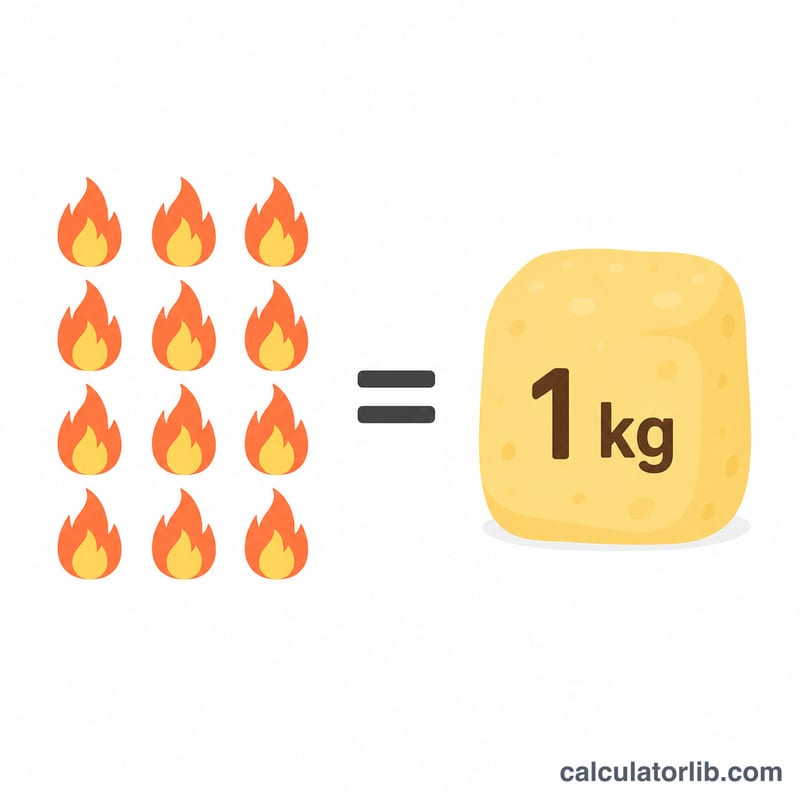
The Weight Loss Calculator turns your daily calorie deficit into an estimate of how much weight you can expect to lose each week and month. It uses the widely cited rule that roughly 7,700 kilocalories equal one kilogram of stored body fat (about 3,500 kcal per pound). This tool is universal — the energy-to-fat relationship is the same everywhere.
How to Use It
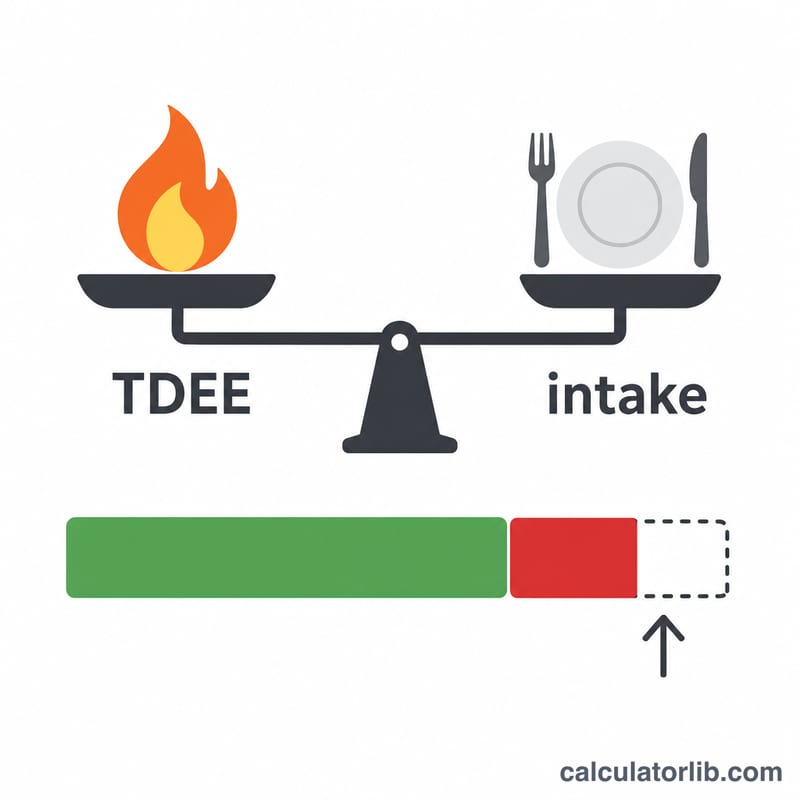
Enter your TDEE (Total Daily Energy Expenditure — the calories your body burns in a day) and your planned daily calorie intake. The calculator subtracts intake from TDEE to find your daily deficit, multiplies it by 7 for the week, then divides by 7,700 to convert energy into kilograms of fat. It also shows the result in pounds and a rough monthly figure.
The Formula Explained
Daily deficit = TDEE − Intake. Weekly loss in kg = (deficit × 7) ÷ 7700.
$$\text{Loss}_{kg/week} = \frac{\left(\text{TDEE} - \text{Intake}\right) \times 7}{7700}$$
Because energy balance drives fat change, a larger sustained deficit means faster loss — but very large deficits are hard to maintain and can cost muscle, so a 300–700 kcal daily deficit is commonly recommended.
Worked Example
Suppose your TDEE is 2,500 kcal and you eat 2,000 kcal per day. Your daily deficit is 500 kcal. Over a week that is 3,500 kcal. Dividing by 7,700 gives about 0.45 kg per week (roughly 1 lb), or about 1.97 kg per month.
$$\text{Loss}_{kg/week} = \frac{\left(2500 - 2000\right) \times 7}{7700} = \frac{3500}{7700} \approx 0.45\ \text{kg/week}$$
Weekly and Monthly Loss at Different Calorie Deficits
The calculator uses the common rule of thumb that about 7,700 kcal corresponds to 1 kg of body weight (about 3,500 kcal per lb). The weekly loss is \(\frac{(\text{TDEE}-\text{Intake})\times 7}{7700}\). Monthly figures below assume 30 days. All values are rounded estimates.
| Daily deficit (kcal) | Weekly deficit (kcal) | kg/week | lb/week | Approx. kg/month |
|---|---|---|---|---|
| 250 | 1,750 | 0.23 | 0.5 | 0.97 |
| 500 | 3,500 | 0.45 | 1.0 | 1.95 |
| 750 | 5,250 | 0.68 | 1.5 | 2.92 |
| 1,000 | 7,000 | 0.91 | 2.0 | 3.90 |
Worked example: with a TDEE of 2,500 kcal and an intake of 2,000 kcal, the deficit is 500 kcal/day, so \(\frac{(2500-2000)\times 7}{7700}=\frac{3500}{7700}\approx 0.45\) kg per week.
Note: commonly cited guidance is about 0.5–1 kg per week (roughly 1–2 lb). The 750 and 1,000 kcal deficits sit at the upper end of that range or beyond it once the estimate is adjusted for real-world factors. A 1,000 kcal daily deficit is also a very large cut for many people, since it may leave intake very low relative to TDEE. Smaller deficits are generally easier to sustain.
Interpreting Your Result
Public health bodies such as the NHS (UK) and the CDC (US) commonly cite a gradual loss of about 0.5–1 kg per week (about 1–2 lb) as a realistic and sustainable pace. If your result falls below this, the deficit is modest. If it falls well above it, the estimate may be unrealistic or hard to maintain, and you may want to review your TDEE and intake figures.
Why real loss slows over time
- Lower TDEE as weight drops: a smaller body generally burns fewer calories, so the same intake produces a smaller deficit later.
- Metabolic adaptation: the body may reduce energy expenditure somewhat more than weight loss alone predicts, for example through lower daily movement and hormonal changes.
- Adherence drift: tracking errors and small intake increases tend to accumulate over weeks.
Early-week fluctuations
Body weight can change by a kilogram or more over days from water, glycogen (stored carbohydrate holds water), salt intake and digestive contents. Early loss often looks faster than the formula predicts, mostly from water and glycogen, and later weeks can look flat even when fat is being lost.
An estimate, not a prediction
The 7,700 kcal/kg figure is a population-level approximation. Individual results vary with body composition, the proportion of fat versus lean tissue lost, and how accurate your TDEE and intake numbers are. Treat the output as a rough guide and look at trends over several weeks. For personal health decisions, consult a doctor or registered dietitian. This is general information, not medical advice.
Key Terms: TDEE, Deficit, and Energy Balance
- TDEE (Total Daily Energy Expenditure)
- The estimated calories you burn in a day, including BMR, daily movement, exercise and digestion. It is the first input (tdee) and is usually itself an estimate.
- BMR (Basal Metabolic Rate)
- The energy your body needs at rest to maintain basic functions. It is the largest part of TDEE and is not entered directly, but it underlies your TDEE estimate.
- Calorie deficit
- TDEE minus intake. A positive value means you consume less than you burn. This difference, multiplied by 7 and divided by 7,700, gives the estimated kg lost per week.
- Energy balance
- The relationship between energy in (food and drink) and energy out (TDEE). A deficit tends to lead to weight loss, a surplus to weight gain, and balance to stable weight.
- kcal vs. Calorie
- A food "Calorie" (capital C) is the same as a kilocalorie (kcal), which is 1,000 small calories. Both the intake and TDEE inputs are in kcal, and 1 kcal is about 4.184 kJ.
- Metabolic adaptation
- A reduction in energy expenditure beyond what is explained by lower body weight, which can occur during prolonged calorie restriction. It lowers your actual deficit over time, so real results often fall short of the calculator's constant-rate estimate.
FAQ
Is the 7,700 kcal/kg rule exact? No — it's an estimate. Real weight change also reflects water, glycogen, and metabolic adaptation, so actual results vary.
What if my intake is higher than my TDEE? The deficit becomes negative, meaning you'd gain rather than lose weight.
How big a deficit is safe? Many guidelines suggest aiming for around 0.5–1 kg loss per week and not eating below your basic needs without professional advice.