What this calculator does
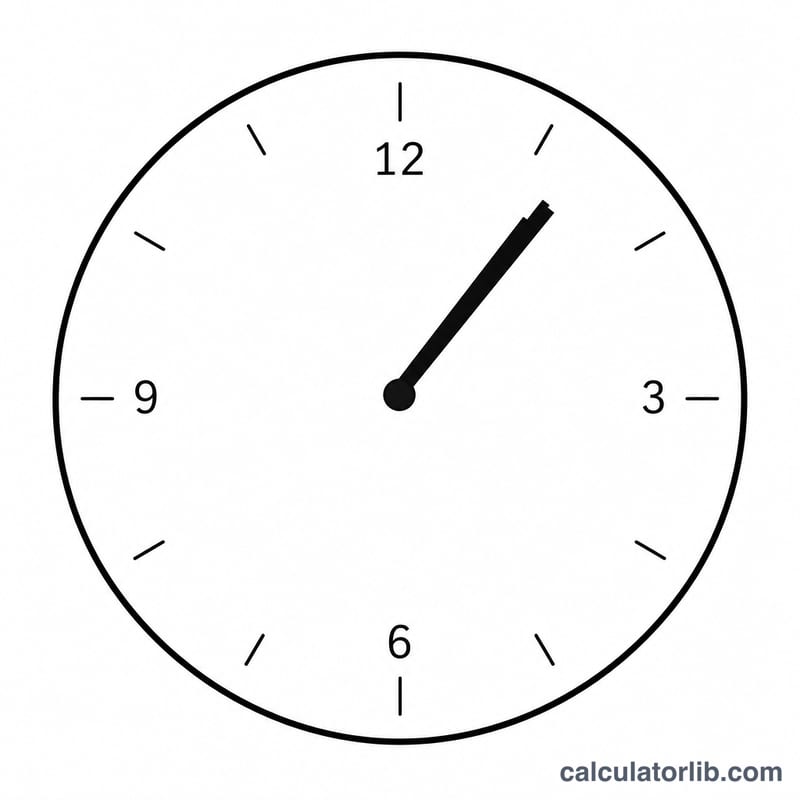
This tool solves the classic "clock problem": given a one-hour window on a standard 12-hour analog clock (for example "between 1 and 2 o'clock"), it finds the exact moment the long minute hand catches up to and overlaps the short hour hand. The mathematics is universal and requires no real timekeeping rules.
How to use it
Pick the one-hour interval from the dropdown. The calculator returns the overlap time as an exact fraction of minutes (\(60H/11\)), as a decimal, and as a clean clock time in H:MM:SS form, along with the initial angular gap.
The formula explained
The minute hand sweeps 360 degrees in 60 minutes, so it moves 6 degrees per minute. The hour hand sweeps 360 degrees in 720 minutes, so it moves 0.5 degrees per minute. The minute hand therefore gains on the hour hand at \(6 - 0.5 = 5.5\) degrees per minute. At exactly H o'clock the hour hand is \(H \times 30\) degrees ahead of the minute hand. Closing that gap takes
$$t = \frac{30 \times \text{Hour}}{5.5} = \frac{60 \times \text{Hour}}{11}\ \text{minutes after the hour}$$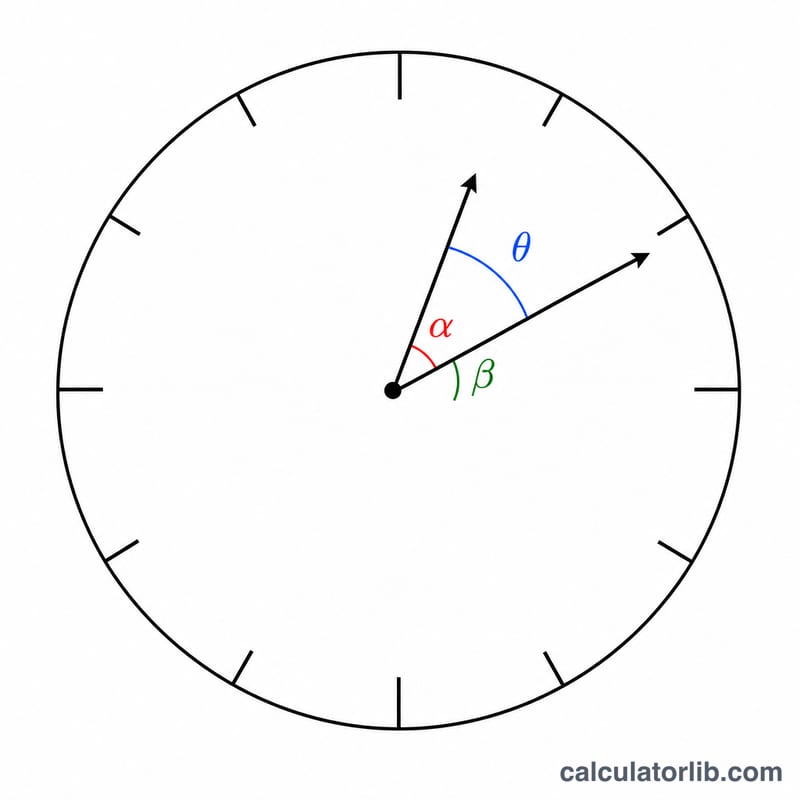
Worked example
For "between 3 and 4 o'clock" (\(H = 3\)): the gap at 3:00 is \(3 \times 30 = 90\) degrees. The overlap occurs
$$\frac{90}{5.5} = \frac{180}{11} = 16.3636\ldots \text{ minutes after 3:00}$$which is 3:16 plus \(\frac{4}{11} \times 60 = 21.8\) seconds, i.e. about 3:16:21.8.
All 11 Hand Overlap Times in 12 Hours
The minute hand gains on the hour hand at a constant rate, so in any 12-hour cycle the two hands coincide exactly 11 times — once in each window except the 11–12 window, which has no interior overlap. Each overlap occurs \(\frac{60H}{11}\) minutes after the hour, where \(H\) is the hour at the start of the window (\(H = 0\) for the 12–1 window).
| Window | H | Exact fraction (minutes) | Decimal minutes | Clock time (H:MM:SS) |
|---|---|---|---|---|
| 12–1 | 0 | 0 | 0 | 12:00:00 |
| 1–2 | 1 | 60/11 | 5.4545 | 1:05:27.3 |
| 2–3 | 2 | 120/11 | 10.9091 | 2:10:54.5 |
| 3–4 | 3 | 180/11 | 16.3636 | 3:16:21.8 |
| 4–5 | 4 | 240/11 | 21.8182 | 4:21:49.1 |
| 5–6 | 5 | 300/11 | 27.2727 | 5:27:16.4 |
| 6–7 | 6 | 360/11 | 32.7273 | 6:32:43.6 |
| 7–8 | 7 | 420/11 | 38.1818 | 7:38:10.9 |
| 8–9 | 8 | 480/11 | 43.6364 | 8:43:38.2 |
| 9–10 | 9 | 540/11 | 49.0909 | 9:49:05.5 |
| 10–11 | 10 | 600/11 | 54.5455 | 10:54:32.7 |
Note on the missing twelfth row: putting \(H = 11\) into the formula gives \(\frac{660}{11} = 60\) minutes after 11 o'clock — that is, exactly 12:00:00. So the 11–12 window contains no overlap strictly inside it; its "overlap" is the same event already listed as \(H = 0\). That is why there are 11 coincidences per 12 hours, not 12, and why consecutive overlaps are spaced \(\frac{720}{11} \approx 65.4545\) minutes apart rather than a neat 60 minutes.
How to Calculate Hand Overlap by Hand
The method is a simple relative-speed chase problem on a 360° dial. Work through it with \(H = 7\) (the 7–8 window) as the running example.
- Identify \(H\), the hour at the start of the window. For the overlap between 7 o'clock and 8 o'clock, \(H = 7\). Use \(H = 0\) for the 12–1 window.
- Compute the initial angular gap. At exactly H o'clock the minute hand is on 12 and the hour hand is \(H\) hour-marks ahead of it. Each hour-mark is 30°, so the gap is \(30H\) degrees: \(30 \times 7 = 210^\circ\).
- Use the relative (gain) speed. The minute hand turns 6° per minute and the hour hand 0.5° per minute, so the minute hand closes the gap at \(6 - 0.5 = 5.5\) degrees per minute.
- Divide gap by gain speed. $$t = \frac{30H}{5.5} = \frac{60H}{11}\ \text{minutes after the hour}$$ For \(H = 7\): \(t = \frac{210}{5.5} = \frac{420}{11} = \) 38.1818 minutes.
- Take the whole minutes. \(\lfloor 60H/11 \rfloor\). Here \(\lfloor 38.1818 \rfloor = 38\) whole minutes, leaving a remainder of \(\frac{420}{11} - 38 = \frac{420 - 418}{11} = \frac{2}{11}\) minute.
- Convert the leftover fraction to seconds. Multiply by 60: \(\frac{2}{11} \times 60 = \frac{120}{11} = 10.909\) seconds. (The same step for \(H = 3\) gives a remainder of \(\frac{4}{11}\) minute, and \(\frac{4}{11} \times 60 = 21.818\) seconds.)
- Assemble H:MM:SS. Combine the hour, the whole minutes and the seconds: \(7\text{:}38\text{:}10.9\). The hands of a 12-hour analogue clock therefore coincide at 7:38:10.9, not at the commonly guessed 7:35.
A useful check: every answer is a multiple of \(\frac{60}{11} \approx 5.4545\) minutes, and the seconds always land on a multiple of \(\frac{60}{11}\) seconds, so the only exact clock times are the eleven listed in the table above.
Key Terms and Variables
| Term / symbol | Value or unit | Meaning |
|---|---|---|
| \(H\) — hour window index | integer 0–10 (dimensionless) | The hour reading at the start of the window being searched. \(H = 0\) means the 12–1 window, \(H = 7\) the 7–8 window. The overlap time is measured in minutes after H o'clock. |
| Minute-hand angular speed | 6 °/min | The minute hand sweeps 360° in 60 minutes: \(360/60 = 6\) degrees per minute. |
| Hour-hand angular speed | 0.5 °/min | The hour hand sweeps 360° in 12 hours (720 minutes): \(360/720 = 0.5\) degrees per minute — one-twelfth of the minute hand's rate. |
| Relative (gain) speed | 5.5 °/min | How fast the minute hand closes on the hour hand: \(6 - 0.5 = 5.5\). This single constant drives every hand-position problem on an analogue dial. |
| Initial angular gap | \(30H\) degrees | The lead the hour hand holds at exactly H o'clock. Each of the 12 hour-marks spans \(360/12 = 30^\circ\), so the gap is 30° at 1 o'clock, 210° at 7 o'clock, and so on. |
| Coincidence (overlap) | target angle 0° | The instant the two hands point in exactly the same direction — the gap has been reduced to zero. Happens 11 times in 12 hours, i.e. 22 times per day. |
| Opposition | target angle 180° | The hands point in exactly opposite directions, forming a straight line through the centre. Same method, different target: \(t = \frac{30H \pm 180}{5.5}\) minutes, choosing the root that falls inside the hour. Also 11 times in 12 hours. |
| Right-angle positions | target angle 90° or 270° | The hands are perpendicular. Solved the same way with \(t = \frac{30H \pm 90}{5.5}\); these occur 22 times in 12 hours (44 per day), because most hours contain two of them. |
In every case the recipe is identical — take the gap at the start of the hour, add or subtract the target angle, and divide by the 5.5 °/min gain rate. Only the target angle changes. Note that this geometry assumes an idealised analogue dial with hands that move continuously; clocks with a stepping (jumping) minute hand will show the overlap snapped to the nearest step, and digital displays have no hands at all.
FAQ
How many times do the hands overlap in 12 hours? Exactly 11 times, once every \(12/11\) hours (about 65.45 minutes), not 12 times as people often assume.
Why is \(60H/11\) a repeating decimal? Because the denominator 11 does not divide evenly into \(60H\), the decimal repeats with a period of 11. Using the exact fraction avoids rounding.
What about 11 to 12 or 12 to 1? The overlap there lands on 12:00 exactly (the trivial case), which is why those windows are often left out.