What this calculator does
This tool tells you exactly how much pure water to add to a salt-water (saline) solution to dilute it from a known concentration down to a lower target concentration. It also reports the dissolved salt mass and the total mass of the final solution. The math is pure concentration arithmetic — conservation of solute mass under dilution — so it works for any solute/solvent pair expressed as a mass percent, not just table salt in water.
How to use it
Enter three values: the mass of your starting solution A (in grams), its salt concentration as a mass percent, and the target concentration you want the final solution C to have. Because adding pure water can only lower concentration, the target must be smaller than the starting concentration. Press calculate and you get the amount of water to add.
The formula explained
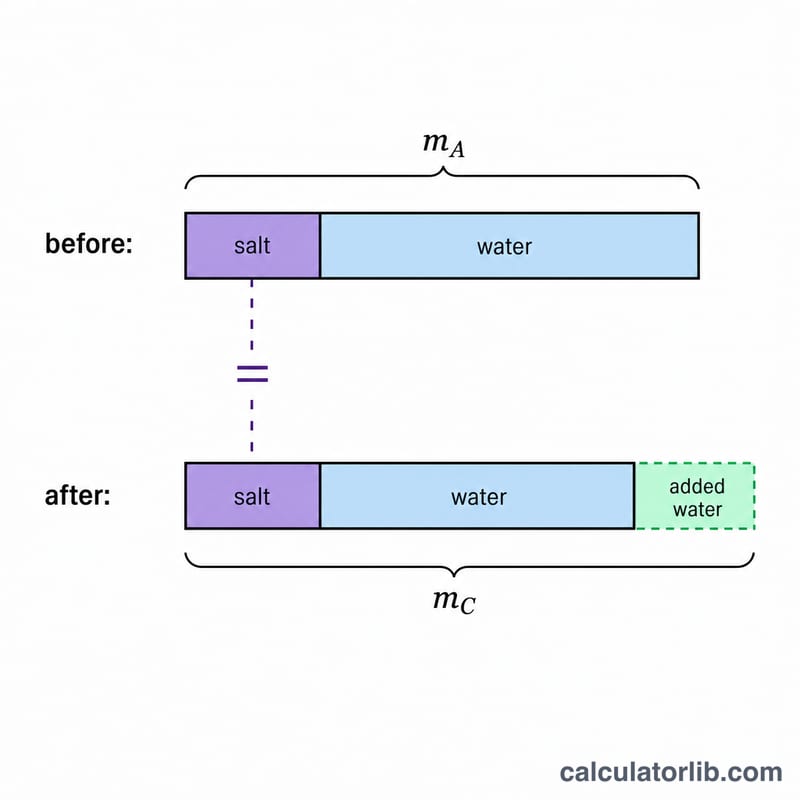
The key insight is that adding pure water adds no salt, so the salt mass is conserved. First find the salt: \(\text{salt} = \text{mass} \times (\text{concentration} / 100)\). The final solution must contain that same salt at the new fraction, so its total mass is \(\text{final} = \text{salt} / (\text{target} / 100)\). The water to add is simply the difference: \(\text{water} = \text{final} - \text{starting mass}\).
$$\text{Water to Add} = \text{Mass}_A \left( \frac{\text{Conc}_A}{\text{Conc}_C} - 1 \right)$$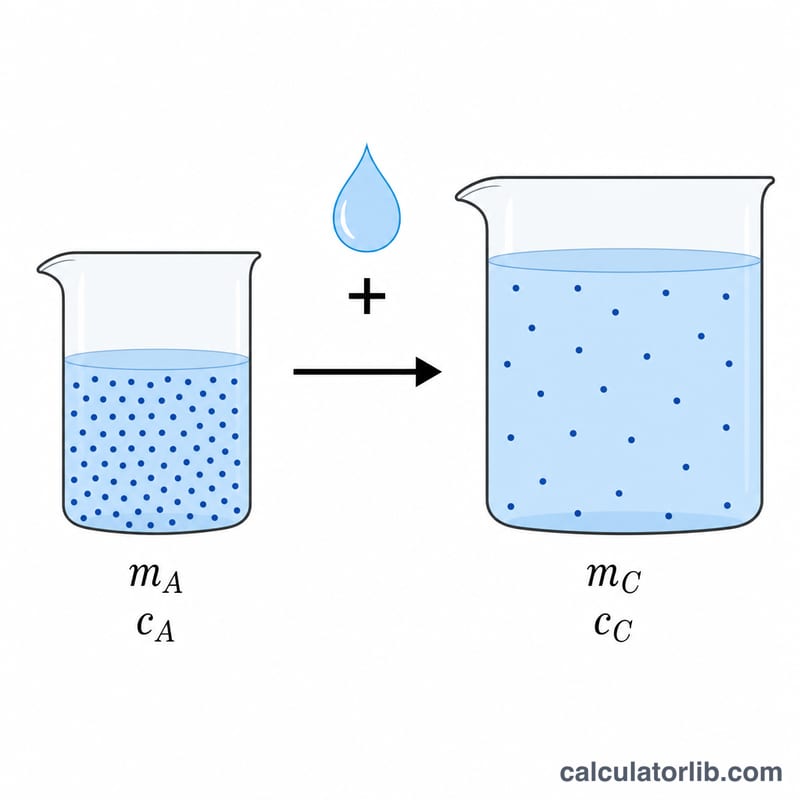
Worked example
Start with 200 g of 30% saline and dilute to 20%. Salt = \(200 \times 0.30 = 60\) g. Final mass = \(60 / 0.20 = 300\) g. Water to add = \(300 - 200 = \mathbf{100}\) g.
$$\text{Water to Add} = 200 \left( \frac{30}{20} - 1 \right) = 100 \text{ g}$$So adding 100 g of water turns 200 g of 30% saline into 300 g of 20% saline.
Common Saline Concentrations Reference
The table lists widely used salt (sodium chloride, NaCl) solution strengths. Medical saline is normally labelled as w/v (grams of NaCl per 100 mL of solution). This calculator works in w/w (mass percent, grams of salt per 100 g of solution). For dilute solutions the two are close but not identical, because the solution density is slightly above 1 g/mL.
| Solution | Approx. concentration | Approx. NaCl | Notes |
|---|---|---|---|
| Half-normal saline | 0.45% | 4.5 g/L | Often called hypotonic saline |
| Normal (isotonic) saline | 0.9% | 9 g/L | Roughly matches the salt level of body fluids |
| Hypertonic saline | 3% | 30 g/L | Stronger than body fluids |
| Hypertonic saline | 5% | 50 g/L | Stronger than body fluids |
| Typical seawater | about 3.5% (w/w) | about 35 g/kg | Varies by location |
| Saturated NaCl solution at 20 °C | about 26% (w/w) | about 35.9 g per 100 g water | \(35.9 / (100 + 35.9) \approx 26.4\%\) by mass |
These values are given for factual reference only. They are not medical advice, and they do not replace the instructions of a qualified professional or a manufacturer's label.
Dilution Scenarios Compared
Each row starts from the same 100 g of 20% saline, which contains 20 g of salt. Because the salt mass stays constant, the final mass is \(20 / \text{Conc}_C\). The water to add is then found with:
$$\text{Water} = \text{Mass}_A \left( \frac{ \text{Conc}_A}{ \text{Conc}_C} - 1 \right)$$
| Target concentration | Salt mass (g) | Final mass (g) | Water to add (g) | Check |
|---|---|---|---|---|
| 15% | 20 | 133.3 | 33.3 | \(100 \times (20/15 - 1) = 33.3\) |
| 10% | 20 | 200 | 100 | \(100 \times (20/10 - 1) = 100\) |
| 5% | 20 | 400 | 300 | \(100 \times (20/5 - 1) = 300\) |
| 0.9% | 20 | about 2222.2 | about 2122.2 | \(100 \times (20/0.9 - 1) \approx 2122.2\) |
In every row, final mass = starting mass + water added (for example, 100 g + 2122.2 g ≈ 2222.2 g). The lower the target, the more water is needed, and the amount grows quickly as the target approaches zero. Results are by mass (w/w), so they are not directly the same as volume-based (w/v) labels.
FAQ
Why must the target be lower than the start? Pure water has 0% salt, so it can only dilute. To raise concentration you must add salt instead, not water.
Does the salt amount change? No. Diluting with water keeps the salt mass constant; only the total mass and the percentage change.
Can I use kilograms or milligrams? Yes — just keep the mass unit consistent. The water-to-add result comes out in the same unit you entered the mass in.