What is a spherical cap?
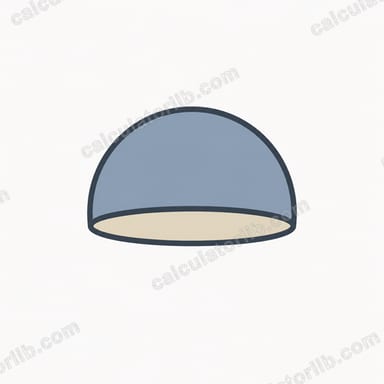
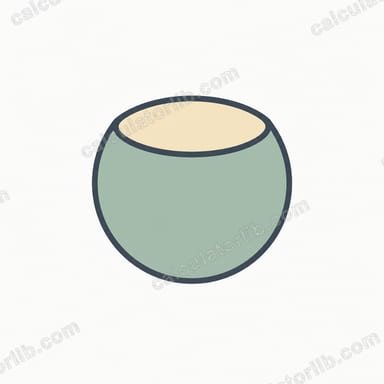
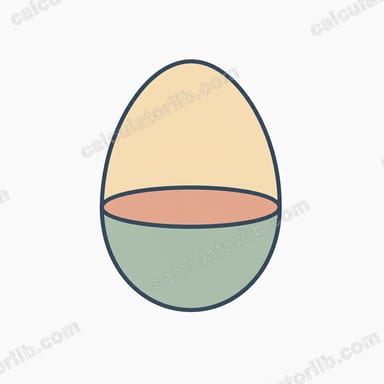
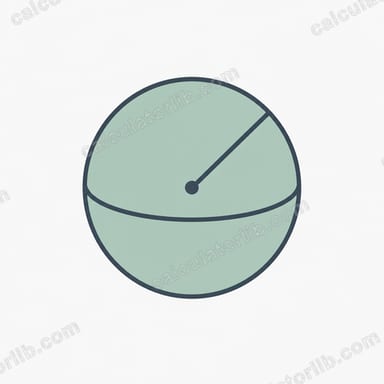
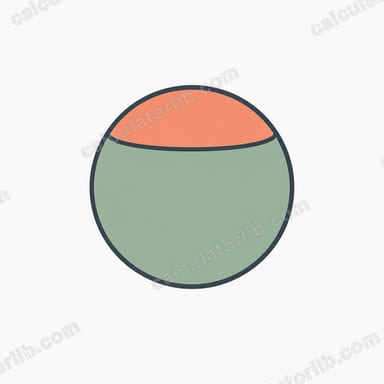
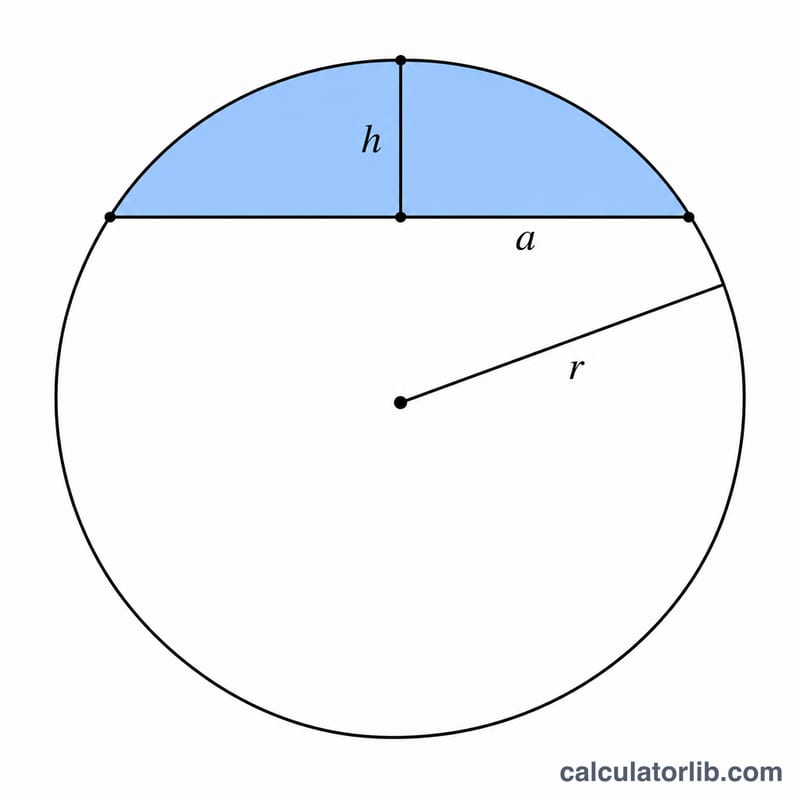
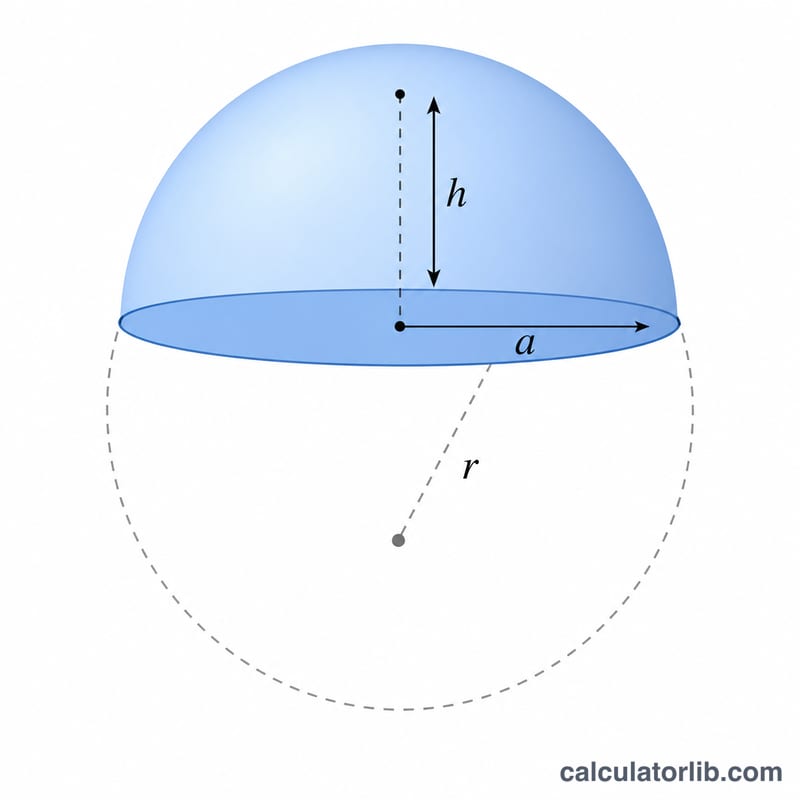
A spherical cap is the portion of a sphere cut off by a plane. It is defined by the sphere's radius r and the cap's height h (the perpendicular distance from the cutting plane to the top of the cap). When h equals r the cap is exactly a hemisphere, and when h equals 2r it is the whole sphere.
How to use this calculator
Enter the sphere radius and the cap height in the same units. The calculator returns the cap volume, the curved (lateral) surface area, the flat base circle area, the total surface area, and the radius of the base circle. The cap height is automatically clamped to lie between 0 and the diameter 2r.
The formulas explained
The volume is $$V = \frac{\pi h^{2}}{3}\left(3r - h\right).$$ The curved surface area is $$A = 2\pi r h.$$ The base of the cap is a circle whose radius \(a\) satisfies \(a^{2} = h(2r - h)\), so the base area is \(\pi a^{2}\) and the total surface area is the curved area plus the base area.
Worked example
For \(r = 5\) and \(h = 2\): $$V = \frac{\pi\cdot 4}{3}\left(15 - 2\right) = \frac{4\pi}{3}\cdot 13 \approx 54.4543 \text{ cubic units}.$$ Curved area \(= 2\pi\cdot 5\cdot 2 = 20\pi \approx 62.8319\). Base radius \(a = \sqrt{2\cdot 8} = 4\), so base area \(= 16\pi \approx 50.2655\) and total area \(\approx 113.0973\).
Cap Volume for Different Cap Heights
The table fixes the sphere radius at \(r = 5\) and varies the cap height \(h\). Base radius is \(a=\sqrt{h(2r-h)}\), volume is \(V=\frac{\pi h^{2}(3r-h)}{3}\), curved area is \(2\pi r h\), base area is \(\pi a^{2}\), and total area is the curved area plus the base area. The full sphere volume is \(\frac{4}{3}\pi r^{3}\approx 523.599\).
| h | Base radius a | Volume V | Curved area 2πrh | Base area πa² | Total area | % of full sphere volume |
|---|---|---|---|---|---|---|
| 1 | 3.0000 | 14.661 | 31.416 | 28.274 | 59.690 | 2.80% |
| 2.5 | 4.3301 | 81.812 | 78.540 | 58.905 | 137.445 | 15.63% |
| 5 (hemisphere) | 5.0000 | 261.799 | 157.080 | 78.540 | 235.619 | 50% |
| 7.5 | 4.3301 | 441.786 | 235.619 | 58.905 | 294.524 | 84.38% |
| 10 (full sphere) | 0 | 523.599 | 314.159 | 0 | 314.159 | 100% |
Worked check for \(h = 2.5\): \(V=\frac{\pi (2.5)^{2}(3\cdot 5-2.5)}{3}=\frac{\pi\cdot 6.25\cdot 12.5}{3}=\frac{78.125\pi}{3}\approx 81.812\). Note that \(h=2.5\) and \(h=7.5\) give the same base radius, because the two caps are cut by parallel planes at the same distance from the center, and their volumes add up to the full sphere's volume plus nothing extra: \(81.812+441.786=523.598\), which matches 523.599 apart from rounding.
Definitions of Terms and Variables
- Sphere radius (r): the distance from the center of the original sphere to any point on its surface.
- Cap height (h): the thickness of the cap, measured along the axis perpendicular to the cutting plane, from the plane to the farthest point of the cap on the sphere's surface. It ranges from 0 to \(2r\).
- Base radius (a): the radius of the circular face created by the cut, given by \(a=\sqrt{h(2r-h)}\).
- Curved (lateral) surface area: the area of the spherical part of the cap, \(2\pi r h\).
- Base area: the area of the flat circular face, \(\pi a^{2}\).
- Total surface area: curved area plus base area, \(2\pi r h+\pi a^{2}=\pi h(4r-h)\).
- Hemisphere: the special case \(h=r\), where the cutting plane passes through the center. Then \(a=r\) and \(V=\frac{2}{3}\pi r^{3}\).
The volume can also be written in terms of the base radius and height: $$V=\frac{\pi h\,(3a^{2}+h^{2})}{6}$$ This gives the same result as \(V=\frac{\pi h^{2}(3r-h)}{3}\) because \(a^{2}=h(2r-h)\).
FAQ
What if h = r? You get a hemisphere: with \(r = 3\), \(h = 3\), $$V = \frac{\pi\cdot 9}{3}\left(9 - 3\right) = 3\pi\cdot 6 = 18\pi \approx 56.5487.$$
What units does it use? Any consistent unit — output volume is in cubic units and areas in square units.
Can h be larger than the diameter? No. The tool clamps h to a maximum of 2r, the full sphere.